
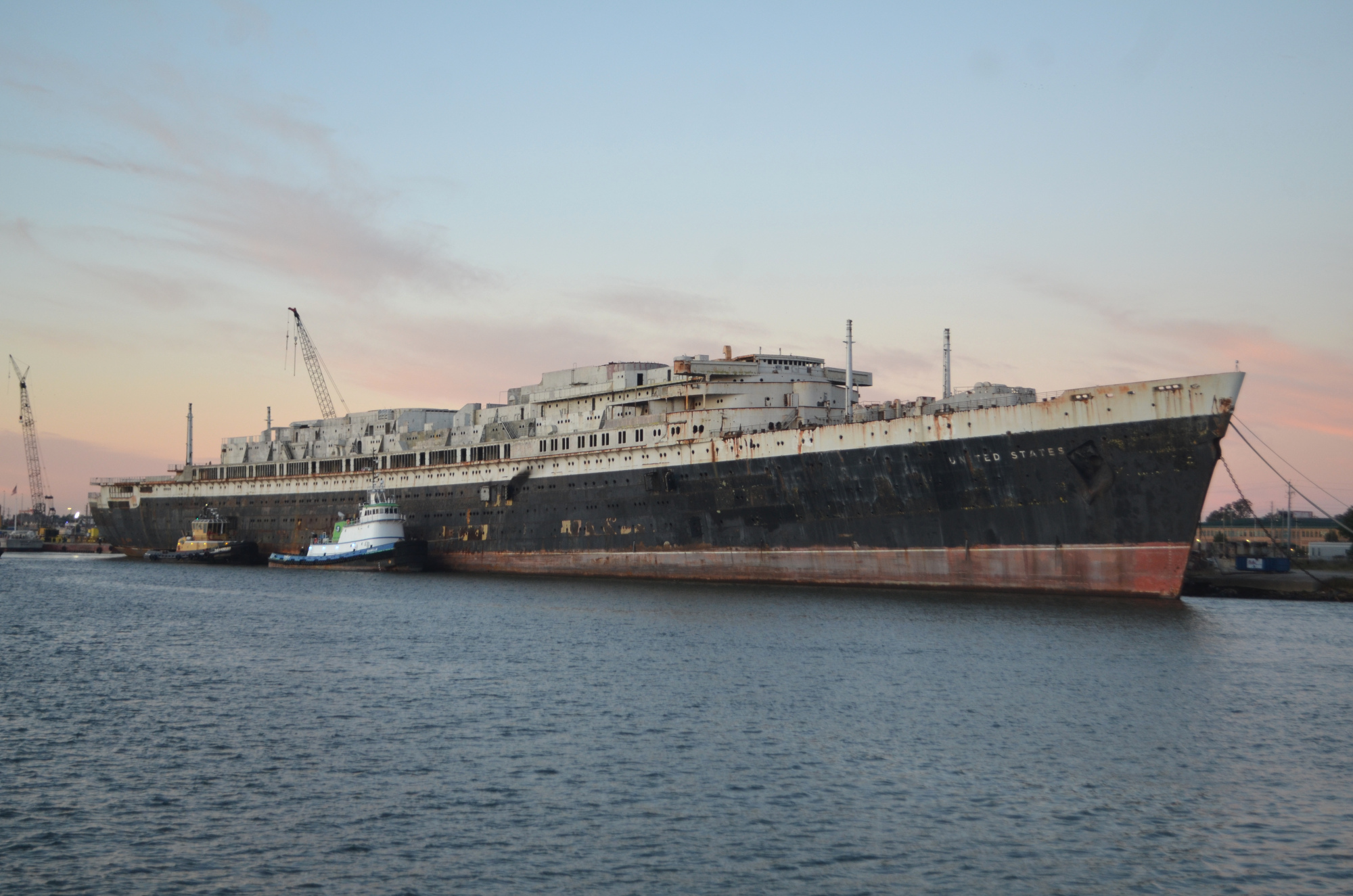
(CN) — For some people, the tow of the SS United States was like a funeral.For others, it marked a rebirth.On Wednesday, Nov. 11, the 990-foot ship was intentionally sunk roughly 22 nautical miles southwest of Destin-Fort Walton Beach, Florida, where its aluminum and steel hull became the world’s largest artificial reef.The ship sat low and still among a scatter of spectator boats while seawater began its slow work.Crews had opened the old intake valves and the cut openings in her decks and sides. For hours, the change was almost invisible, the hull settling only by inches as the sky darkened.Then, around 9 p.m., the SS United states leaned sharply to port. Her stern dropped, her bow rose and the rust-streaked superstructure vanished under the surface, leaving only a brief boil of white water before the Gulf closed over her.Designed by renowned naval architect William Francis Gibbs and launched in 1952, the SS United States was the fastest passenger ship ever built — a floating emblem of postwar American engineering. It could cross the Atlantic in just over three days and also served as a troop transport in wartime.During 17 years of service, it carried more than 1 million passengers, including presidents, celebrities and ordinary travelers. Then jet travel rendered ocean liners obsolete and left the ship idle for decades.After its final voyage in 1969, the ship sat in a Virginia shipyard and later at a Philadelphia pier, where it slowly deteriorated as preservation groups tried and failed to return it to service or convert it into a floating attraction.Mason Fisher of Orlando, Florida, was among a group of people who sought to preserve the SS United States as a museum ship. Ultimately, he said reefing the ship is better than scrapping it. (Gabriel Tynes/Courthouse News)Facing eviction after a court battle with the pier operator, the SS United States Conservancy sold the vessel to Okaloosa County, Florida, for $1 million in late 2024.The countytowed it to Alabama in early 2025, where workers removed hazardous materials and thousands of artifacts and prepared the hull for controlled flooding.“It’s a bittersweet moment for sure,” said Warren Jones, who watched the ship’s final tow Monday. Jones traveled aboard the SS United States when he was 8 years old and now serves on the conservancy’s board.“Okaloosa County came forward with others and offered to purchase the ship for the purpose of reefing,” Jones explained as the ship’s massive gray hull cruised slowly into the bay. “We liked the Okaloosa folks. We worked well with them, and they understood the importance of this ship [and] really grasped its historical significance.”The county also plans to establish an on-shore museum dedicated to the ship, featuring relics including its smokestacks, anchor, radar mast and some interior components and furnishings. The ship was stripped of environmental contaminants over the past year, and workers cut holes in watertight compartments to prepare it for sinking.As the SS United States begins a new life as a home for algae, aquatic invertebrates and reef fish, the ship will still be frequented by human visitors in the depths of the sea. Florida officials hope that the sunken ship will become a destination, attracting divers interested in poking around the historic vessel.“They will be able to explore the bridge, the first class areas, theaters, a ballroom, staterooms and cabins,” Jones explained. “They’ve cut several openings to make those transitions between the decks as easy as possible for divers.”Archival photos show the interior of the SS United States in 1953, shortly after it launched. Clockwise from top left: a staircase; the Cabin-class lounge; the grand ballroom; and a landing. (Gottscho-Schleisner Collection/U.S. Library of Congress via Courthouse News)Scuba diving and snorkeling contribute substantially to Florida’s tourism economy. A2021 NOAA analysis found roughly 4.56 million scuba visitor-days and 4.24 million snorkeling visitor-days annually statewide.That year, reef-related diving and snorkeling supported about 8,700 jobs and generated roughly $900 million in annual economic output in southeast Florida. Florida’s broader artificial reef program — one of the largest in the country — is estimated to generate about $3.1 billion in annual economic activity and support tens of thousands of jobs.In the Florida Panhandle, these underwater attractions are more often shipwrecks than natural coral reefs. The Florida Panhandle Shipwreck Trail, created in 2012, links more than 20 sites from Pensacola to Port St. Joe.The best known is the USS Oriskany, the 911-foot aircraft carrier sunk off Pensacola in 2006. It has held the title of the largest artificial reef in the United States — a distinction the SS United States now surpasses. Other attractions include the Underwater Museum of Art off the coast of Destin, smaller Navy vessels such as the USS Strength and USS Accokeek and a variety of purpose-built reef structures.Rian Hamby crossed the Atlantic aboard the SS United States in 1966, when he was 6 years old. His family was returning to New York from Liverpool after his father had been stationed in Germany.Most of the family suffered from seasickness, leaving Hamby and his older sister free to roam the ship, including its first-class areas. They even walked a German shepherd the family had acquired in Europe.“My family was pretty dysfunctional,” Hamby recalled. “We don’t have many pictures of my childhood and most of my memories are bad, I hate to say.”The voyage stood out as an exception.“It was one of the high points of my childhood, for sure,” he said.Crowds along Mobile Bay watched as the SS United States was towed from its berth in Philadelphia to Alabama, where it will remediated and prepared for sinking as the world's largest artificial diving reef off the coast of Florida. (Gabriel Tynes/Courthouse News)Now a certified diver, Hamby first took a scuba class in college. He’s since explored underwater sites in the Florida Keys, Hawaii and New Zealand and plans to visit the wreck once it opens to divers.“There’ll never be another ship like this,” he added. “It’s from a time in history that’s never going to repeat. And it seems like now more than ever, we need to remember where we as Americans came from.”Also watching the ship’s final voyage Monday was Mason Fisher of Orlando, Florida.A longtime fan, Fisher wanted to see the vessel on the surface one last time. Wearing a commemorative T-shirt and carrying replica models of the ship, he said he had once signed a petition to preserve it.“The design of the hull is beautiful, its speed and performance was impressive, the interior was unlike anything else, and I loved the sound of her whistles,” Fisher said. “I would have rather have seen her saved as a museum ship or restored for cruising again, but I know that’s not happening. I will admit, reefing is better than scrapping. At least she’ll have a new life.”Subscribe to our free newslettersOur weekly newsletter Closing Arguments offers the latest about ongoing trials, major litigation and rulings in courthouses around the U.S. and the world, while the monthly Under the Lights dishes the legal dirt from Hollywood, sports, Big Tech and the arts.Additional Reads
America’s flagship ocean liner begins new life on Gulf floor
Full Article
Original Source
Read the full article at Courthousenews →KhanList aggregates and links to publicly available news content. We do not host full articles from third-party sources. Always verify important information with original sources.