
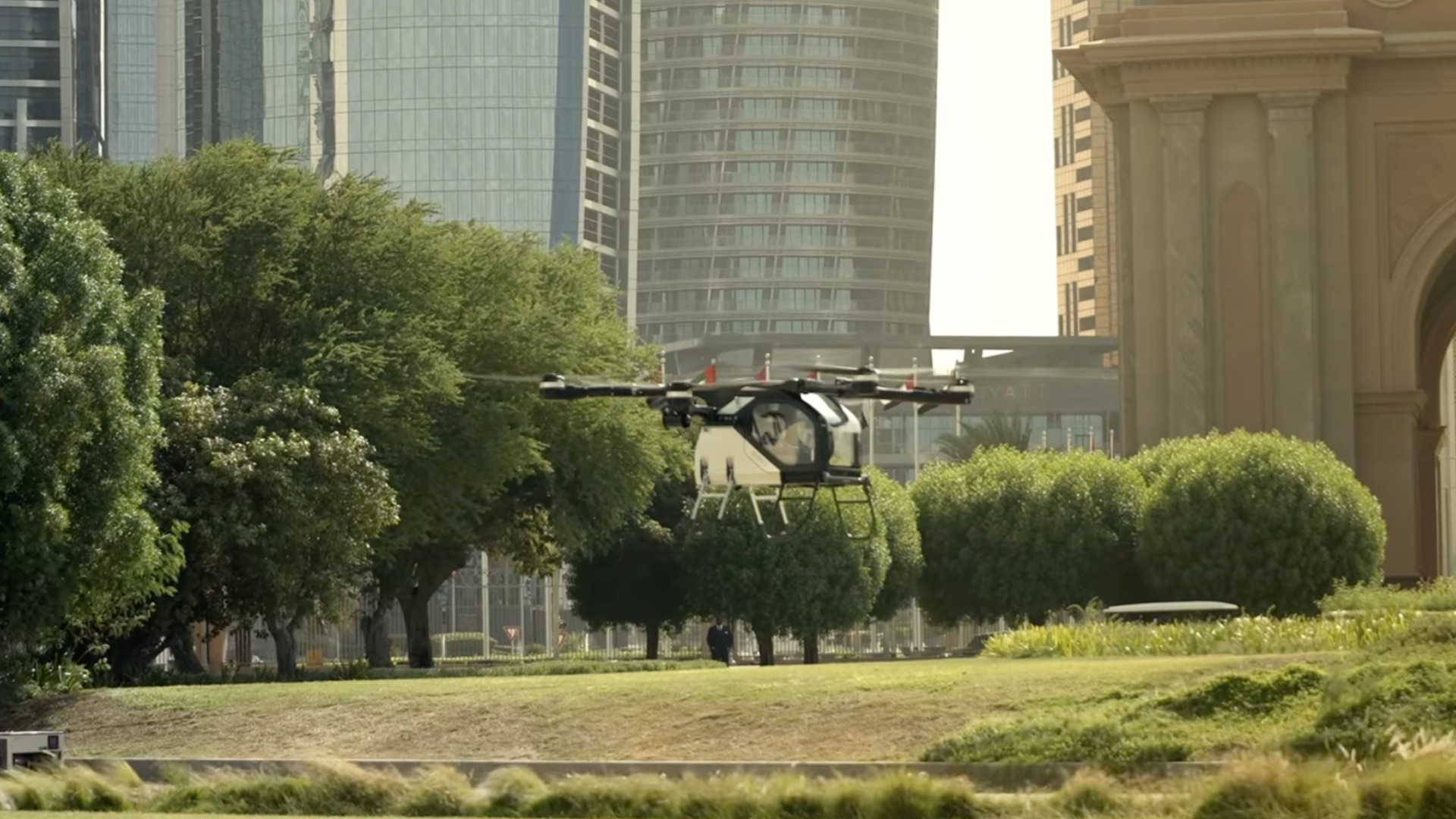
Electric vehicle manufacturer XPeng reportedly revealed its two-seat flying car could begin limited commercial operations in China in the second half of 2027. The company plans to make the low-altitude aircraft available for recreational use in rural areas and emergency services. The vehicle, developed over a decade, has undergone extensive testing, including trials of flying motorbikes at XPeng’s Guangzhou facility. The company unveiled its flying car at CES 2025, featuring a modular architecture, which includes a detachable air module housed within the ground vehicle. Flying cars arrive XPeng plans to introduce its two-seat flying vehicle for limited commercial use in the second half of 2027. Priced at approximately $300,000 (£225,000), the aircraft has received approval from China’s civil aviation authorities for restricted operations following nearly a decade of development and testing. XPeng CEO Deli Zhao said the initial market would include recreational users interested in activities such as diving, surfing, and off-roading. However, the vehicle will initially be restricted to approved park areas in China and emergency services operating in locations that are difficult to access, as reported by The Guardian. The aircraft has a reported flight range of 18.6 miles (30 kilometers) and can cruise at altitudes of up to 0.6 miles (1 kilometer). XPeng plans to double its range by increasing battery energy density to 400 kilowatt-hours per kilogram, according to Zhao. The development is part of China’s broader push to establish a low-altitude economy covering drones, cargo aircraft and passenger-carrying vehicles. Zhao said XPeng was among about 20 Chinese companies developing flying vehicles and had signed agreements with the United Arab Emirates and Southeast Asian countries to explore potential applications. Last month, Elon Musk unveiled an experimental Tesla Roadster prototype featuring rocket-inspired thrusters and gravity-defying stunts. Demonstrated at a SpaceX facility in Texas, the vehicle used compressed-air nozzles to perform mid-air flips, jumps, and controlled landings. Modular flying vehicle It is worth mentioning that Xpeng has also introduced its Land Aircraft Carrier, AEROHT, which is a modular transportation system combining a road-going EV with a detachable electric vertical take-off and landing (eVTOL) aircraft. It allows users to drive to a suitable location, deploy the aircraft, and take off without requiring a conventional airport. AEROHT, renamed ARIDGE in October 2025, is XPeng’s flying mobility subsidiary. The ground vehicle, known as the mothership, features a three-axle, six-wheel configuration with all-wheel drive and rear-wheel steering. Measuring approximately 5.5 meters (18 feet) long, 2 meters (6.6 feet) wide, and 2 meters (6.6 feet) high, it is designed to fit into standard parking spaces. Its rear compartment houses the aircraft and includes an automated deployment mechanism. The vehicle also functions as a mobile charging station. Its range-extender electric powertrain uses an 800-volt silicon-carbide platform and offers a claimed combined driving range exceeding 621 miles (1,000 kilometers) under China’s CLTC test cycle. The detachable aircraft is a two-seat electric vehicle featuring six rotors arranged in a dual-duct configuration. Its rotor arms and propeller blades fold inward, allowing it to fit inside the mothership. The aircraft uses carbon-fiber materials and features a 270-degree panoramic cockpit. It supports manual and autonomous flight modes, with a single-stick control system for manual operation. Autonomous functions include one-touch takeoff, route planning, flight control, and landing assistance. Redundant safety systems cover propulsion, flight controls, electrical power, and communications. An automated mechanism allows the aircraft to separate from the mothership and reconnect after landing in approximately five minutes. The ground vehicle can recharge it while driving or stationary. XPeng established a 1.29 million-square-foot (120,000-square-meter) manufacturing facility in Guangzhou, China. Trial production began in November 2025, and the factory is designed for an annual capacity of 10,000 aircraft modules, with an initial production target of 5,000 units. Customer deliveries were planned for 2026, which is now slated to begin next year.Get the latest in engineering, tech, space & science - delivered daily to your inbox.Jijo is an automotive and business journalist based in India. Armed with a BA in History (Honors) from St. Stephen's College, Delhi University, and a PG diploma in Journalism from the Indian Institute of Mass Communication, Delhi, he has worked for news agencies, national newspapers, and automotive magazines. In his spare time, he likes to go off-roading, engage in political discourse, travel, and teach languages.
XPeng’s ‘flying car’ could rival Tesla as it eyes commercial launch in 2027
Full Article
Original Source
Read the full article at Interestingengineering →KhanList aggregates and links to publicly available news content. We do not host full articles from third-party sources. Always verify important information with original sources.