
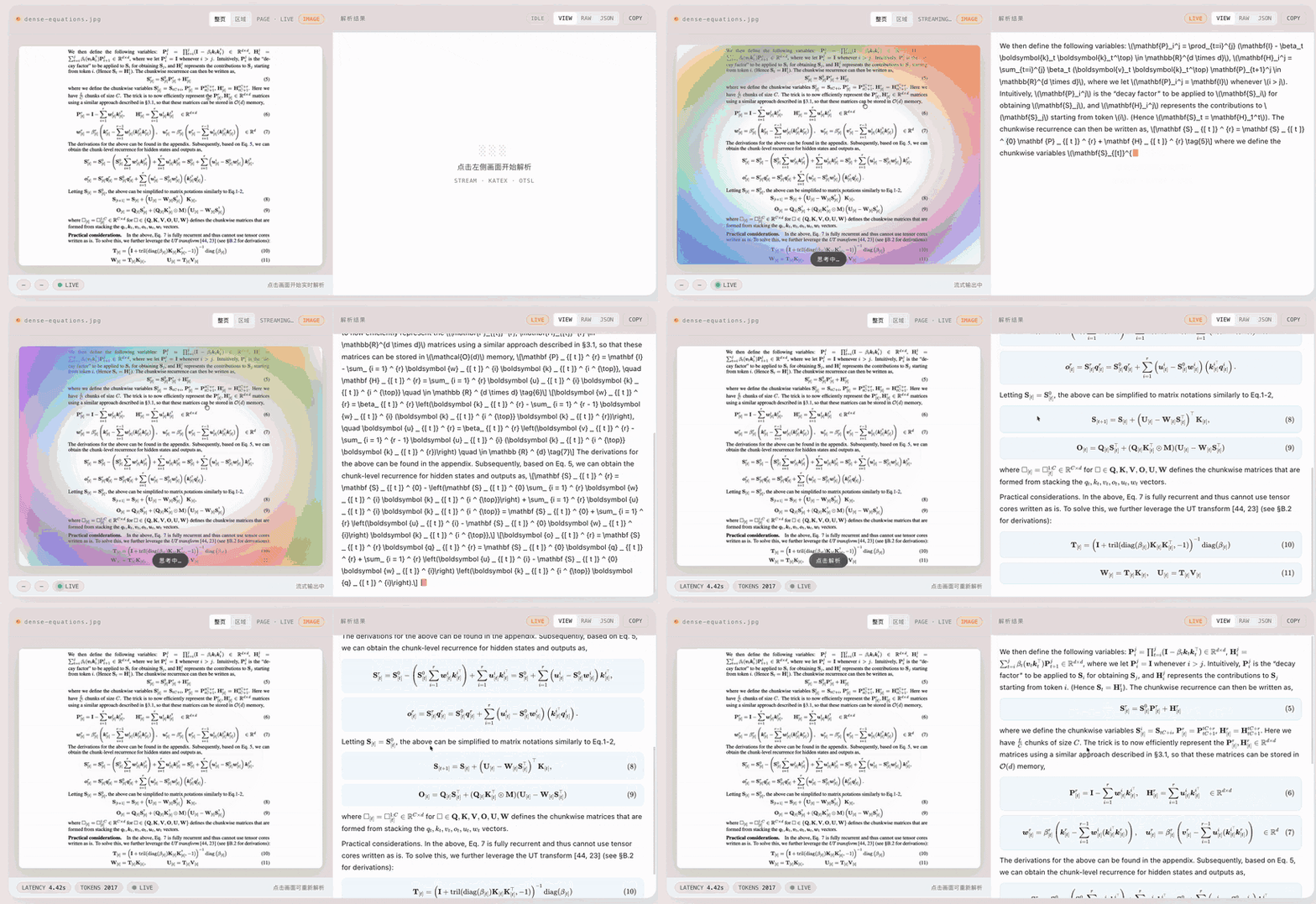
OverviewXiaomi-OCR-0 is a unified 0.8B-parameter OCR-focused vision-language model for document parsing and OCR-centric understanding. It supports text, tables, formulas, OCR-oriented visual question answering, and key information extraction. The model is described as handling scanned, warped, photographed, skewed, and recaptured documents. Maintainer: xiaomi-research.Best use casesUse it for parsing document images into text and structure, recognizing formulas and tables, answering questions about text-rich images or documents, and extracting structured fields. The supplied results also cover historical handwriting and calligraphy, including Clerical, Cursive, Running, and Regular scripts.LimitationsThe supplied evidence does not specify supported image dimensions, languages, maximum input size, hardware requirements, or a reproducible inference example for the original checkpoint. Benchmark results are reported by the model source; they do not establish performance on every document type or deployment setup. Community GGUF and NInfer conversions are separate from the original checkpoint, and their reported results should not be treated as original-model results.How it comparesOn the reported document-parsing benchmarks, Xiaomi-OCR-0 scores 96.83 on OmniDocBench v1.6, 95.24 on Real5-OmniDocBench, and 87.94 on Wild-OmniDocBench. The source lists TeleOCR at 96.87 on OmniDocBench v1.6 and 88.53 on Wild-OmniDocBench, and OvisOCR2 at 96.58, 92.29, and 87.91 respectively; Real5 is not reported for TeleOCR. On five OCR-centric VQA benchmarks, Xiaomi-OCR-0 has a reported mean of 83.2, compared with 72.9 for Qwen3.5-0.8B, 80.9 for Qwen3.5-2B, 84.9 for Qwen3.5-4B, and 82.6 for MiniCPM-V-4.5. These are source-reported benchmark figures, not a general quality ranking. The supplied alternatives include TeleOCR, MiniCPM-OCR-1.0, Unlimited-OCR, and Qianfan-OCR; their short descriptions do not support broader capability comparisons.Technical specificationsThe exact model is a 0.8B vision-language model based on Qwen3.5-0.8B-Base. Its training recipe uses Q-Mask text anchoring, OCR-centric continued pretraining, and mixed-task reinforcement learning. The source describes an approximately 170M-sample OCR-centric training corpus. Metadata identifies Transformers and Safetensors, and lists the Apache-2.0 license. Reported scores include 97.84 on UniMER-Test for formula recognition, 92.27 on PubTabNet for table recognition, and 73 on Chronicles-OCR Mature Scripts. No hardware, context length, or measured inference performance is supplied for the original checkpoint. The 4B teacher figures in the source describe separate models, not this 0.8B checkpoint.Model inputs and outputsInputsThe model is an image-text-to-text vision-language model. The source supports document images and OCR-oriented visual question answering, but does not specify an exact input schema, image-size limits, or prompt controls for the original checkpoint.OutputsSupported tasks include document parsing, text and structure recognition, formula and table recognition, OCR-oriented question answering, and structured key information extraction. The source does not define a required output schema or decoding controls for the original checkpoint.Frequently asked questionsQ: What is Xiaomi-OCR-0 designed to do?A: It combines document parsing with OCR-centric understanding. The listed tasks include text, tables, formulas, visual question answering, and key information extraction.Q: How large is the exact model?A: Xiaomi-OCR-0 is described as a 0.8B-parameter model. The 4B teacher results in the source refer to separate models.Q: What document conditions are mentioned?A: The source describes stable parsing on standard documents and scanned, warped, photographed, skewed, and otherwise recaptured documents.Q: What OCR-oriented VQA results are reported?A: The reported mean across DocVQA, InfoVQA, ChartQA, OCRBench, and TextVQA is 83.2. The source defines this as the arithmetic average on a 0–100 scale.Q: Does the supplied README provide a complete Transformers inference example?A: No. The supplied excerpt gives an installation command but does not include a complete inference example for the original checkpoint.Q: Are community conversions covered by the original checkpoint's benchmark results?A: No. The source says the community GGUF conversions have not been evaluated by the maintainers, and separates NInfer contributor measurements from the original checkpoint's benchmark results.This is a simplified guide to an AI model called Xiaomi-OCR-0 maintained by xiaomi-research. If you like these kinds of analysis, join AIModels.fyi or follow us on Twitter.
Xiaomi-OCR-0: A 0.8B AI Model for Document Parsing and OCR
Full Article
Original Source
Read the full article at Hackernoon →KhanList aggregates and links to publicly available news content. We do not host full articles from third-party sources. Always verify important information with original sources.