
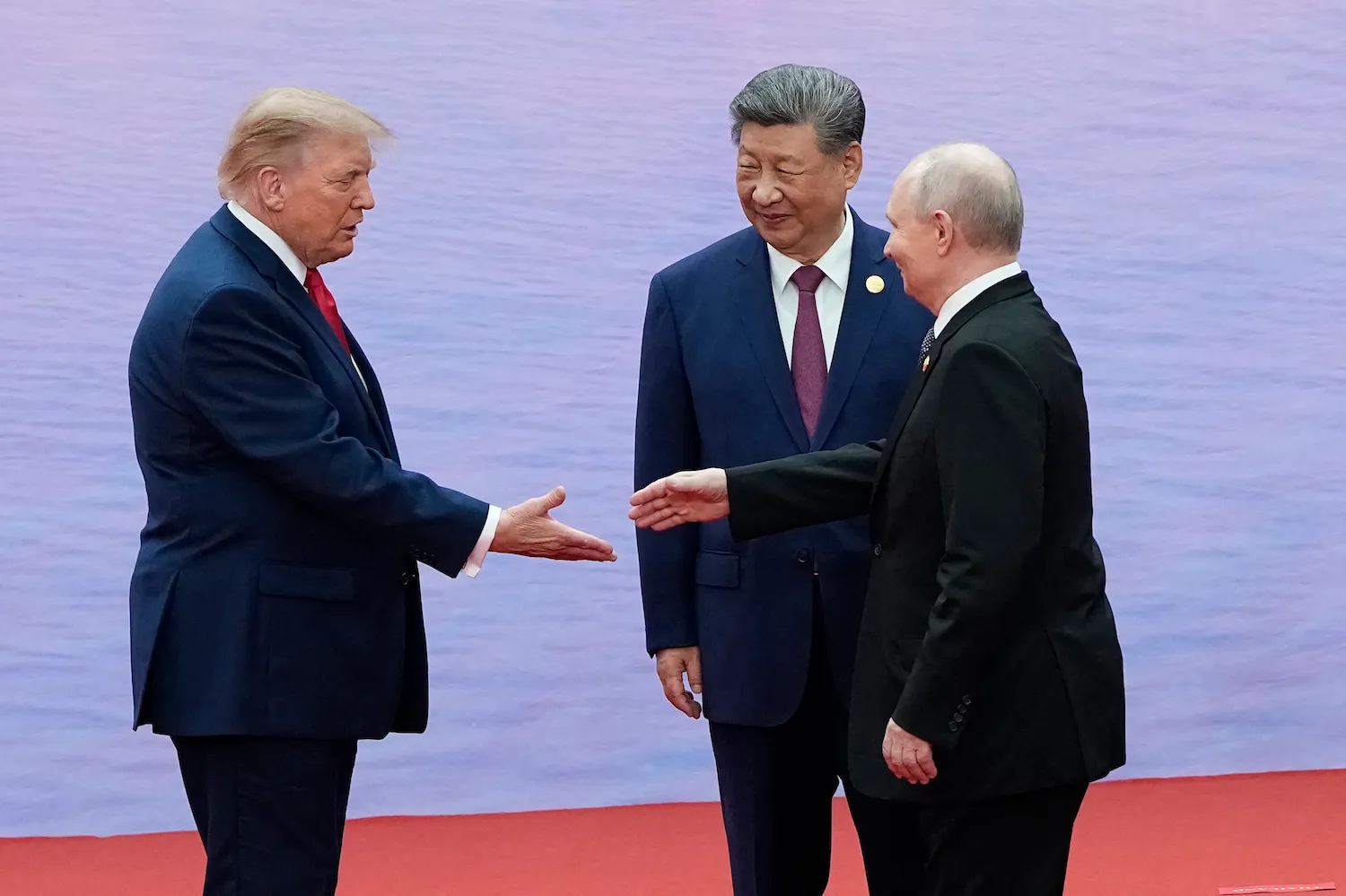
Welcome back to World Brief, where we’re looking at Chinese President Xi Jinping’s APEC agenda, an Iranian attack on a U.S. military base in Kuwait, and the European Union’s latest loan to Ukraine. Mixed Signals Chinese President Xi Jinping is just warming up for his highly anticipated trilateral summit with Russian President Vladimir Putin and U.S. President Donald Trump on Thursday. From delivering a pointed speech that criticized “unilateralism and protectionism” to breaking protocol with a big hug for Trump on the tarmac, Xi appears to be showing the world that he is eager to hold the diplomatic reins. Welcome back to World Brief, where we’re looking at Chinese President Xi Jinping’s APEC agenda, an Iranian attack on a U.S. military base in Kuwait, and the European Union’s latest loan to Ukraine. Mixed Signals Chinese President Xi Jinping is just warming up for his highly anticipated trilateral summit with Russian President Vladimir Putin and U.S. President Donald Trump on Thursday. From delivering a pointed speech that criticized “unilateralism and protectionism” to breaking protocol with a big hug for Trump on the tarmac, Xi appears to be showing the world that he is eager to hold the diplomatic reins. The Asia-Pacific Economic Cooperation (APEC) summit kicked off in the Chinese city of Shenzhen on Wednesday with a two-hour meeting between Xi and Putin. During the talks, Xi highlighted the importance of the China-Russia relationship and touted the necessity of a multipolar world. In a keynote address later that day, he further vowed to defy trade protectionism and maintain a “free and open” system, painting Beijing as a stable economic partner that can counter the White House’s volatile tariff war. Putin echoed that message in his own speech while criticizing Western sanctions imposed on Russia due to its war against Ukraine. The meetings and speeches did not signal a dramatic shift in policy; Xi has already used this week’s Asia-Pacific summitry to curry favor with some of the region’s most influential allies, from Canada to Peru. However, the timing was notable, as just a few hours after the Xi-Putin talks, Xi was on the tarmac at Shenzhen Baoan International Airport to personally greet Trump with a warm embrace. Such a personal welcome is uncommon for the Chinese president, who usually sends a high-level representative to meet with foreign leaders when they touch down in China. However, the friendly greeting may be an effort to parallel Trump’s own approach to their relationship, as Trump met Xi at the bottom of the stairs to his jet when the latter flew to Washington in September. Wednesday’s red-carpet welcome for the U.S. president also included an honor guard, a military flyover, an array of flowers, and a cheering crowd. Trump “loves pomp and circumstance, and these kinds of events present an incredible opportunity there,” Mike Kuiken, the vice chair of the U.S.-China Economic and Security Review Commission, told FP’s Rishi Iyengar ahead of Trump’s Asia trip. “[T]his is the kind of thing that plays to his insecurities in a way that he’ll very much enjoy,” Kuiken added. Xi later hosted Putin, Trump, and the other gathered dignitaries at an APEC welcome banquet, during which the Chinese leader outlined the primary goals of the summit. “We will discuss steps to expand mutual openness, explore pathways to innovation-driven growth, extend opportunities for result-oriented cooperation across various fields, and strive to deliver more tangible results on the ground,” Xi said. As for what will be on the agenda for Thursday’s trilateral meeting, Trump has stressed his interest in discussing the Russia-Ukraine and Iran wars as well as nuclear disarmament; however, experts expect Xi to try to steer the conversation away from nuclear arms collaboration. Putin, meanwhile, appears optimistic about Thursday’s dialogue, insisting that the talks will likely have a significant impact on global affairs. “I therefore expect big potential benefit from the upcoming trilateral meeting,” Putin said. Today’s Most Read The Middle East Is Finally on Its Own by Stephen M. Walt A Diminished Trump Could Get Played in Asia by Howard W. French Democrats Can’t Return to Pre-Trump Foreign Policy by Rebecca Lissner and Mira Rapp-Hooper What We’re Following Widening strikes. Iranian forces targeted a U.S. air base in Kuwait on Wednesday for the first time since September, upending a roughly two-month pause on strikes against U.S. military sites. That same day, Tehran also launched several attacks on Bahrain, which hosts the U.S. Navy’s Fifth Fleet. Both small Persian Gulf countries claimed to have intercepted Iran’s aerial assaults. Wednesday’s strikes marked the latest round of tit-for-tat attacks between Iran and the United States. According to Iran’s military, the operation against Kuwait’s Ali Al Salem Air Base on Wednesday was in retaliation for a U.S. airstrike on Iran’s Qeshm Island the day before. Qeshm serves as a staging ground for Iranian forces targeting global shipping in the Strait of Hormuz, and it hosts an expansive underground tunnel network that is often used as a base of operations for the Islamic Revolutionary Guard Corps. “If the enemy repeats its mistake,” Iranian Army chief Amir Hatami said in a video posted by state media on Wednesday, “we have the readiness and the plans to confront it and its supporters in a stronger, more crushing way and without geographic limitations.” Such a threat comes one day after seven U.S. officials told CNN that Tehran is considering detonating a so-called dirty bomb or chemical weapon inside Washington to target senior Trump administration officials. The White House has stressed that there is no imminent threat to the U.S. homeland. Strapped for cash. The European Commission proposed a new $49.5 billion loan to Ukraine on Wednesday to help Kyiv avert its looming cash crisis and bolster its defenses against Russia. “We think this is the best way to give Ukraine a strong hand at the negotiating table,” European Commission President Ursula von der Leyen said. “And Ukraine only needs to repay once Russia pays for the damage it has caused in Ukraine.” Last month, Ukrainian President Volodymyr Zelensky outlined a $76.8 billion funding gap for 2027, at a time when Russia has intensified its attacks on Ukraine’s critical energy infrastructure. Notably, Moscow is expected to double its drone deployments next year to 20 million units, which EU Defense Commissioner Andrius Kubilius said will likely force Kyiv to allocate some 62 percent of its military budget on drones. A nearly $50 billion EU loan will cover roughly two-thirds of this gap; aid will be split between weapons funding and civilian needs, such as for hospitals and schools, and foreign allies will be encouraged to supply the rest. Von der Leyen expressed confidence on Wednesday that all 27 EU member states will support the loan. However, Bulgaria, the Czech Republic, Hungary, and Slovakia have already said that they will not take part in the latest funding round, prompting Germany to threaten to veto the bloc’s seven-year budget until all nations are on board. AI cheating concerns. Around 550,000 South Korean students are preparing to take their university entrance exam, known as the Suneung, at more than 1,300 testing centers across the country on Thursday. The high-stress event is known for causing minor disruptions to businesses, as traffic is redirected, offices and tourist attractions open later, and extra trains run to accommodate test-taking. However, this year’s exam will also include new restrictions to crack down on potential cheating after the top scorer of another professional test admitted on Sunday to using artificial intelligence to secure his suspiciously high score; the individual only got one question wrong on the tax accountant exam by using a miniature camera, a phone, and AI. The admission prompted South Korean President Lee Jae-myung to convene an emergency cabinet meeting this week to discuss what the prime minister described as the “social evil” of AI-empowered fraud. “Cheating on exams using advanced equipment is no different from stealing the scores of hundreds of thousands of examinees who worked hard,” Lee wrote on X on Tuesday. Among the new testing measures, all smartphones will be confiscated, glasses and watches will be inspected, and some public Wi-Fi spots will be blocked. A reward of at least 100 million won ($75,000) will also be given to anyone who reports an instance of cheating involving advanced equipment. Odds and Ends A packed week of high-stakes summitry has kept Trump busy and, perhaps, hungry. But Philippine President Ferdinand Marcos Jr. believes that he has the perfect solution. The host of this year’s Association of Southeast Asian Nations conference arranged for the U.S. president to receive a late-night delivery of Jollibee fried chicken on Wednesday as a sort of pick-me-up after a hard day’s work. Jollibee is the Philippines’s most popular fast-food chain and represents what Marcos described as a “taste of Manila.” FP’s World Brief writer would like to note that she too has been kept busy and famished by this week’s onslaught of news and would also enjoy some Jollibee fried chicken if Marcos wants to put in a second order.
Xi Plays the Field at APEC Summit
Full Article
Original Source
Read the full article at Foreignpolicy →KhanList aggregates and links to publicly available news content. We do not host full articles from third-party sources. Always verify important information with original sources.