
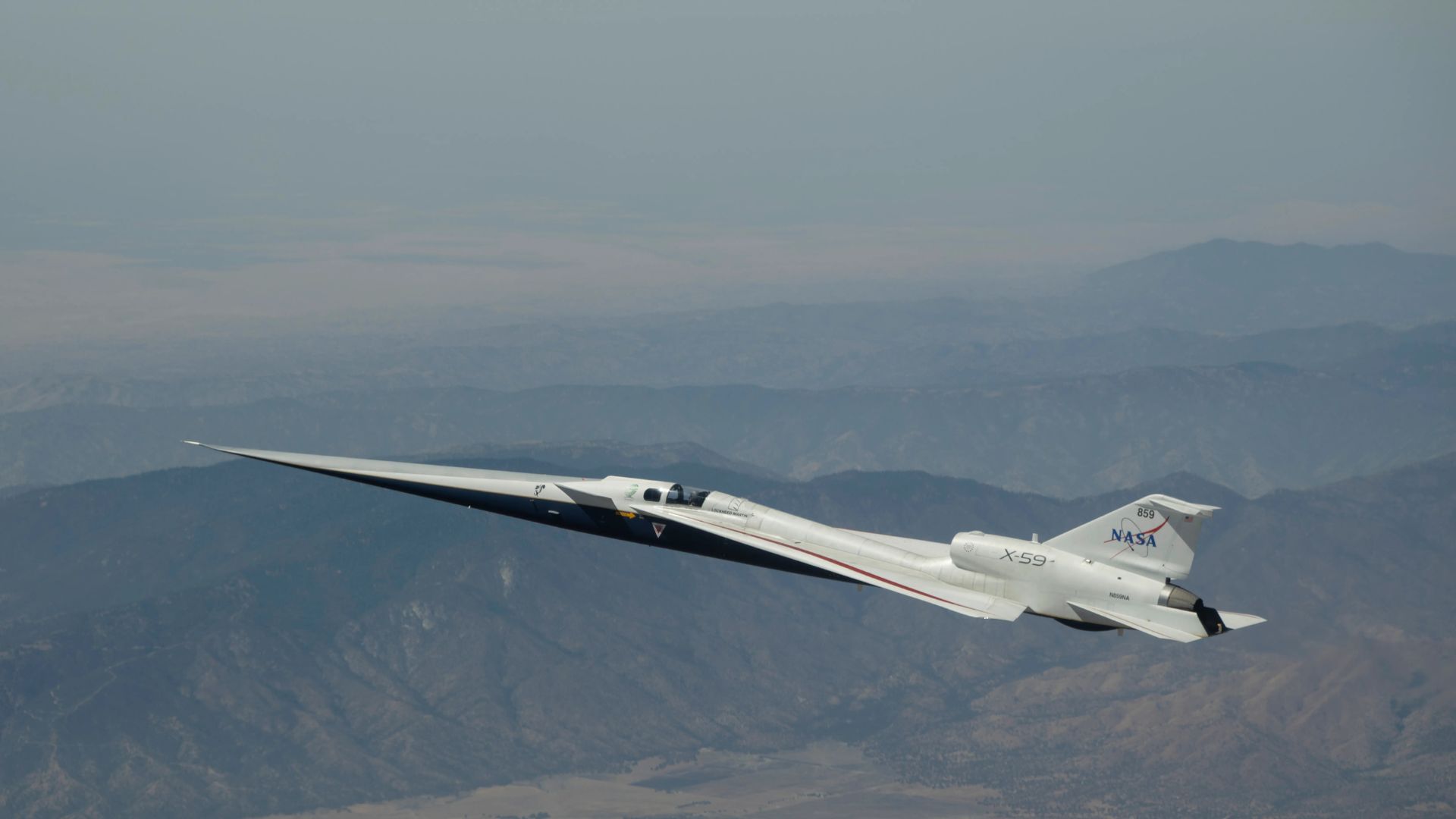
NASA’s X-59 experimental supersonic aircraft has successfully completed 25 test flights. It reached Mach 1.2 at 49,000 feet and validated key predictions regarding stability, flying qualities, and structural loads. Rather than the speed itself, the flight’s true success lay in how quietly it passed over the desert floor. Designed to trade the deafening crack of supersonic travel for a gentle, barely noticeable “thump,” the needle-nosed aircraft is meeting every single performance mark set by its engineering team. These trials clear the way for NASA to begin measuring the jet’s acoustic signature later this year. “Through our ongoing flight tests with the X-59, we’ve gained invaluable insights into both the aircraft’s performance and the unique challenges of the aircraft design,” said Cathy Bahm, project manager for NASA’s Low Boom Flight Demonstrator project. “Each test point has validated our models and predictions, and it has strengthened our confidence in the aircraft’s performance. Every flight brings us closer to transitioning to the next phase where we will demonstrate the X-59’s quiet supersonic flight capabilities.” Use of computer modeling Building a jet meant to defy decades of acoustic limits requires equal parts hubris and hyper-precise computer modeling. Before construction began, NASA engineers developed a virtual “digital twin” to simulate the X-59’s flight dynamics. Today, real-time sensor data from actual test flights is validating those early computer models with accuracy. The X-59 has passed several crucial design checks. Flight controls remain smooth and responsive under high stress. Aerodynamic forces stay within safe limits without twisting the airframe. The top-mounted inlet also reliably feeds air to the GE-F414 engine during maneuvers. Tests show no unexpected vibration, flutter, or instability. NASA test pilots describe the flights as remarkably smooth, allowing engineers to focus on evaluating performance across the aircraft’s full operational range. In fact, NASA test pilot Nils Larson described flying the cutting-edge experimental jet as “exciting but uneventful.” Every test flight builds on past data to refine control software and resolve minor sensor glitches. Key components, such as the single GE-F414 engine’s top-mounted air inlet, have performed reliably across diverse flight conditions. These successful trials set the stage for the Quesst mission’s main objective: evaluating how the X-59 actually sounds at supersonic cruise speeds. The real test lies ahead While the X-59 has already hit its cruise targets of Mach 1.4 and 55,000 feet, previous flights relied on conventional chase planes whose own roaring sonic booms masked the experimental jet’s sound signature The mission will soon enter its crucial acoustic validation phase. Researchers will deploy ground sensors and airborne microphones to measure the aircraft’s shockwaves. This data will reveal the exact acoustic footprint of the X-59’s supersonic flight. “Acoustic validation will put the tools and methods used to design the X-59 to the test — tools that could ultimately become part of the DNA of every future commercial supersonic aircraft,” said Larry Cliatt, acoustic validation technical lead for NASA’s Quesst mission. “It will be a complex and demanding flight campaign focused on demonstrating that the X-59 can produce the quiet sonic thump it was designed to achieve.” If those ground tests show the jet’s acoustic thump is soft enough for suburban skies, NASA plans to fly the X-59 over several US communities to gather public feedback. This data could persuade regulators to lift the long-standing ban on overland commercial supersonic flight. Eliminating the ban would pave the way for airliners that cut travel times in half without disturbing people on the ground. Get the latest in engineering, tech, space & science - delivered daily to your inbox.Mrigakshi is a science journalist who enjoys writing about space exploration, biology, and technological innovations. Her work has been featured in well-known publications including Nature India, Supercluster, The Weather Channel and Astronomy magazine. If you have pitches in mind, please do not hesitate to email her.
X-59: US supersonic aircraft hits Mach 1.2 at 49,000 feet in 25th test flight
Full Article
Original Source
Read the full article at Interestingengineering →KhanList aggregates and links to publicly available news content. We do not host full articles from third-party sources. Always verify important information with original sources.