
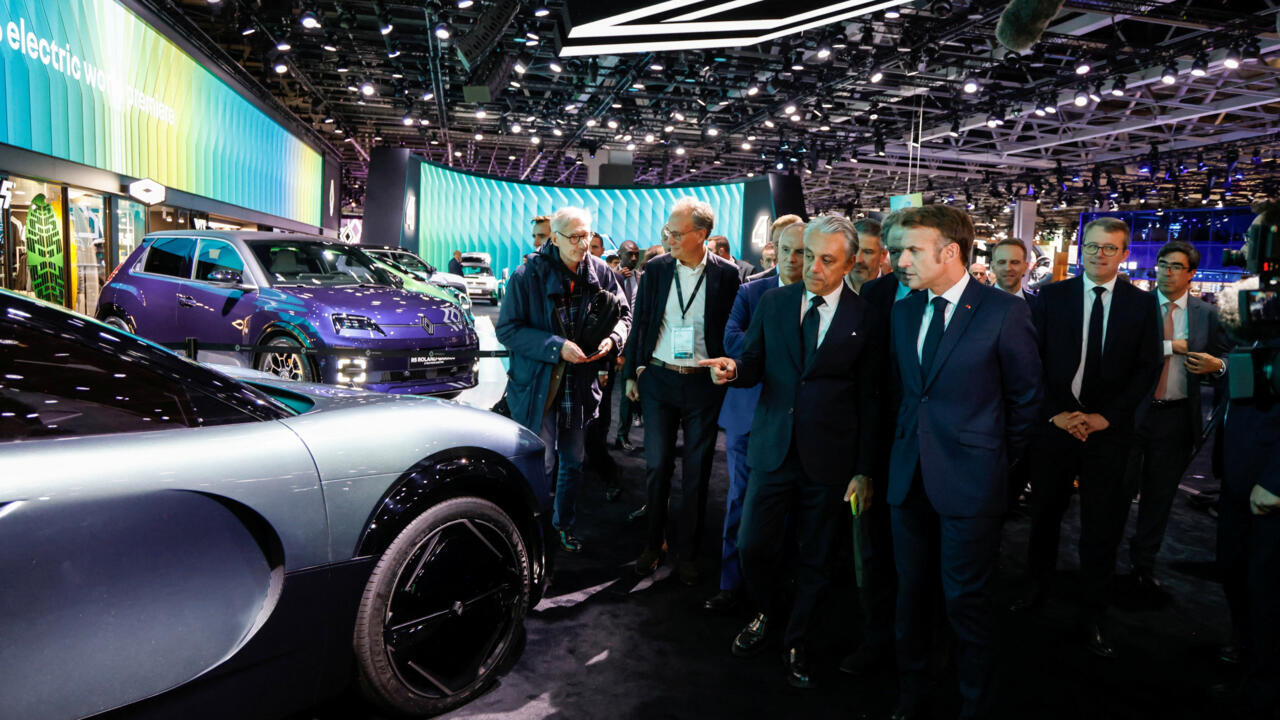
A record 20 Chinese car brands are expected at the opening of the Paris Motor Show on Monday, as Europe's car industry faces growing competition and struggles to keep pace with the shift to electric vehicles. Issued on: 12/10/2026 - 06:41 3 min Reading time The Chinese presence will be twice as large as in 2024, with established manufacturers such as BYD and Chery joined by newcomers including Aito and Avatr. Chinese brands are gaining ground through electric cars and hybrids, which combine a traditional engine with an electric motor. They accounted for 10.7 percent of the European market in the second quarter, up from 5.7 percent a year earlier, Schmidt Automotive Research said. Chinese manufacturers are increasingly targeting Europe as they face barriers to selling in the United States and weaker demand at home. Newcomer Aito plans to unveil four premium electric SUVs for Europe. It aims to increase overseas sales to 20 percent of its total within three years, from less than 1 percent currently. “The Chinese are saying 'we've got to try and dominate Europe because we can't do anything in the US',” said Brad Kunz, a partner at consultancy Grant Thornton Stax. Asian carmakers besting US rivals at home, China poised to strike Europe fights back The Paris Motor Show comes at a key moment for Europe's struggling car industry. Sales by European manufacturers in China have dropped since the Covid-19 pandemic. Chinese competition, alongside weak European demand, US tariffs and the costs of developing electric vehicles, are all taking their toll. Germany's Volkswagen is cutting thousands of jobs and considering factory closures, while BMW is also shedding thousands of workers. A report by France's National Assembly found that 38,600 jobs had been lost in the country's car industry between 2020 and 2025. European manufacturers will use the show to unveil new models and demonstrate they can compete, particularly with more affordable electric cars. Stellantis, a multinational carmaker based in the Netherlands, is reviving the Citroen 2CV, with the model expected to test new rules allowing manufacturers to remove some features to make electric cars cheaper. “This motor show will probably be the most important one in the region since the pandemic,” said automotive analyst Felipe Munoz. “This is the platform the Europeans are using to tell the Chinese they're still strong and still ready.” The 1959 Paris Motor Show. Created in 1898 it's the oldest and one of the most visited in the world. © AFP France bets on 'desirable' electric future, thanks to major private funding Tariff troubles The European Union imposed tariffs on Chinese-made electric cars two years ago. French President Emmanuel Macronn supported the tariffs, arguing that state subsidies gave some Chinese manufacturers an unfair advantage and threatened Europe's ability to preserve its car industry. Chinese manufacturers have responded by expanding into conventional fuel-driven cars and plug-in hybrids, which can be charged from an external power source. Chinese brands accounted for more than 26 percent of Western Europe's plug-in hybrid market in the second quarter, up from 2.2 percent two years earlier. European carmakers are pushing for tariffs on Chinese plug-in hybrids, while the EU is developing rules requiring minimum levels of European-made components for electric cars to qualify for certain subsidies or government contracts. However, some European manufacturers are also seeking to benefit from Chinese technology and selling space in underused factories to Chinese companies. Stellantis, the group behind Citroen and Peugeot, has partnered with Chinese state-owned manufacturer Dongfeng. The EU and China held trade talks on hybrid car exports on Thursday and Friday in Beijing, aimed at curbing the surge in Chinese hybrid-car exports and reducing a trade deficit now running at around €1 billion per day. China's commerce ministry said on Friday that Beijing had reached “an understanding” with the EU and agreed to continue exploring the possibility of lower tariffs on some products, without specifying details. (with newswires)
Chinese carmakers descend on Paris as battle for European market intensifies
Full Article
Original Source
Read the full article at Rfi →KhanList aggregates and links to publicly available news content. We do not host full articles from third-party sources. Always verify important information with original sources.