
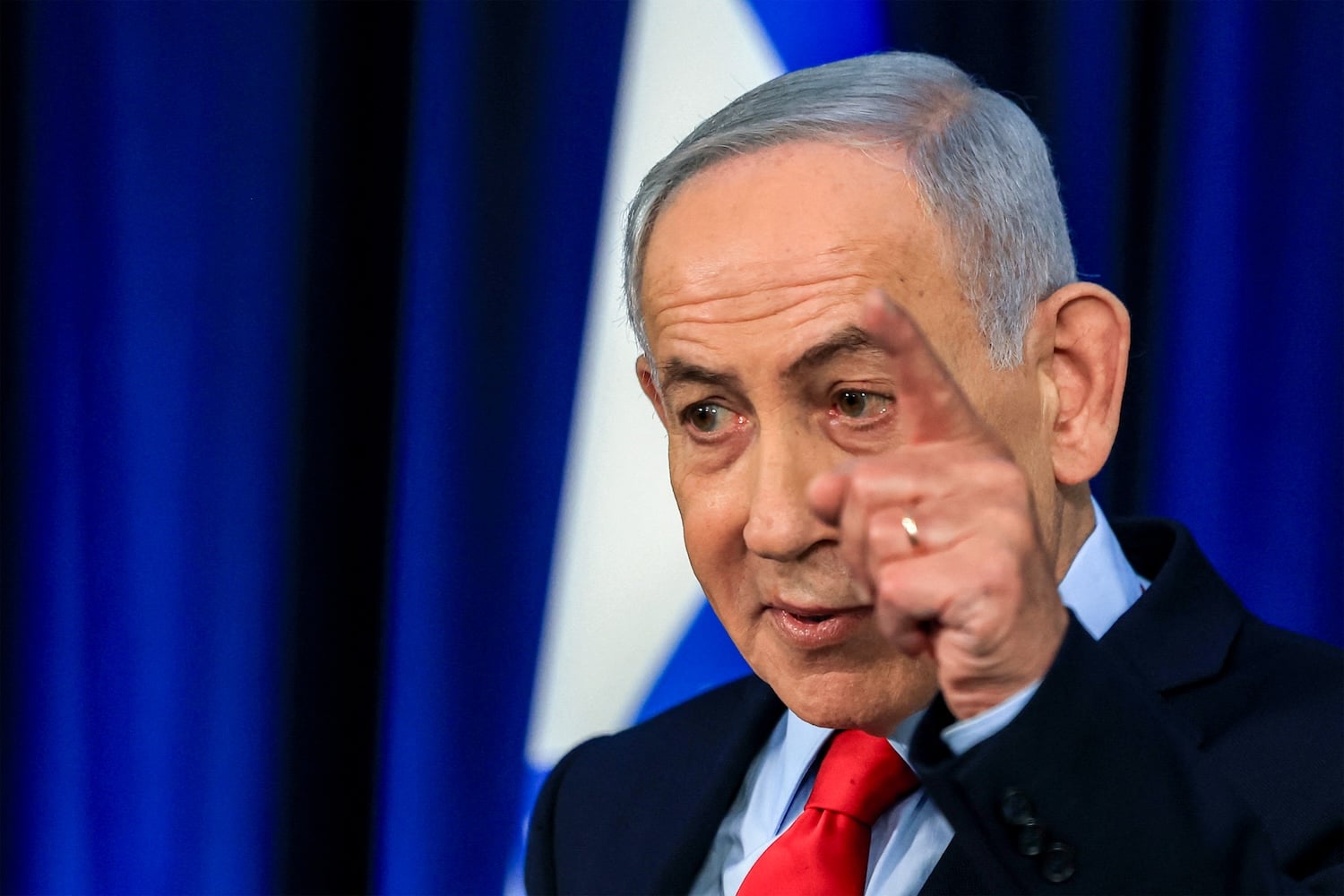
Israeli elections are less than two months away, and Prime Minister Benjamin Netanyahu’s prospects are not looking good. Opinion polls show support for his Likud party stagnating or even declining, while the main opposition party is steadily rising. The scare tactics that Netanyahu employed so successfully in the past against his rivals aren’t gaining traction this time. Meanwhile, a clutch of new right-wing parties threatens to divide his bloc and steal votes from Likud. So, what can Netanyahu do to rescue himself from the very real risk of being voted out of power? Israeli elections are less than two months away, and Prime Minister Benjamin Netanyahu’s prospects are not looking good. Opinion polls show support for his Likud party stagnating or even declining, while the main opposition party is steadily rising. The scare tactics that Netanyahu employed so successfully in the past against his rivals aren’t gaining traction this time. Meanwhile, a clutch of new right-wing parties threatens to divide his bloc and steal votes from Likud. So, what can Netanyahu do to rescue himself from the very real risk of being voted out of power? Political analysts and commentators have warned that Netanyahu might disrupt the election by encouraging (if not orchestrating) violence, deploying the police against the opposition, delegitimizing the Central Elections Committee that oversees the vote and, if all else fails, raising Trump-style “stolen election” claims after the polls close. While none of these threats has materialized so far, the campaign gets underway in earnest only on Sept. 7, when the parties submit their final election slates. However, there is one campaign tactic that Netanyahu may have already set into motion, namely, to create one or more security crises. The aim would be to polish his now-tarnished “Mr. Security” reputation and give more moderate voters who have fled the Likud second thoughts about putting the country into the untested hands of Netanyahu’s main rival, Gadi Eisenkot. Netanyahu wouldn’t necessarily have to start a full-fledged war. Instead, he could instigate a military confrontation and allow it to escalate—to a point where he could plausibly argue that there was no choice but to go to war. A preview of this may have occurred Aug. 18, when Israeli fighter jets bombed the Abu al-Duhur air base in Syria. Netanyahu and his defense minister, Israel Katz, said the attack was meant to warn Turkey against deepening its military presence in Syria. A Turkish military delegation had indeed visited the base, reportedly to deploy drones and air defenses there. Israel has legitimate concerns about Turkish aspirations in Syria and elsewhere in the Middle East, but many observers—including Tom Barrack, U.S. President Donald Trump’s envoy to Turkey and Syria—expressed doubts about the security claim. “One theory is they were just baiting Turkey, and it’s a very aggressive, but maybe well-received, pre-election concept,” Barrack speculated. On other fronts, Netanyahu’s ability to stir up trouble is constrained by Trump. Iran, which remains the Israeli public’s biggest source of anxiety, has effectively been put off limits by the U.S. president, who has made it clear that he doesn’t want war to flare up again, at least until after the United States’ midterm elections in November. In Gaza and Lebanon, where Trump has imposed cease-fires, Netanyahu also has limited room to maneuver. Aggressive behavior on the Syrian-Turkish front poses risks, as well. Washington is backing Syrian President Ahmed al-Sharaa’s efforts to stabilize the country and align it with the West, and views Turkey’s military assistance as a helpful component. The United States, which has presided over security talks between Syria and Israel, doesn’t want Israel to undermine Sharaa. Striking Syria and precipitating a crisis or worse with Turkey, therefore, might be too risky in terms of Netanyahu’s already strained relations with Trump. Still, in recent weeks, the Israeli prime minister has been increasingly calling out Turkey as a threat, as if he is preparing the public for a confrontation. Turkish President Recep Tayyip Erdogan has responded with inflammatory rhetoric of his own toward Israel. Given Trump’s short attention span and historic tolerance for Israeli cease-fire infractions in Gaza and Lebanon, Netanyahu may get the green light he needs. The real danger, however, is the West Bank. The violence by extremist settlers that began not long after the 2023 Hamas attacks has grown in recent weeks and become more brazen. Extremists are not only assaulting Palestinians and their property, but the foreign media, pro-Palestinian activists, and even Israeli soldiers if (as rarely happens) they try to intervene. The Israeli army’s chief of staff, Eyal Zamir, has warned that the situation has gotten out of control and is deploying more troops there. Netanyahu and his cabinet have turned a deaf ear. Worried that they may soon be out of power, the government’s religious far right sees the violence and settlement expansion as a last chance to create facts on the ground—including land grabs and the displacement of Palestinians from their homes. In their best-case scenario, the attacks will precipitate the mini apocalypse that they have been hoping for, whereby Palestinians finally fight back, allowing the army and the settlers to respond with a full-fledged assault that leads to the mass expulsion of the Palestinian population. Netanyahu doesn’t share the far right’s messianic fantasies, but his refusal to publicly criticize the violence, much less crack down on it, reflects a cynical willingness to exploit the crisis for his own benefit. Faced with a wave of Palestinian counterattacks and memories of Hamas’s attack on Oct. 7, 2023, the average Israeli won’t be asking who started it all but who’s best-suited to deal with the problem. Netanyahu is betting that the public will see him as the safer pair of hands. The Trump administration has been far less critical of Israeli provocations in the West Bank than in other theaters. U.S. Ambassador to Israel Mike Huckabee has called out the violence, but Trump himself hasn’t (publicly, at least) said anything. Thus, the risk of getting into a public confrontation with the U.S. president seems low, certainly compared to the other options. If the situation escalates in the West Bank, or if a security crisis elsewhere leads to a resumption of war, then Netanyahu might try to use the emergency to delay elections altogether. It’s an unlikely scenario, but Israeli election law entitles the Knesset to act, albeit only with a supermajority that Netanyahu would struggle to obtain. Nevertheless, his harshest critics don’t dismiss such a maneuver out of hand. Like Trump, Netanyahu has tested democratic norms and would almost certainly have the backing of his coalition partners. It might seem counterintuitive that after nearly three years of nonstop war, Israeli voters would reward the man who wants to entangle the country in more confrontations. But public opinion is complicated. There is a certain amount of war fatigue, but it is more than counterbalanced by the sense that the wars have not left Israel safer. A July poll by the Institute for National Security Studies found that more Israelis thought Israel’s security situation was bad or very bad (37 percent) than believed it was good or very good (26 percent). Oddly enough, among respondents who support the Netanyahu government, 49 percent thought it was bad or very bad. A large part of the Israeli public regards the wars as unfinished business. Yet it is far from obvious that Netanyahu would benefit from stoking the flames of war. Polls show that most Israelis believe Netanyahu is making his military decisions based at least in part on electoral calculations. He and his cabinet generally enjoy less public trust than the army and the rest of the defense establishment, even among coalition voters. Yet, Netanyahu has a history of employing devious tactics to stay in power that other politicians would hesitate to use, and this election is shaping up to be no different. For Netanyahu, losing really isn’t an option. It would almost certainly end his political career, destroy his legacy by opening the way for a full and impartial government investigation into the Hamas attacks, and make it harder to further delay his criminal trial or reach a plea deal to end it on favorable terms. With that in mind, Netanyahu may just go for broke.
Would Another War Help Netanyahu Win Reelection?
Full Article
Original Source
Read the full article at Foreignpolicy →KhanList aggregates and links to publicly available news content. We do not host full articles from third-party sources. Always verify important information with original sources.