
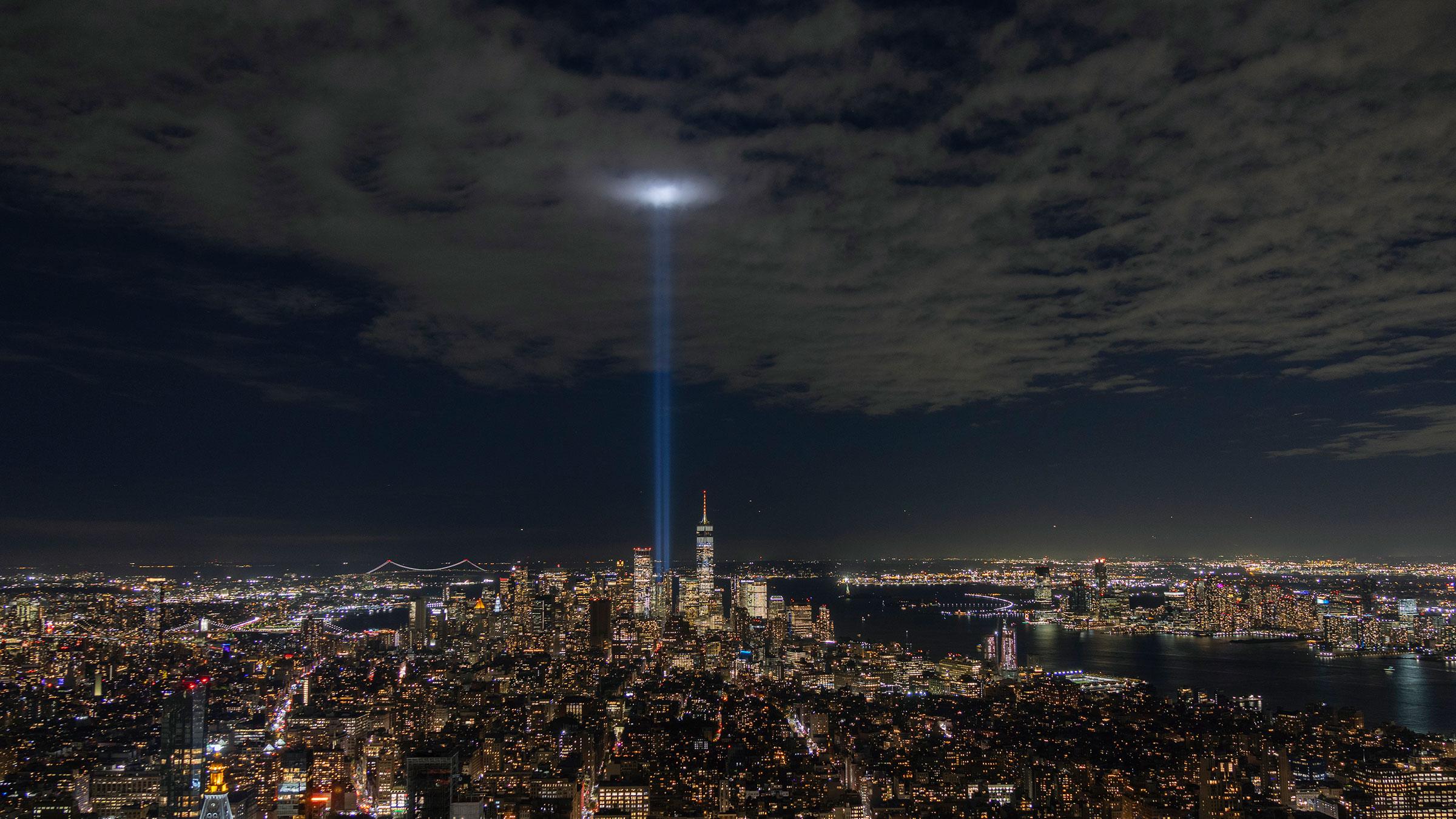
Twenty-five years later, Sept. 11 remains a watershed moment, one with both personal and global implications. To mark the anniversary, TIME spoke to people with very different connections to the day, to hear about what they experienced at the time as well as the ripple effects. For some, the legacy of the date is one of profound loss. Others know about the tragedy mostly from history class. One thing is clear: The attacks that changed the world also changed lives. Photograph by Andres Kudacki for TIME Photograph by Andres Kudacki for TIMEI was 4½ when my dad died. I have only brief memories of that day. I remember my mom taking my twin brother and me out of preschool. I remember watching the TV at home and then going over to one of her friends’, whose husband was also a firefighter, and watching it there. We were so young, we didn’t really grasp what was actually going on. But as you get older, you start to realize what you’ve missed out on. It’s not quite the same as being sad because you miss someone close to you. It’s more like you’re sad because you didn’t really get to be close to them.My dad was a cop for 12 years and a firefighter for only 18 months, but joining the FDNY was always his plan. For as long as I can remember, I also wanted to be a firefighter. I did the entry exam when I was 18, even though they don’t take anyone until 21. I went to college, but I think I was just killing time. I dropped out after two years, as the process ramped up. My mom kept encouraging me to consider other things, but she knew I had put all my eggs in that basket. I loved the routine and discipline of the academy, and I really tried to earn my spot; I didn’t want to feel like I was getting special treatment. A lot of things about the fire department don’t change, and I remember thinking my dad might have stood right where I was standing, worrying about getting yelled at by some drill instructor for having a button undone. I don’t have many shared memories with him, but that came close. He worked in Brooklyn, just on the other side of the tunnel from the World Trade Center. I wanted to go to a different firehouse, to let the guys make up their mind about me without having known his reputation, so I’m in the Bronx. The firefighters I meet that knew him, I feel like they're happy to see that I'm on the job.On 9/11 I usually go to Mass at my firehouse and then drop by Ladder 101, where Dad worked. Last year for the first time I met someone who was actually riding that day, and he gave me the full rundown. They were staged at the mouth of the tunnel right under the towers, and as they sat there on the rigs, they watched the second plane come in. They could feel the impact and then they went straight in. From what I understand, his group went up a way, came back down, and were in the lobby when the building collapsed.Dad was also a lifeguard at Overlook Beach in Long Island, and the lifeguards there put up a little memorial for him. My mom is not big on going to the firehouse or the ceremonies in the city on the anniversaries. I think it’s just too overwhelming. So we do a more casual gathering in the afternoon. It’s less somber, more a reason for everyone to just get together. Sometimes the attention that comes with being a legacy firefighter is uncomfortable, but not for the reasons you might think. I don’t have trouble talking about it; it was something that happened when I was young, but I had a happy childhood and a very fortunate life. I’m not looking for sympathy—I feel lucky to have had that role model of selflessness and self-sacrifice. On the other hand, I do miss having had a real relationship with my dad. Do I wish he was still alive? Of course. I sometimes wonder if I’d be different if I’d known my dad. But that event shaped my way of thinking and shaped me. I’m very proud of what he did, and I think it’s a very admirable and honorable way to die. And I wouldn’t want someone else to have been in his place because I don’t think that’s what he would have wanted. –As told to Belinda LuscombeKelsey Griffin Courtesy PhotoMy journey of becoming a pilot started when I was 14, when I went to a youth summer camp sponsored by the Organization of Black Aerospace Professionals (OBAP). When I first told my parents that I wanted to be a pilot, of course they were a little bit concerned about the dangers that come with flight training at a young age, but they were also very supportive.I took my first discovery flight with an instructor in 2022. At first I was definitely nervous, because there was so much going on in the plane at once. But once we were at around 2,000 feet, everything became incredibly peaceful. Looking down at the scenery gave me a sense of freedom that I never really experienced anywhere else. I knew at a young age that I never wanted to work a traditional nine-to-five job. I was also really big on traveling, and that discovery flight showed me that being a pilot was something I could do every day and enjoy. I took my first solo fight in 2024.Flight training is expensive, but my parents made sacrifices to support me financially as I sought out scholarships and opportunities. I was drawn to the LeRoy W. Homer Jr. Foundation Scholarship, because of their mission to empower future aviators. He was an African American pilot, and a first officer for United Airlines on Flight 93. I wasn’t alive when 9/11 happened, so my understanding comes from learning about it through documentaries and conversations with my parents and grandparents and others. The tragedies definitely impacted not only the lives of everyday people, but also caused major disruption in the aviation industry. When my mentor just started his career as a pilot, he got furloughed soon after 9/11 because the airline industry was completely devastated over Americans’ fear of flying. I have a family member that is still afraid to fly on aircrafts.Before I went to college, I became a private pilot and a licensed drone pilot. I briefly stopped my training after one of my friends passed away, but getting the scholarship lifted my spirits and gave me an extra push to continue my goal. The scholarship exists because of somebody who lived with courage, professionalism, and commitment to serving others. Knowing that I’m representing his legacy motivates me to work harder and fly with integrity, and never take opportunities for granted.At Middle Georgia State University, I'm enrolled in aviation courses to finish out my remaining ratings and license and also to, as we call it in the industry, time build. I have to get at least 1,000 flight hours before I can go to a regional airline. It will probably take me about six more years of training to become a major airline pilot. African American women make up less than 1% of professional pilots in the U.S. I have had the privilege of connecting with several of them through organizations such as Sisters of the Skies, OBAP, Aviation Career Enrichment, Pink STEM, and Youth in Aviation. Having this support gives me a sense of comfort and understanding that through hard work, I can also achieve it. –As told to Philip WangAlka Pradhan via ICCI was infamous as an undergraduate at Johns Hopkins for choosing classes in the afternoon so I could sleep all morning. My more diligent roommate would try to wake me so she’d have someone to talk to. On 9/11, I thought that’s what she was doing. Maybe a minute or so after she got me to the TV, the second plane hit. It was terrifying.Even at 19, I was on track to study the intersection of human-rights law and international humanitarian law. When it became clear in early October that we, the U.S., were going to strike Afghanistan in a way that seemed not entirely targeted and seemed to conflate the Taliban with al-Qaeda, that began my interest in all this. But to me, our actions didn't seem to comply with the law of war that I had been studying. I really did not anticipate that I would eventually use my specialization to litigate as hard as I possibly could against my own government. But that is what I have done for the past 13ish years in my work at Guantánamo.I was already working with Guantánamo detainees when, in 2015, I got a call from a friend at the Department of Defense, who said the military commissions, which are prosecuting those actually alleged to have organized the attacks on 9/11, were hiring civilians. He asked if I’d be interested in representing Ammar al-Baluchi, Khalid Sheikh Mohammed’s nephew. I thought, well, there's nothing I can do that is deeper in the heart of this morass than the military commissions, because the CIA torture programs are at the heart of these cases. So I've been a defense attorney for Ammar al-Baluchi’s 9/11 case since 2015. It has been in pretrial hearings for 14 years. For 9/11, the actual fact allegations against al-Baluchi are that he transferred money to people who ended up being the hijackers. We have never contested the fact that he transferred money. He was in Dubai, he was asked to transfer money, he transferred money. The $10,000 question is: What did he know at the time? And the government has no evidence that is not derived from torture that indicates he had any knowledge of what was happening on Sept. 11.The 9/11 case really is all day, every day. It is the biggest criminal case in U.S. history. I hold a top-secret security clearance, and I still don’t have all the information I need about the torture at the black sites that impacted how Ammar is today and the statements he gave later. The trial has just been scheduled for June 2028, but I don’t know if it will ever happen, and I think that is a very hard truth, particularly for the victims’ family members. Witnesses have passed away, evidence has been destroyed by the government. The men themselves are deteriorating because the U.S. refuses to give them the medical care they need as undisputed torture victims. Millions and millions of dollars have been wasted on this exercise so far. It’s the Jarndyce v Jarndyce of the United States. However I also think this is one of the most important things I will ever do because it shows fellow Americans that this is what dissent looks like, and I know it sounds trite, but this is also what patriotism looks like. I am both grateful for and have great contempt for what the Department of Defense has done over these 25 years. On 9/11 I will reach out to the victims’ family members who I am in touch with and convey my very deep sadness and anger over what happened. I will watch the commemorations. I will contemplate. Then I will start speaking again about everything that we are continuing to do wrong. –As told to B.L.Jukay Hsu Courtesy Jukay HsuI was student-body president at Stuyvesant High, three blocks from the World Trade Center. I had an early meeting that day with the principal about the plans for the year. So normally I’d be walking to school when the first plane hit. We evacuated, I think, just as the first tower fell, and I remember looking through these two-story plate-glass windows at this billowing black-gray kind of fog coming from one way as we went out the other way into a sunny sky.I grew up in Queens. My mother was a social worker. I was lucky to get full financial aid to Harvard, and signed up for ROTC, then went to Iraq. I always thought service was public service. I was a second lieutenant leading a platoon of 40 men in Salahuddin province, kind of at the mid-end of the surge. Even with combat patrols, I ended up doing a lot around civil governance because counterinsurgency involves that. It was a very different kind of learning.When I got out of the military, all my classmates were going into tech. I was like, If New York is going to become a tech sector, how can more people be included in that? All the soldiers I worked with never went to college. That's the difference between officer and soldier. Even though my platoon sergeant was 20 years older than me, I was in charge because I went to college. It really got you thinking: All these companies and jobs and wealth are being created, but two-thirds of Americans and two-thirds of New Yorkers don’t have a four-year college degree. In 2011, I ended up creating Pursuit. Our idea was to train working-class people in the skills tech companies tell us they need. The average student arrived making $16,000 and a year later has a job paying $94,000. I left Pursuit to start a research organization called Bright Future to focus on AI alignment for the benefit of humanity. There’s this idea that AI is going to be so dominant, so superpowerful, not just tools, but creating a being—we’re trying to create like a god, essentially, right? It's kind of crazy. So what does that mean for humans? This year I also joined the New York City Economic Development Board, which oversees and shapes AI policy.Perhaps the future is not college versus noncollege. Perhaps it’s going to be AI and non-AI. But hopefully, there’s a way to democratize that and enable cooperation. We're creating these new digital minds, so you have to consider their power and impact. Early on in high school, it was imprinted on me that what’s most important is what happens to all of us. And the ability to have agency in that. 9/11 helped cement that. Important critical junctures really can bring out the best in humanity, if we choose to respond.Marc Rivera Lev Radin—Pacific Press/ZUMA/AlamyI was born in Puerto Rico but have lived all but the first three months of my life on the Lower East Side of Manhattan. Next year, it will be 50 years that I'm pastoring down here. Primitive Church is within eyeshot of the towers. On 9/11, I saw the towers fall and then didn’t set foot outside lower Manhattan until March the following year.I had just dropped my younger son at high school a block away from the Trade Center and I was going into the church office when I saw my secretary outside. She simply says, “Look.” Sure enough, there was a gaping hole in the north tower. I could see what I thought was debris falling. Later on, I discovered it may have been people. I turned around to get my son, but the police wouldn’t let me through, so I went back to the church, and all of a sudden, a sea of people filled with soot and stuff came walking down our street. We opened the church to them. We had four landlines that were somehow still working. Eventually my son walked in with a bunch of friends, all covered in soot. My older son also arrived from midtown. That was a rebirth moment for me. I was able to shift my attention to helping the helpers and healing the healers. By day two after the collapse, I was doing what I've always done: galvanizing people and starting to help individuals, raising money to pay people's rent and medical bills and for funerals. We established the Ground Zero Clergy Task Force, which was simply clergy of different faiths, denominations, and traditions who gathered together to help at the site and to coordinate churches with FEMA and the New York City government. Every day, anywhere from 15 to 50 clergy would meet in the sanctuary, and then go down to the hole, to ground zero, to see what we could do. About a year afterward, I established a Northeast Clergy Group, which was broader and longer-standing. It tried to run the same program for people at the Pentagon and in Pennsylvania.We closed those organizations eventually, but through them I saw the importance of not being so rigid or immovable in my theological training. Many religious people, regardless of faith tradition, tend to think that we have the patent on truth. This event broadened my perspective and really challenged me to make that change intellectually and also in my practice. When tragedy strikes, no one cares how much training you have, how many books you have written, how large your congregation is. Because the bottom line is love. I saw a fireman who looked so tired and I asked if I could pray for him. I didn’t ask what he believed first. The most painful consequence for me personally was that my oldest son, Tim, was diagnosed with Stage IV colorectal cancer, one of the cancers that is covered by the 9/11 fund. He fought it courageously for three years, but this September will mark one year since his passing. He would have been 46. We believe he probably got it because we live down here. One of my greatest concerns today is that there are still people in our congregation and in this community who may qualify for assistance through the 9/11 fund that the federal government set up, but some remain reluctant to apply. They’re more afraid of the system than they are of getting sick. So, more than two decades later, part of our ministry is still helping people understand that the consequences of Sept. 11 did not end on Sept. 11. We are still caring for people. We are still encouraging people to seek the help that is available to them. And we are still learning what that terrible day taught us from the very beginning: when people are hurting, our first responsibility is to love them.Connie Stevanus Courtesy PhotoThat day, I was working at a bank, and as I went from department to department, they were bringing this up on their computers. On my way home, it’s just a two-lane country road, and there was so much traffic. Cars were passing me in either direction. They were state police cars. When I finally got home, I see my husband picking things out of the yard, and I didn’t know what he was doing until I went to pull into our driveway. It was black, totally black, with small pieces of burnt debris. And it just hit me then what I was looking at. Flight 93 carried mail. We had mail in our trees, in our yard. The neighbor across the road from us had a piece of the United Airlines magazine in her yard.We started volunteering at the Flight 93 National Memorial in Shanksville, Pa., after my husband had retired from work, like five years after 9/11. People come from all over—Europe, Australia, different countries. They like to tell you where they were and their experiences of that day. And then they always ask, “Where were you when this happened?” We get a lot of school students, and they're very alert to what happened here, so they're usually very quiet and very respectful. My 21-year-old grandson wasn't born yet. And when he was in eighth grade, I think it was, his school came out. I never get tired of talking about it. Probably 99% of them still feel the pain and show their emotions easily when we're talking. Sometimes it’s a little hard to be there, because I’m that person—I might not be able to say the right thing to you, but I can cry right alongside of you. At the Visitor Center, we have those three phone messages. You know that some of the passengers on Flight 93 had to leave messages because they didn’t get an answer? Those are very powerful. Can I share one little story with you? This was just after they were done with the excavation and the road opened up. So it was about two weeks later. My husband and I stopped there after work one evening. And it was just like the day of 9/11. Sunny, bright blue sky, not a cloud in the sky. There was nobody around, just me and my husband. We looked down through the field, and you could just see where the crash site was, the fresh soil that covered that area. And we just stood there. And all you could hear were birds, the rustling of the high grass, and just silence. And there wasn't a flag. There was nothing where you would think something like this happened. You could see the little fence that they had around the debris field. But that is a moment that I'll never forget. –As told to Karl VickShams Frough Photograph by Kevin Serna for TIMEI was going into fifth grade when 9/11 happened. I remember, because it was two days after a famous Northern Alliance commander was assassinated. Obviously, there was no TV in Kabul, but our ears were wide open and we did hear about it on the radio. (From a very young age, I was listening to BBC Persian.) Then came the bombings, and life in Kabul became a bit hard, so for a short period, I went back to my village, Kapisa, which is 100 km from Kabul, where I had shepherding duties. I remember very well the big difference when we returned to school; girls were going too, and we no longer had to wear black turbans. Everybody wanted the Taliban to go, but we didn’t know that eventually all these American soldiers would come and there would be a hot war again. We all thought the Northern Alliance would take over. My mother died when I was young, and my father really worked to make sure his children did not have to work on the farm. I went to an elite Turkish-run high school; out of 6,000 applicants, only 100 were accepted—and some of those places were reserved for the children of government ministers. Most lessons were in English, but we also learned Turkish. I wanted to go to medical school, but I was young and male and I believed the hype, and in the last year of school I began working with the U.S. Army. I was sent to Kandahar as an interpreter. After I was nearly killed twice, I was transferred to the Department of Procurements in Kabul and ended up doing simultaneous translation for colonels and generals who were advising the Afghan military and police. I reported what looked like corruption in the Afghan procurement process, and then I knew I had to leave. It took three years, until 2014—a week or so after I resigned—for my Special Immigrant Visa to be processed. My wife and I were initially assigned to Albuquerque, N.M., which was funny, because my Army friends always made fun of the mud huts in Afghanistan and there they were in America, only it was called adobe. When we moved to Chicago, I went to community college and so I took up driving taxis and Ubers. I’d study all week and then sleep in my taxi at the airport, because there was always a three-hour wait for a fare. Then in 2021, I started a business called Kapisa Rugs; it was rebranded as Rugistan in 2024, and we directly source hand-knotted rugs from Afghanistan. It’s not easy with Amazon and other competition, so to keep prices down, I’m here seven days a week. Right now we have two locations, but this is not the goal. I love rugs. I'll always cherish them. But hopefully, in about a year, it will be profitable enough, and my wife will have taken over and I will be able to fire myself. Some of my high school friends who didn’t join the Army are already doctors here, so I sometimes feel like I haven’t lived up to my capacity in the way I could have in Afghanistan. I am currently completing my master’s of public health at Southern Illinois University Carbondale, and I hope to start medical school in 2028. I joke with my wife that I’ll probably graduate alongside our sons. –As told to B.L.Sari Beth Rosenberg Courtesy PhotoMy first day of student teaching was supposed to be 9/11. I was 26, in grad school, planning to observe a teacher teaching U.S. history at LaGuardia High School. My alarm-clock radio played Z Morning Zoo, a show known for its goofiness, but the hosts were talking about a plane crashing into the Twin Towers and I thought, “That’s not funny.” I turned on the TV, and that’s when I was like, “Oh my, no, this is actually real.” I got a phone call from one of my best friends who worked on Canal Street near the Twin Towers, and when I saw the first tower buckle, I yelled to her, “You have to run!” The next semester, I was placed at Stuyvesant High School by what was once the Twin Towers. The air was constantly being tested in the cafeteria. And yet 9/11 never came up in the classroom. In the years that followed, I would have students interview a friend or family member about that day as a lesson in how history is remembered, showing them that they just collected primary sources.Nowadays, students are more clued into current events on their devices and TikTok, so they’re asking really interesting questions about 9/11, like “Why did we attack Afghanistan?” Many students don’t understand the difference between why we went into Afghanistan in the early 2000s versus Iraq. Many adults don't know the difference if they don't really pay attention to the news or recent current events. How do you understand what’s going on in Iran now if you don’t understand the history of Iraq, Iran, the Middle East? Kids don’t talk about the fear of terrorists coming from the Middle East. The thing that kids are more scared of today is what they see as domestic terror coming from ICE agents. I’ve had to explain that ICE was created in 2003 as part of the new Department of Homeland Security, which was established in response to 9/11, and now it’s being used to, in my opinion, terrorize communities. I’m definitely going to bring up the 25th anniversary in class this year. They were born so long after 9/11, it’s history to them. We need to find ways to cover more recent history. In a U.S. history class—or any history class—there’s so much to cover, and we don’t get to the recent history, from 1980 to the present, because it’s not emphasized on tests and also you run out of time. –As told to Olivia B. WaxmanAllison Turkel Courtesy Department of JusticeOn Sept. 11, I was outside of Albuquerque, N.M. I worked for a not-for-profit then called the National Center for Prosecution of Child Abuse, and we were running a conference. And the receptionist where we were holding it said a plane just hit the World Trade Center, and you could go into our break room to watch it on TV. I went in just in time to see the second plane hit. Luckily I was able to reach my dad, who had a meeting downtown that day. I got him right before the phones went out in New York, and then we started driving back. We looked on our map. We tried to avoid missile silos because we thought that those might be under attack or shooting things. We had no idea. I drove crying. Not the whole time, but a lot. It’s a skill.I lived in the D.C. area at the time, but I grew up in Manhattan, up in Washington Heights. I worked down in the Manhattan district attorney’s office, which was actually in the zone. So all of it translates well into how and why I’ve been the Special Master of the September 11th Victim Compensation Fund for the last 3½ years. We want as many people as possible to know, one, we’re still here. We are in business until 2090. We have as much funding as is necessary to pay every eligible claimant. And two, we serve people beyond first responders. We serve people that lived, worked, went to school in the New York exposure zone, who were at Shanksville and at the Pentagon. We really encourage people if they were there, to register with the VCF. In order to file a claim, folks need to get certified that they have a 9/11 illness from the World Trade Center Health Program, which is our sister program that runs out of HHS. We are receiving over 700 new claims a month.Since 2011, when we reopened, we have received over 110,000 claims. We've paid out $18.5 billion compensation. [The original VCF closed in 2004 after paying out the $7 billion appropriated for those killed or physically injured on 9/11.] The CDC estimates that in New York alone, over 400,000 people may have been exposed to the toxins.Remember “America Strong”? “Let everybody return”? “Let's begin to live, work, go to school, start over again”? People went back into the New York zone, and the consequence, of course, is they were exposed to these toxins that have made them ill. And people have died from it. On that day, 2,977 people perished at all three sites and on the planes. Since we reopened, we’ve had 6,100 of our claimants die from exposure to the toxins. And unfortunately, every year there are more people becoming ill. Today, 63% of our claimants have a cancer, and those cancers, because of the unique nature of what people were exposed to, may have long latency periods.Every Sept. 11, the memorial and museum in New York City does the reading of the names of the victims, and there’s always six moments of silence, to mark the four moments of impact and two tower collapses. This year, they’re adding a seventh, to honor the people that have become ill from the toxins. I think that’ll help spread awareness that so many are still suffering and that the 9/11 VCF is here to help. Christopher Ashley Courtesy PhotoI actually didn't behave that great that day. I almost got into a fistfight. It was the first day of rehearsal for the play Wonder of the World, which I was directing. We canceled rehearsal for that day and the next, and I ended up walking back home to the West Village. Late that night, there was a very drunk man who put himself in front of me and asked if I was an Iraqi. He kept putting himself in front of me, and I kept trying to get away. Then he took a swing at me, and I punched him in the face. It’s not automatic that people are their best selves in these moments. I think one of the things people do with traumatic situations is move on, so it was really meaningful to me to dig back into the feelings that that day created while directing Come From Away, a musical about 38 planes grounded in Gander, Newfoundland, and the people who took care of strangers at this moment of real terror. Telling that story around the world, onstage, on Apple TV helped me heal.In 2011, the play’s authors, David Hein and Irene Sankoff, went to a 10th anniversary event reconvening a lot of the people who had been diverted there on 9/11. They expected to be there for a couple of days and ended up staying for weeks and weeks. Claude Elliott, the mayor of Gander, used to joke, "Wait, you guys are making a musical about making sandwiches?”In the current world we're living in, it almost seems mythical that people would take this good care of each other because there are just so many things that pull us apart and make us suspicious of each other. We're all vulnerable. Nobody’s safely apart behind a wall. We're all going to have to figure out how to share the world and the space together. The world keeps changing, but the show remains about the responsibility we have to each other and the value of kindness and connection. Twenty-five years ago, if more people thought like the people in Gander—“these people are my problem, my responsibility, and I will take care of them, despite the fact that I didn't meet them until today”—I think we'd be in a better place. –As told to O.B.W.Nancy Gibbs Elizabeth D. Herman for TIMEMoments after 8:46 a.m., attention fixed on one incomprehensible event. As first responders scrambled and survivors fled, the rest of us skidded to a stop and watched. At TIME, editor Jim Kelly launched a reporting army: correspondents around the world tracked the attacks and reactions in real time. White House correspondent Jay Carney was with President Bush in the press pool; writers and editors in the New York City headquarters headed downtown, or to city hospitals and command centers. My job was to curate and condense it all into a single story for a special issue of the magazine. “I just want you to tell the story of today,” Jim told me. “Think of it as a time capsule.”In one sense we all saw something different. If you lived in New York City, not only did you see the smoke, you smelled it, tasted it. You heard the sirens, felt the fear. Elsewhere, the alerts jolted large towns and small. Local landmarks shivered and then shut down: Disney World and the Sears Tower, Congress and the Supreme Court, the Space Needle. Also, the entire airspace of the United States. But at a deeper level, we all saw the same thing, a once unimaginable attack on what we soon started calling the Homeland, as though we were all residents of the same reality. No matter how different our individual experiences of that day, we lived through it together and emerged more united: By October, 60% of people said they trusted the government to do the right thing all or most of the time, a three-decade high. It’s easier to put a jigsaw puzzle together when you can see the whole picture on the lid of the box. Yes, there were toxic rumors and conspiracies even without the yet-to-be-invented Facebook and X. But compared with what has transpired since then, the information landscape looks practically pristine. The demolition of the business model for traditional news sources corresponded with sinking institutional trust across the board. Journalism’s self-inflicted wounds and technological upheaval radically changed how people make sense of the world. Trust in government now sits around 17%. Trust in the media has hit an all-time low. If you had told me 25 years ago, as we color-coded the threat level, cast a wide surveillance net, launched a Global War on Terror, that we would manage to avoid further terror attacks, I would have found it hard to believe. But I also couldn’t have imagined the maceration of the media as our news channels filled with content of all kinds streaming in from all corners. This year for the first time, more people globally rely on social and video platforms for news, rather than TV or news websites. As audiences migrate from broadcast and cable, print and radio, to creators on TikTok and YouTube, the very notion of a shared reality feels quaint. Eight in 10 of us say Democrats and Republicans can’t even agree on basic facts, which makes reasoned discussion of everything from security threats to education reform all but impossible.Twenty-five years ago, like journalists everywhere, I focused on how to tell this story, in the belief that stories are stickier than bloodless fact. But what has happened since makes me wonder if I missed the actual war. Sept. 11 did not cause 21st century truth decay, but it coincided with it. Jolted out of the snug 1990s, people went searching for answers they could trust, tribes they could join, distraction as an antidote to alarm. We no longer hear the same stories and too many leaders are counting on that. We can each collect the puzzle pieces, but it's harder to see the full picture. Even when the country is broadly united around key values—reject political violence, protect the safety net, get money out of politics, regulate AI—the sense of division abides and people on both sides see mainly a caricature of their opponents. Strong societies need good information; communities benefit from shared stories. On Sept. 11, many of those stories were of quiet, reflexive heroism, sacrifice, service. First responders and random strangers modeled courage under fire, and the rest of us were swept up in a wave of gratitude that helped drain the fear. Those are stories worth retrieving now. –Nancy GibbsKeira Unterzuber, Eric Johnson, and Freya Johnson Courtesy PhotoKeira: My first child was due on Sept. 3, and my doctor was going to induce me on the 13th. So the 11th was any other day, really. I was getting ready for work when my husband, who is a pilot and was home on family leave, said, “Keira, come here.” He explained that a plane had crashed in the World Trade Center, and I said, “But it's so sunny!” He's like, “Yeah, that's really weird.” And while we were watching the TV, the second plane hit. As the morning went on, I started to feel unwell. But then I don’t think anybody felt well that day.Eric: We live near the Pentagon, and suddenly, it was like somebody pushed over a piano in the room next to us. It shook the whole house. The cats jumped off the bed and hid. I went outside and saw smoke. Sometime in there, Keira said, “I’m having the baby today.” I drove 80 to 90 miles an hour all the way to the hospital. There was zero traffic. It was eerie, like driving somewhere in the middle of the night. Keira: Because of construction, we had to go through the emergency-room entrance and I remember all these emergency medical staff just waiting, and not for me. In the delivery room, Eric started to say he was ready to join the military and go fight the terrorists and because of the mood that he was in, he suggested several new names for the baby: Phoenix, America, Freedom, Liberty. I just said no, no, no. Eventually he picked Freya, who is goddess of war and love and a very strong woman. Freya: When I was young, I didn’t really understand the significance of the day. But around the 10th anniversary, I realized, “Oh, this is huge,” and then it became very depressing. On the morning announcements at school, they’d show a video tribute, and those videos were obviously very sad. In middle school, some kid told me that I was the reincarnation of Osama bin Laden. So I used to wish I was born on the 10th or the 12th. I actually didn’t celebrate my birthday from ages 10 to 13. It just felt inappropriate and weird to be so happy when everyone else was not. I can’t tell you how many times I’ve told people my birthday, and it becomes a whole conversation. When I need ID at a bar or when I have to pick up a prescription, and they ask me for my birthday, they’re like, “Really?” I’ve even had people ask me, “What was that like for you?” And I have to say, “Well, I was not even born yet so I was not aware of anything.” I’ve learned to just say my birthday is in September. However, as I’ve gotten older, I’ve realized that I like my birthday. It’s such a beautiful time of year. I’m at the point where I can acknowledge that it was sad, but I can also celebrate myself. All my friends tell me that when they think of 9/11, they think of me as their first thought. Keira: When something tragic happens, it’s a beautiful thing to be around a newborn baby. My brother’s wife lost her first husband on the 10th, and his funeral was on the 13th. She adores Freya because, in her world, she’s a bright light at a dark moment. We have a lot of friends who say that year after year: She was the shining light that day. –As told to B.L.
How 9/11 Shaped My Life
Full Article
Original Source
Read the full article at Time →KhanList aggregates and links to publicly available news content. We do not host full articles from third-party sources. Always verify important information with original sources.