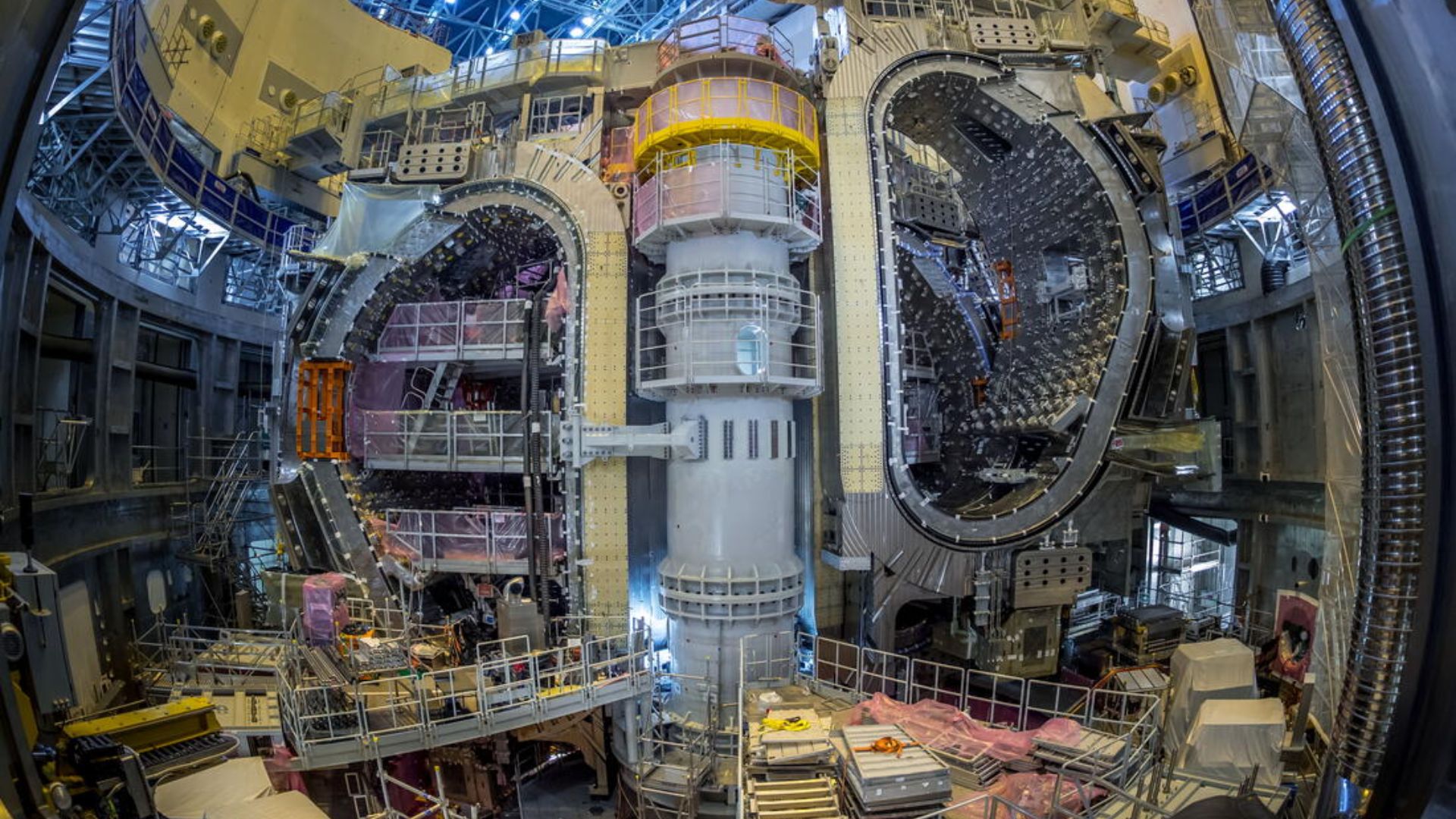
The new unit is one of nine modules forming the main containment structure in the tokamak pit.ITER Engineers at the ITER nuclear fusion facility in southern France have placed the final vacuum vessel sector module into its central assembly space, completing a critical structural stage for the experimental tokamak reactor. The placement occurred during an industry gathering on July 22 that brought together public officials, researchers, and corporate partners to review technical progress on the project. The newly installed unit represents one of nine total sector modules that will make up the main donut-shaped containment structure inside the central tokamak pit. Once all nine units are fully integrated, the combined steel vessel will weigh roughly 5,000 metric tons. Its core function is maintaining an ultra-high vacuum environment capable of insulating magnetically confined plasma heated past 100 million degrees Celsius. Each sector module acts as a composite unit rather than a simple vessel segment. Before installation into the central pit, the primary vacuum vessel sector is joined with thermal shielding panels and super-cooled magnetic hardware. Precision engineering for plasma confinement The inner steel hull blocks heat transfer, which protects external superconducting magnets that operate near absolute zero. These magnets generate the intense magnetic field that is required to pinch, stabilize, and suspend the superheated plasma away from the reactor’s interior walls. However, an unconfined plasma column could instantly destroy solid surfaces upon contact. Therefore, maintaining precise mechanical geometry across all adjoining sectors is necessary to ensure uniform magnetic fields. “Although each vacuum vessel sector is an ultra-large structure measuring 11.3 meters in height, 6.6 meters in width, and weighing approximately 400 tons, it demands an extraordinarily high level of manufacturing precision to ensure seamless assembly with the other sectors,” said HD Hyundai in a press release. Despite these physical dimensions, the joint surfaces demand millimeter-level precision to enable accurate continuous welding during final ring closure. Manufacturing procedures also had to satisfy French regulations for nuclear pressure-retaining equipment, international nuclear standards, and internal ITER engineering controls. Built on refined techniques HD Hyundai Heavy Industries fabricated four of the nine total sectors, applying manufacturing techniques originally developed for large-scale maritime hulls and offshore industrial facilities. The company initially received an order for two sectors assigned to South Korea in 2010, later taking over two additional sectors originally assigned to the European Union in 2016. Delivery of all four units was completed in 2024. The manufacturing processes used for ITER build directly upon techniques refined during earlier fusion projects. The company previously contributed to South Korea’s domestic fusion research platform, KSTAR, which was completed in 2007. For KSTAR, engineers designed and built the primary structural components, including its ultra-high vacuum vessel and outer cryostat shell. Experience gained from managing heavy steel distortion during the welding of KSTAR’s vacuum boundaries informed the tooling and quality control methods later used to fabricate the thicker, more complex ITER sections. The broader ITER effort remains a joint enterprise involving South Korea, the European Union, the United States, Japan, China, Russia, and India, aimed at evaluating the technical feasibility of sustained nuclear fusion power. Recommended ArticlesGet the latest in engineering, tech, space & science - delivered daily to your inbox.An active and versatile journalist and news editor. He has covered regular and breaking news for several leading publications and news media, including The Hindu, Economic Times, Tomorrow Makers, and many more. Aman holds expertise in politics, travel, and tech news, especially in AI, advanced algorithms, and blockchain, with a strong curiosity about all things that fall under science and tech.
World’s largest nuclear fusion reactor adds HD Hyundai’s 5000-ton vacuum vessel part
Full Article
Original Source
Read the full article at Interestingengineering →KhanList aggregates and links to publicly available news content. We do not host full articles from third-party sources. Always verify important information with original sources.