
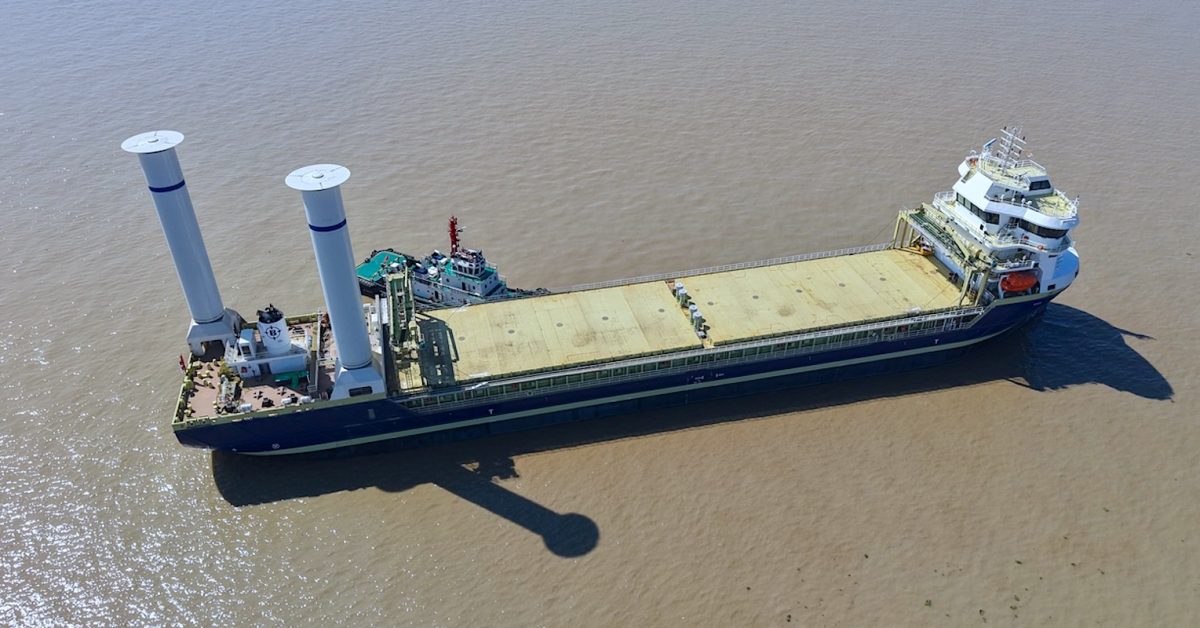
Moving millions of tons of coal, sugar, and other bulk cargo is serious business, and decarbonizing that business presents a number of unique problems – but if the new BRF Froan bulk carrier proves anything, it’s that battery size isn’t one of them. The new electric cargo ship is packing an impossibly huge, 23,500 kWh battery. Fitted with the equivalent of nearly 300 long-range electric car batteries, 130 meter (426 ft.) BRF Froam built by SOHO Marine Heavy Industry for Norwegian shipping firm Berge Rederi Future (BRF) will use the ship to haul up to 13,250 deadweight tonnes (DWT) across the 230 nautical miles (or about 265, as the crow flies) between the ports at Brønnøy and Elnesvågen without burning a drop of diesel. “It’s going to run back and forth, back and forth, just like a ferry,” explains Oivind Berge, co-owner of Berge Rederi Future, in a TradeWinds interview. He added that the round trip takes around 24 hours, with charging facilities installed at the loading and discharge ports. “Then we can go back and forth continuously.” The 130M vessel BRF Froan left the shipyard at Jiangsu SOHO Marine Heavy Industry, in China last week, and is currently en route to Norway where it is set to begin shipping huge chunks of marble early next year. About the stovepipes BRF Froan; Berge Rederi. The ship’s massive battery sends electrons to a 6,000 kW (about 8,000 hp) electric motors that turn the propellers. How that works is obvious – what might be less obvious is what those big stovepipe deals at the back of the BRF Froan are. Those are called rotor, or rotary sails, and they one-up the old-school version by using something call the Magnus effect to produce forward thrust. Basically, as the tall cylinders spin, the wind flowing around them creates a pressure difference that generates lift perpendicular to the wind. That lift produces forward thrust, helping push the ship along and reducing the amount of electricity it needs to draw from its batteries once under way. The company estimates the two rotary sails will save about 339 kW per trip, while the switch to battery power will save another 10,000 tons of harmful carbon emissions and 220 tons of nitrous oxides each year. Interesting Engineering is reporting the total cost of the project at approximately USD 52 million (NOK 500 million). A second vessel, named BRF Frøya, is already under construction in China and is scheduled for delivery in 2027. SOURCE | IMAGES: BRF, via Naval Porto Estaleiro. Rising energy costs mean more people than ever are considering solar, and it’s always a good idea to get quotes from a few installers. To make sure you find a trusted, reliable installer near you at a competitive price, check out EnergySage, a free service that makes it easy for you to go solar. It has hundreds of pre-vetted solar installers competing for your business, ensuring you get high-quality solutions and save 20-30% compared to going it alone. Plus, it’s free to use, and you won’t get sales calls until you select an installer and share your phone number with them. Your personalized solar quotes are easy to compare online and you’ll get access to unbiased Energy Advisors to help you every step of the way. Get started here. FTC: We use income earning auto affiliate links. More.
World’s largest electric bulk cargo shop packs MASSIVE 23.5 MWh battery
Full Article
Original Source
Read the full article at Electrek →KhanList aggregates and links to publicly available news content. We do not host full articles from third-party sources. Always verify important information with original sources.