
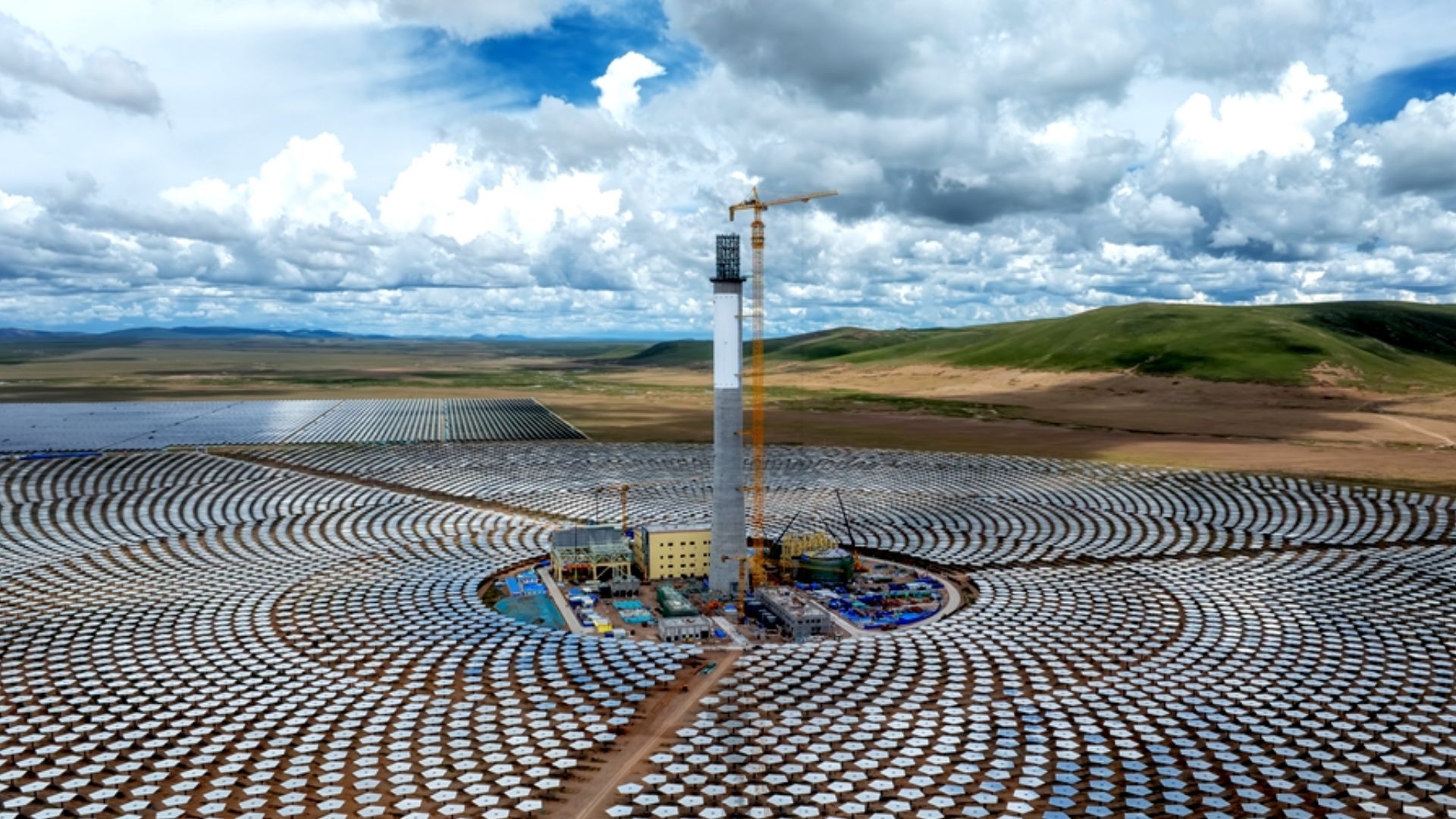
China has completed a major construction milestone at what it describes as the world’s highest-altitude molten-salt solar thermal power plant. The facility in Amdo County, Nagqu, in southwest China’s Xizang Autonomous Region, recently finished installing 15,927 heliostats across a solar field covering about 8.6 million square feet. The project is targeting grid connection in October 2026. Solar field reaches key milestone The 100-megawatt (MW) facility is the first tower-type solar thermal power plant in Xizang and the first of its kind built at an ultra-high altitude under extreme cold and weak-grid conditions. Its solar field uses thousands of heliostats, which are mirrors designed to track the Sun and direct sunlight toward a receiver mounted on a central tower. The completed field covers roughly 800,000 square meters (8.6 million square feet). The project is being built in an environment where low temperatures, strong winds, and high elevation can make construction and equipment operation more difficult. Engineers therefore had to adapt construction methods to the plateau environment. Molten salt stores solar heat The plant uses molten-salt tower solar thermal technology to turn sunlight into heat before producing electricity. The system concentrates solar energy onto a receiver positioned at the top of a 210-meter (about 689-foot) tower. Nagqu receives more than 2,800 hours of sunshine each year, giving the project a strong solar resource despite its challenging location. Molten salt plays an important role in the plant because it can absorb and retain heat collected from concentrated sunlight. That stored thermal energy can then be used to produce electricity, helping the facility maintain power generation beyond periods of direct sunlight. Engineering for extreme conditions Construction teams developed specialized techniques to deal with the region’s severe cold and powerful winds. They also adjusted construction plans to account for the difficulties of working at ultra-high altitude. The plant will use an intelligent control system to support operations and maintenance. The system is designed to improve efficiency while helping maintain stable performance after the facility enters service. The combination of concentrated solar technology, thermal storage, and automated controls is intended to allow the plant to operate reliably despite the demanding plateau environment. Power output and local benefits Once operational, the facility is expected to produce about 255 million kilowatt-hours of electricity each year. That output is projected to save approximately 60,000 tonnes (66,139 U.S. tons) of standard coal annually while cutting carbon dioxide emissions by around 165,000 tonnes (181,881 U.S. tons). The project is also being linked to economic development in the surrounding region. Construction and project activities have included specialized training for local farmers and herders. According to project estimates, these efforts are expected to help local residents increase their income by 118 million yuan, or about $17.47 million. With the solar field now fully equipped with its heliostats, the project has moved closer to its planned October 2026 grid connection. If completed as scheduled, the facility will add a large-scale renewable power source to one of China’s most challenging high-altitude environments.Recommended ArticlesGet the latest in engineering, tech, space & science - delivered daily to your inbox.A versatile writer, Sujita has worked with Mashable Middle East and News Daily 24. When she isn't writing, you can find her glued to the latest web series and movies.
World’s highest solar thermal plant in China gets over 15,000 mirrors installed
Full Article
Original Source
Read the full article at Interestingengineering →KhanList aggregates and links to publicly available news content. We do not host full articles from third-party sources. Always verify important information with original sources.