
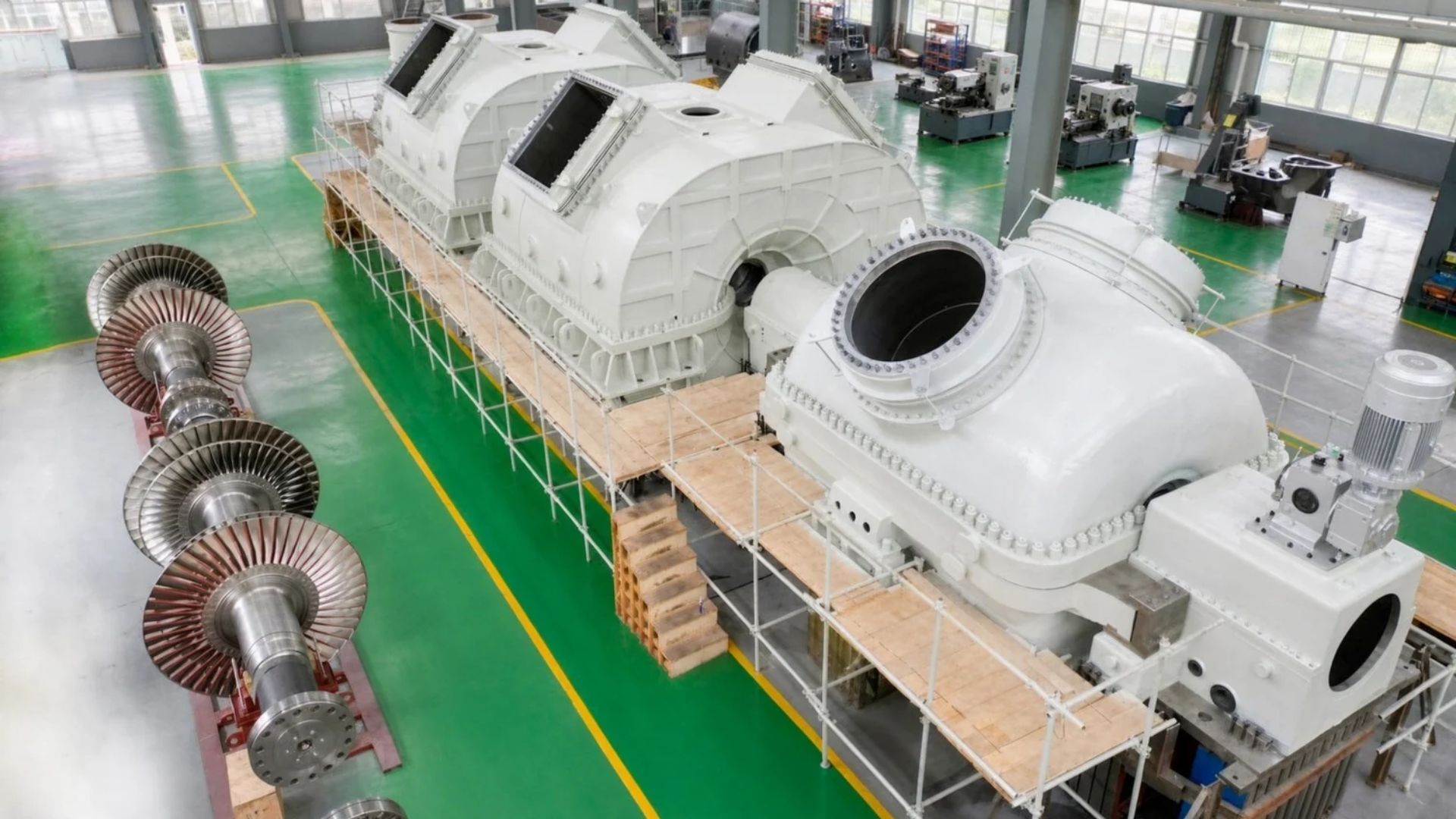
Storing enough wind and solar power to keep a major city running after sunset has long been one of clean energy’s toughest puzzles. China just took a massive step toward solving it. Engineers have completed the centerpiece unit for a 600-megawatt-class compressed-air energy storage system billed as a world first. It is essentially a giant, industrial-scale “air battery.” Reportedly, the development centers on an expander, the heart of the entire facility. This heavy-duty machine takes high-pressure air trapped underground or in massive tanks and releases it to spin turbines, turning stored pressure back into usable electricity when the grid needs it most. The Institute of Engineering Thermophysics under the Chinese Academy of Sciences teamed up with Zhongchu Guoneng (Beijing) Technology Co. to build it. According to the development team, the expander recently passed its final integration and mechanical tests before rolling off the production line. Giant air battery milestone Compressed-air energy storage (CAES) captures energy by pressurizing air and storing it for future electricity generation. Utilities use this technology to support power grids, smoothing out supply and demand fluctuations as energy needs shift throughout the day. Every single piece of the equipment was independently designed and manufactured in China. Real-world power grids are unpredictable, demanding machinery that can adapt on the fly to sudden surges or drops in electricity usage. This unit was built to handle changing speeds and wide swings in demand without losing performance. It fires up quickly, shuts down fast, requires minimal maintenance, and is built for a long service life. Early test results “met or exceeded every design target.” Size matters when it comes to grid storage, and scaling up brings major financial perks. Compared to older 300-megawatt systems, this new 600-megawatt class doubles the overall capacity. That leap in scale slashes unit power costs by 20 percent to 30 percent and even boosts overall system efficiency by 3 percent to 5 percent, according to a report from China Media Group. Clean energy growth for rising demands Compressed-air energy storage offers clear advantages over traditional grid technologies. Relying solely on steel, concrete, and underground geology, these plants reduce the need for mined minerals like lithium, cobalt, or nickel. Facilities also last 30 to 40 years without fire risks, outliving lithium batteries that typically degrade within 15 years. Renewable energy sources like wind and solar are clean, but remain fickle when the weather shifts. Massive storage facilities act as shock absorbers, banking excess electricity on breezy, sunny afternoons for use during calm nights. Deploying this new expander at scale could drive down costs across the entire sector, pushing global compressed-air storage technology into a new era. Lithium-ion batteries still dominate China’s cumulative new-type energy storage mix at roughly 96 percent. However, longer-duration alternatives are steadily gaining ground. Flow batteries account for 1.1 percent, while molten salt thermal storage represents 0.8 percent. Compressed-air energy storage holds a 0.9 percent share, which equates to roughly 1.3 to 1.5 GW of installed capacity by mid-2026. It is largely driven by 300-600 MW salt-cavern facilities across Shandong, Hubei, and Jiangsu. Get the latest in engineering, tech, space & science - delivered daily to your inbox.Mrigakshi is a science journalist who enjoys writing about space exploration, biology, and technological innovations. Her work has been featured in well-known publications including Nature India, Supercluster, The Weather Channel and Astronomy magazine. If you have pitches in mind, please do not hesitate to email her.
‘World’s first’: China completes core unit of 600 MW giant air battery system
Full Article
Original Source
Read the full article at Interestingengineering →KhanList aggregates and links to publicly available news content. We do not host full articles from third-party sources. Always verify important information with original sources.