
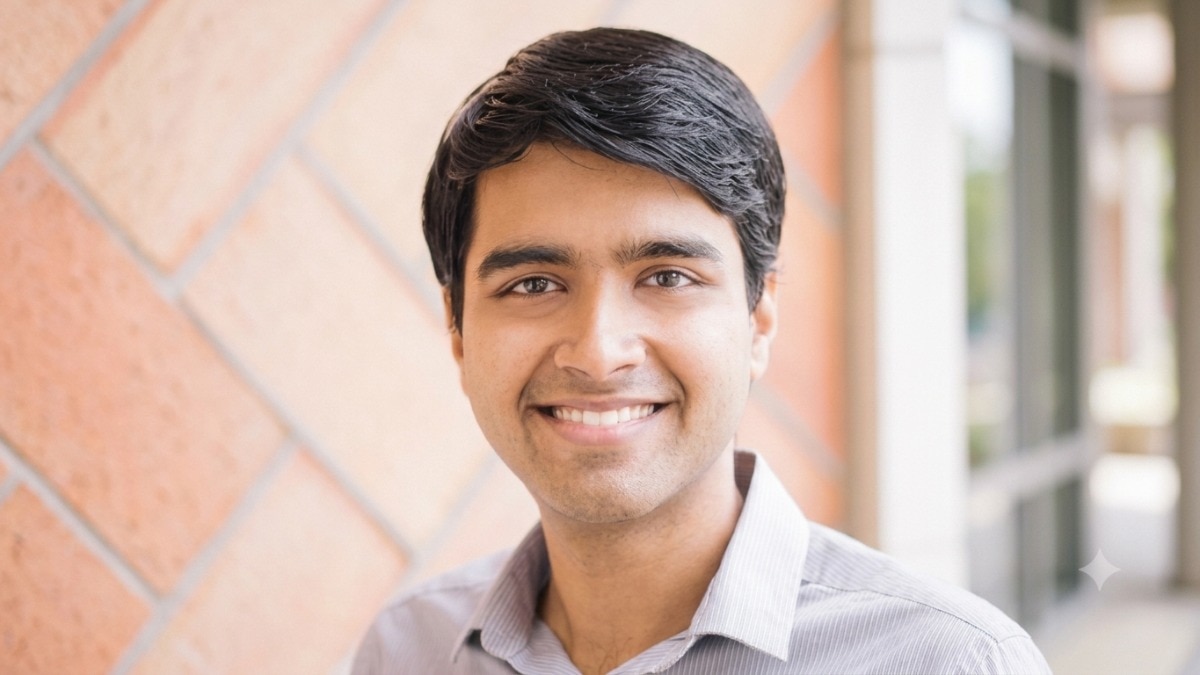
What if wireless signals could do more than connect your phone to the internet? What if they could detect what is happening around you, locate objects and even make robots move without batteries or electronic circuits onboard?That is the kind of technology Indian researcher Swarun Kumar is working on. An IIT Madras alumnus and professor at Carnegie Mellon University in the US, Kumar is pushing wireless communication beyond information delivery, exploring how radio waves can sense and interact with the physical world.His work has now earned him the Infosys Prize 2026 in Engineering and Computer Science.WHEN RADIO WAVES DO MORE THAN CARRY DATAMost people associate wireless technology with Wi-Fi, mobile networks and Bluetooth. Kumar's research explores a different possibility: using the behaviour of radio waves to understand the environment and perform physical tasks. One particularly striking project involves soft robots that can move without onboard electronics.His team uses radio-frequency energy directed at special heat-responsive materials. When these materials absorb the energy, they heat up and change shape, producing controlled physical movement. The robot does not need conventional electronic components to receive commands or power its movement. Instead, wireless energy does the work.His later research demonstrated frequency-selective actuation, allowing specific materials to respond to selected radio frequencies. The challenge is to direct energy accurately without relying on electronic feedback from the robot.TURNING WIRELESS SIGNALS INTO SENSORSKumar's research also explores how wireless networks can sense their surroundings.Radio signals change when they encounter people, objects and different materials. By studying these changes, wireless systems can potentially detect movement, estimate locations and monitor physical conditions without requiring cameras or wearable devices.His work spans applications such as contactless health monitoring, indoor positioning and infrastructure monitoring.He has also improved how low-power wireless devices communicate. In one project, his team used tiny frequency differences in inexpensive hardware oscillators, normally considered imperfections, to distinguish overlapping transmissions and improve network performance.In another award-winning study, researchers combined signals received at geographically distributed base stations to recover transmissions that would otherwise have been too weak to decode.FROM IIT MADRAS TO MIT AND CARNEGIE MELLONKumar completed his BTech in Computer Science and Engineering at IIT Madras in 2010, graduating with an institute rank of first and receiving the President of India Gold Medal.He moved to the Massachusetts Institute of Technology (MIT), where he pursued a PhD in Computer Science, completing it in 2015. His doctoral research focused on wireless networks and systems, under the guidance of Professor Dina Katabi.His doctoral thesis won the George M Sprowls Award for the best PhD thesis in Computer Science at MIT.In 2016, he joined Carnegie Mellon University as an assistant professor in Electrical and Computer Engineering. He became an associate professor in 2021 and was appointed the Sathaye Family Foundation Professor in July 2024.He also leads the university's Emerging Wireless Technologies Laboratory, with research spanning wireless networking, sensing and physical actuation.His other recognitions include the ACM SIGBED Early Career Researcher Award in 2021 and the ACM SIGMOBILE Rockstar Award in 2024.The Infosys Prize recognises his work in expanding what wireless networks can accomplish. For Kumar, the future of wireless technology is not just about sending information faster. It is about building systems that can sense, respond to and interact with the world around them.- Ends
IIT Madras alumnus uses Wi-Fi to make robots move, wins Infosys Prize
Full Article
Original Source
Read the full article at Indiatoday →KhanList aggregates and links to publicly available news content. We do not host full articles from third-party sources. Always verify important information with original sources.