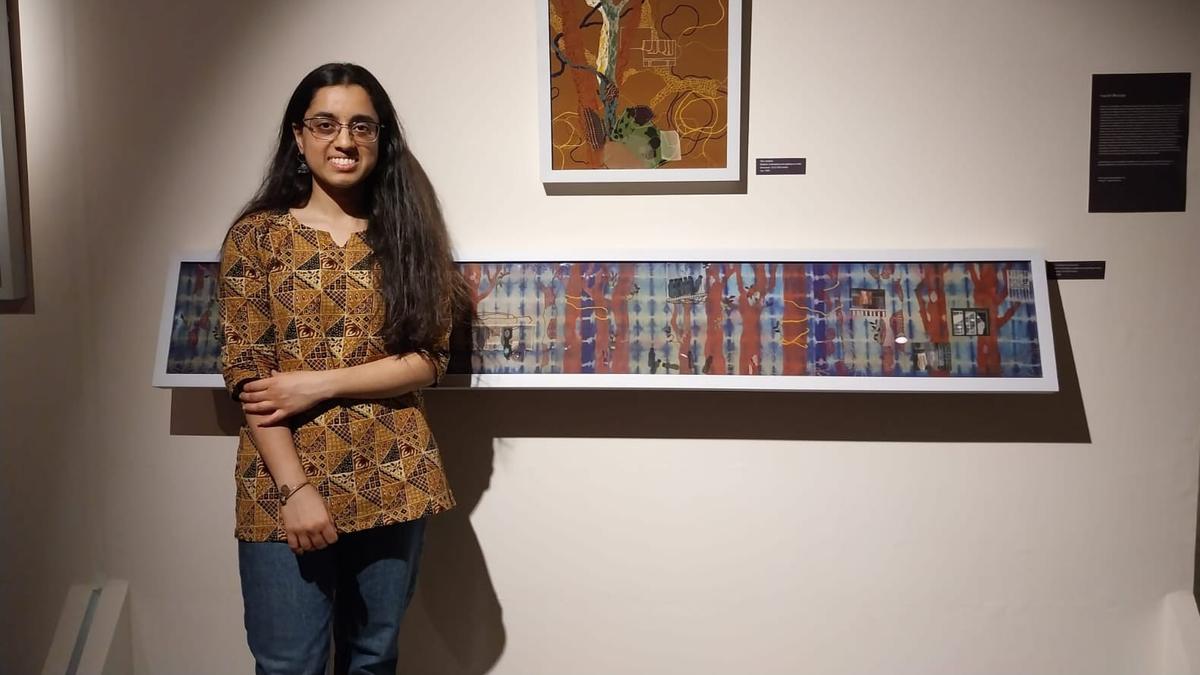
The art of embroidery often evokes images of colourful floral motifs and decorative patterns. Moving away from this traditional approach, a group of emerging women artists in Hyderabad are using thread to explore social and architectural themes.Masters of Fine Arts graduate Dulam Sahetya, from the Jawaharlal Nehru Architecture and Fine Arts University (JNAFAU) in Masab Tank, draws from her memories, emotional wounds and the landscape of Telangana. When she began experimenting with embroidery, a new medium for her, two years ago, translating deeply personal experiences onto a sanitary pad, her first canvas, came instinctively. Dulam Sahetya transforms thread into emotional narratives | Photo Credit: Special Arrangement Stitching her voice onto it felt like an “act of resistance and reclamation,” says the artist, who works with embroidery, fabric, beads, sanitary pads and handmade paper to explore femininity, menstruation, bodily trauma, healing and collective memory.In Baopeta village in Karimnagar district, where she grew up, menstruation was a deeply taboo subject. “It is often treated as a secret or something shameful,” she says. Silent cells - a mixed-media work by Sahetya combines embroidery and painting | Photo Credit: Special Arrangement Sahetya first exhibited her work at the Hyderabad Literary Festival in 2025, using repetitive threadwork to transform shame into visibility and vulnerability into strength. “Some questioned my choice of a sanitary pad as a canvas at first, but later understood the need to break the stigma and recognise menstruation as a natural, healthy process,” she adds. Over time, her practice has expanded beyond surface embroidery into relief and sculptural forms resembling organs, wounds, follicles and ritual artefacts.Ecological art Sayuri Bhanap is drawn towards embroidery | Photo Credit: Special Arrangement July is a special month for emerging artist Sayuri Bhanap, who is part of a group show A Place to Begin at Champa Art Gallery in New Delhi. The show is on till August 14. An MFA postgraduate from Hyderabad Central University (HCU), Sayuri uses textile art to foreground ecological concerns. Sayuri’s work on Futility of wars and patriarchy | Photo Credit: Special Arrangement Her recurring engagement with feminism has found a natural voice in embroidery, a medium she has grown deeply drawn to. “Stitching and embroidery were often considered ‘women’s work’, so I use this medium to speak about patriarchy and gender inequality,” says Sayuri, who has been using this medium for a year now. Working with old and discarded fabrics as her canvas, she is adept at four distinct styles — chain, back and kantha stitch, as well as sashiko, the Japanese stitching technique. As her practice has evolved, she has begun blending appliqué with embroidery to address geopolitical issues and conflicts, tracing patterns that date back to the World War era. “Embroidery is both relaxing and labour-intensive. Sitting with it for long hours requires patience. It’s admirable to see groups of women engaged in Kutch embroidery — it feels like a community coming together to sustain a tradition,” she adds.Farming stories Anukya Katuku likes to experiment with different mediums | Photo Credit: Special Arrangement Hailing from an agrarian community, Anukya Katuku’s earliest memories of embroidery involve stitching parrots and letters onto handkerchiefs. Today, it has evolved into a visual language through which she explores farming — foregrounding the role of women, alongside climate change and rural social realities. Currently, she is working for an eight-month project for Space118 Art Foundation in Mumbai.Growing up in Chinnaodela in Peddapalli, Karimnagar district, she watched her farmer parents nurture their land “like a child.” “My father often spoke about his connection with Nature — its challenges and simple joys,” recalls Anukya, who also works with rice paper, watercolour and textile weaving. Anukya stitching designs | Photo Credit: Special Arrangement Her process begins with sketching on mesh fabric using tailoring chalk, followed by stitching with thread or beads. The fabric’s transparency creates a dual surface, allowing interconnected compositions without overlap. Drawing from lived experience, she references how saris are used as makeshift fences to ward off pigs, using her mother’s sari as a motif to reflect how women labour both in the fields and at home.Experimentation anchors her practice, as she juxtaposes natural landscapes with contemporary agricultural methods to highlight the contrast between tradition and modern technology. Being the only one from her region to do the work, Anukya had showcased her works at ‘Pedagogy as Practice’ art exhibition presented by the New Wave Art Collective in March this year. The show was curated by Nirmala Biluka at the State Gallery of Art in Hyderabad.Sculptural stories Badabagni Srivani | Photo Credit: Special Arrangement Badabagni Srivani prefers to narrate sculptural stories through embroidery. The Bachelor of Fine Arts graduate from Jawaharlal Nehru Architecture and Fine Arts University (JNAFAU) uses French knot stitching on silk fabric to depict cultural and historical treasures. “I hail from Rayalaseema, once ruled by Krishnadevaraya of the Vijayanagara empire. It was a hub of wealth and architecture, but many sculptural works and temples from that period now languish without patronage. Through my work, I want to highlight their architectural brilliance,” says Sivani who has been working on this medium for two years now. Depicting historical and cultural treasures through French knots make her works a unique form of textile art which were displayed at Nehru Art Gallery located on the JNAFAU campus. Narrating a story through silk - by Srivani | Photo Credit: Special Arrangement Though considered beginner-friendly, French knot embroidery demands precision and repetition. “Stitching a single dot may seem simple, but creating depth requires doing it repeatedly. The prolonged focus can strain the eyes,” she adds. Srivani, who has created five works on cotton cora fabric, works exclusively with silk thread has sold a couple of her works to Dhi Contemporary, an initiative of Dhi Artspace in Hyderabad. She now hopes to use this technique on clothes and accessories and explore more contemporary themes while deepening her engagement with Nature.
World Embroidery Day 2026: How Hyderabad’s women artists rework embroidery
Full Article
Original Source
Read the full article at Thehindu →KhanList aggregates and links to publicly available news content. We do not host full articles from third-party sources. Always verify important information with original sources.