
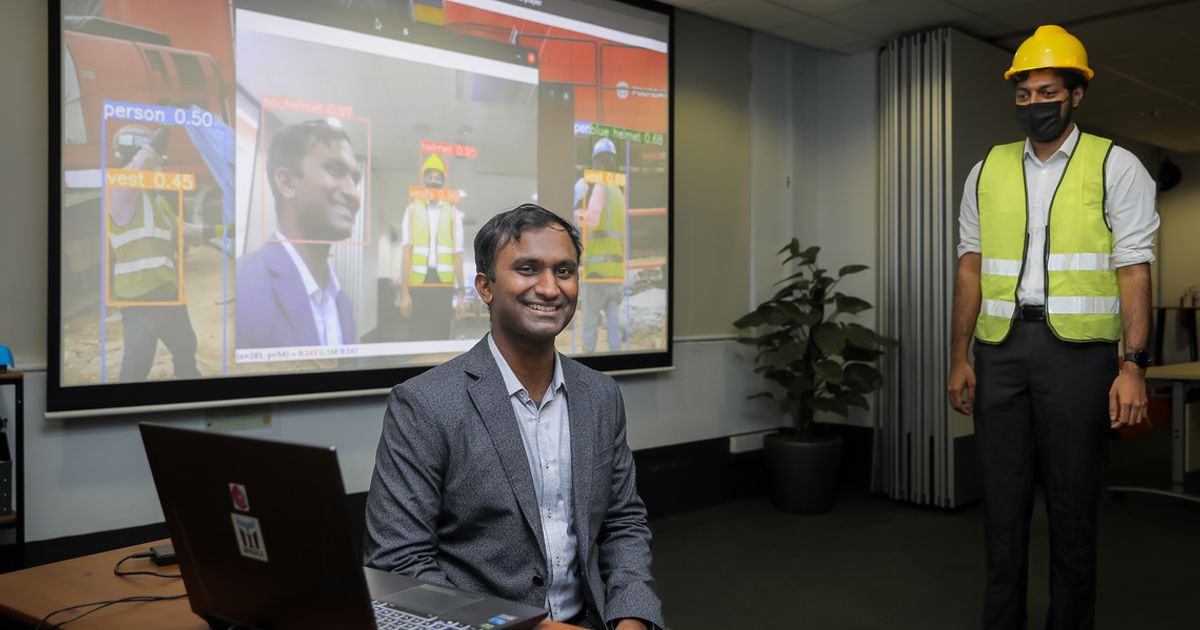
Right out of the National University of Singapore six years ago, Vishnu Saran wanted to build something that would improve the lives of the Indian and Bangladeshi workers he saw around him. Inspired by his own India-born father’s work in process quality and safety, the Singaporean material science engineer cofounded Invigilo, an Artificial Intelligence (AI)-based start-up, to prevent accidents in high-risk industries like oil and gas, mining and construction.Invigilo means “to watch over” in Latin. The platform uses cameras, drones and advanced video analytics, a form of AI, to monitor workplace safety in real time. The system detects unsafe practices and ‘bad habits’, helping human safety officers implement proactive interventions such as clearer signage, worker training, or additional protective measures.“Industrial accidents not only cost lives but also a lot of money. We provide surveillance and safety enforcement technology that can help the vulnerable workforce while providing value to the companies,” Saran, 30, told The Straits Times. Invigilo is now deployed at around 200 sites globally, with clients including Italian oilfield driller Saipem, Australian miners, oil and gas sites in Saudi Arabia, and Singaporean agencies HDB and LTA.On Nov 13, Invigilo won an award for its impactful use of AI to create sustainable livelihoods.It was among a dozen start-ups recognised for using AI for social good at the third edition of the AI Tech4Good Awards in Mumbai, India, sponsored by American tech corporation Salesforce and Indian business newspaper Mint. The summit recognises high-impact AI innovation across Asia, in sectors such as public health, education, financial inclusion, and agriculture. This year, nominations came from countries including Singapore, Malaysia, Sri Lanka, India and the Philippines.Salesforce’s Arundhati Bhattacharya, who heads its South Asia operations, said the next wave of AI breakthroughs may come not from Silicon Valley but from emerging Asian markets, as people like Saran solve real-world problems with AI.Amid global concerns over the accountability and safety of AI, Bhattacharya said that regulation and government oversight, especially of large players, is important to protect communities from harm, but without throttling innovation. However, she added that Asian innovation seemed to be taking a different route.“In the developed world, AI addresses labour shortages, often through automation and robotics. In emerging economies like India, Indonesia, Malaysia, which are far more populous… AI’s primary role is to provide essential services at scale to large populations, overcoming the limitations of traditional ‘brick-and-mortar’ infrastructure,” Bhattacharya told ST. Unlike generative AI developed in the US and China, AI-based innovations in other Asian countries are not—and don’t need to be—large or absolutely cutting-edge models, she added. “A saying in Bengali goes: you don’t need to power up a canon to kill a mosquito. Local issues can be solved with resource-constrained solutions,” she said. Prasanth Subendran, from the erstwhile conflict-afflicted Jaffna in Sri Lanka, for instance, built an AI-powered mind-mapping application that primarily helps students and academics. It converts dense documents, research papers, PDFs, videos, and notes into a visual format that mirrors how the brain works. MindMap AI, founded in 2024 by Subendran and two friends, already has 900,000 users worldwide. It won a Tech4Good award for its use of AI in education. Mind mapping is a non-linear, visual note-taking technique developed by English educational consultant Tony Buzan in the 1960s. Subendran said the AI application automates the process, saving users time.It also works in 29 languages, “which we could not imagine before the era of AI,” Subendran added. Bhattacharya emphasised that natural language processing was a new strength of AI technology, along with the ability to consider many more data points than ever before. This gave AI technologies greater capacity to tackle chronic socioeconomic challenges that earlier promising technologies could not, she said. Entrepreneur Atul Monga from Gurugram in north India noted that given India’s population of 1.4 billion, there was no lack of problems to solve.The former investment banker’s fintech company, Basic, digitises the home loan process in India, specifically targeting underserved mid-tier cities and semi-urban areas. Monga said six of the 10 loans his application helps provide are under 3 million rupees (S$41,600), serving low to middle-income home buyers. “We started in 2020 during COVID, when the problem of homelessness was on our TV screens. Thousands of migrant workers were walking away from cities,” said Monga, who began to research the reasons millions of Indians could not afford homes. The problem was not limited to those who were financially strapped; Monga found that even employed Indians who could afford to repay loans in monthly instalments were unable to get credit, as banks and financiers focused only on top-tier borrowers.“Home loans are the safest bet for lenders because they can seize the property if a borrower is unable to repay his loan,” said Monga. While there were many agencies offering credit worthiness of individuals, he decided to offer value assessment of real estate properties, which were the “real security for lenders”, encouraging them to lend to buyers they might otherwise neglect.Basic created a platform that sends 30,000 human agents countrywide to evaluate property on the ground, and they use the company’s AI bot to collect all documentation, location advantages, and market value. Basic has since helped distribute around 15 billion rupees in home loans in 50 locations, especially very small towns, helping thousands afford homes. Basic won the Best Use of AI for Financial Inclusion award at the All About AI Tech4Good 2026 summit.To anyone eager to jump on the AI bandwagon, Monga had a message, “You can create social good if you use AI to fix a real-life problem, not if you are searching for a social problem to justify the use of AI.”
Workplace safety to home loans: Asian start-ups rewarded for deploying AI for social good
Full Article
Original Source
Read the full article at Straitstimes →KhanList aggregates and links to publicly available news content. We do not host full articles from third-party sources. Always verify important information with original sources.