
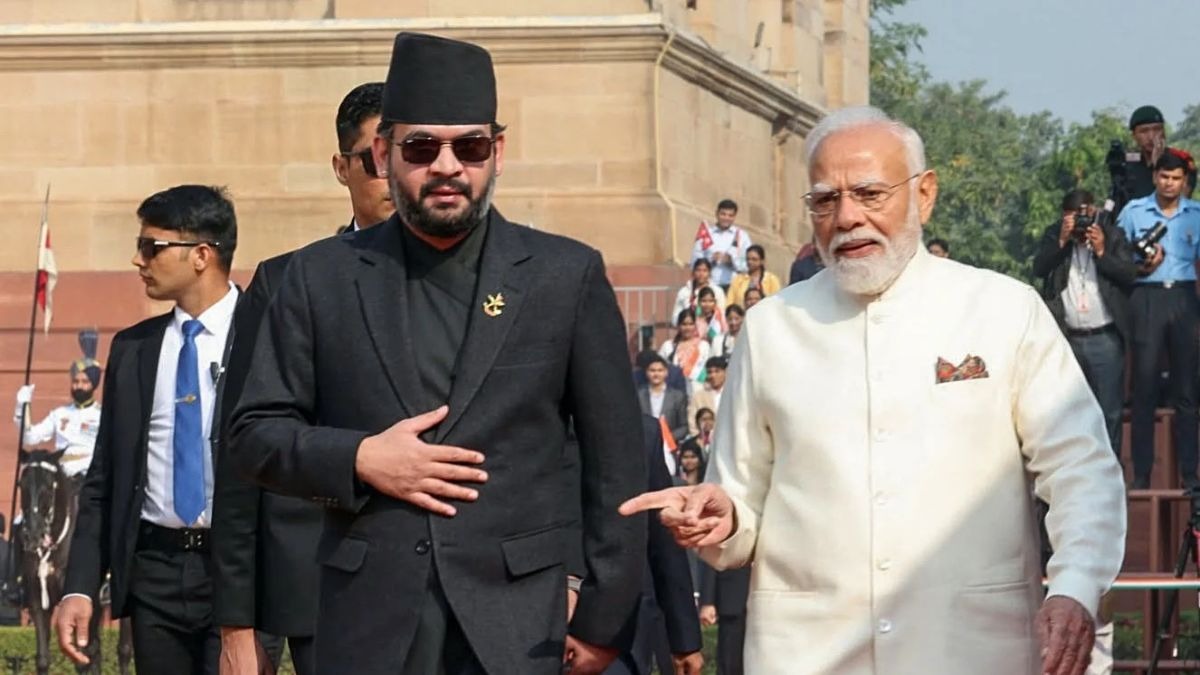
When Prime Minister Narendra Modi welcomed Balendra ‘Balen’ Shah in New Delhi on November 23, it was more than greeting a visiting head of government. Modi embraced Nepal's new prime minister warmly, setting the tone for a meeting that was as much about rebuilding political trust as advancing bilateral cooperation.In their joint media statement, Modi described India-Nepal relations as rooted not merely in neighbourhood but “a deep sense of kinship and enduring trust”.For Shah, who was seen by many as keeping New Delhi at arm's length in his first eight months in office, the reception would have been striking. The November 22-23 state visit was his first bilateral overseas trip since becoming prime minister in March. By the time he left, the two countries had announced a Rs 15,000 crore development cooperation package, signed eight MoUs and adopted a 10-pillar vision for future ties, titled ‘Viksit Bharat and Samunnat Nepal: Re-imagining the Partnership’. This marks substantial economic and strategic cooperation.Modi was laudatory of his guest. Recalling Shah's address to the UN General Assembly, he said he had caught a glimpse of the young prime minister's vision and foresight. Their discussions in New Delhi, Modi added, had reinforced his impression of Shah's clarity of thought and commitment to Nepal's future. Modi also acknowledged the historic electoral mandate Shah had received, describing it as an expression of the aspirations and hopes of Nepal's younger generation. It was a pointed recognition of a leader whose rise had challenged the political establishment governing Nepal for decades.Modi also tapped into the emotional vocabulary of the two countries’ shared civilisation. Recalling his May 2018 visit to Janakpur, he repeated his famous formulation: “Without Nepal, even our Lord Ram is incomplete.” In that context, the November 23 launch of the Sarayu-Kamala Express, connecting Ayodhya with Janakpur Dham, gave a new dimension to this religious and cultural bond.Modi spoke of strengthening connectivity between Buddhist sites such as Lumbini (Nepal) and Bodh Gaya (Bihar). The message was clear: India wanted the relationship to draw strength from shared history, faith and people-to-people ties rather than be defined solely by geography and strategic necessity. Shah, for his part, termed the relationship to be “as firm as the Himalayas and as vast as the ocean”.An India-Nepal diplomatic chill had begun soon after Shah took office. The 36-year-old rapper-turned-politician and former Kathmandu mayor had come to power on the back of the September 2025 Gen Z protests in Nepal that forced the resignation of K.P. Sharma Oli as prime minister. Shah’s Rastriya Swatantra Party swept the March 2026 elections, winning 182 of the 275 seats in Parliament.Shah assumed office promising a break from the old politics of patronage and corruption. He instructed ministers and officials to concentrate on domestic priorities and initially restricted foreign travel and meetings with visiting dignitaries, except heads of state and government. His office reportedly did not schedule even a meeting with visiting US special envoy Sergio Gor in April-May.In May, Indian foreign secretary Vikram Misri’s proposed visit to Kathmandu too did not materialise, apparently because Shah was not available. The signal seemed to be that Nepal’s new prime minister would not automatically follow the diplomatic habits of his country’s traditional political class.For India, the distance would have been uncomfortable. Nepal is a major trading and development partner, as well as a landlocked neighbour whose access to the sea depends heavily on Indian transit routes. The open border, energy links and extensive family and cultural connections make the relationship indispensable to both countries. Shah's seeming reluctance to engage with New Delhi had, therefore, threatened to become more than a matter of diplomatic protocol.The repair began quietly. In June, Rastriya Swatantra Party chairman Rabi Lamichhane and foreign minister Shishir Khanal visited New Delhi and met Indian leaders. In August, Indian ambassador to Nepal Naveen Srivastava and Indian Army chief General Dhiraj Seth held separate meetings with Shah, helping reopen channels that had fallen silent.The devastating Rasuwa-Bhotekoshi floods that month, which caused extensive loss of life and damaged infrastructure, added urgency to the need for bilateral cooperation. India was among the first countries to extend humanitarian and technical assistance to Nepal.The Rs 15,000 crore package announced now is the most substantial financial outcome of Shah’s visit that has also advanced border connectivity, transit access and cooperation in infrastructure. The two sides inaugurated a motorable bridge, linking Dharchula in India with Darchula in Nepal. The foundation stone for an Integrated Check Post at Banbasa was laid while work on facilities at Bhairahawa, Sunauli and Dodhara Chandani is progressing. Energy cooperation featured the 669 MW Lower Arun hydroelectric project, the dedication of Phase II of the Motihari-Amlekhgunj petroleum pipeline and the foundation stone for the Jhapa petroleum terminal, part of the proposed Siliguri-Jhapa pipeline.Both sides agreed to make the existing unidirectional B345 Kathmandu-Bhairahawa-Lucknow air route bidirectional. Technical consultations will be required to finalise the modalities even as other civil aviation proposals remain under discussion.The eight MoUs signed cover forensic sciences, police training, civil service capacity-building, Ayurveda, satellite communications, sustainable urban development, health, and livestock and fisheries. The two sides also envisaged an offshore IIT campus in Nepal and cooperation on start-ups, digital services and innovation. The 10-pillar vision seeks to move the relationship beyond conventional infrastructure and aid, bringing artificial intelligence, digital public infrastructure, climate resilience, disaster management, sports, agricultural research and technology into the partnership.A high-level monitoring group, led by Nepal's foreign secretary and India's ambassador, will meet at least once every six months to review implementation. It is an acknowledgement that India-Nepal cooperation has often suffered not from a shortage of announcements but from delays in delivering them.Yet the diplomatic bonhomie should not be mistaken for a strategic realignment. Shah's nationalist credentials are well established. As Kathmandu mayor, he had displayed a ‘Greater Nepal’ map in his office in 2023—seen as a symbolic response to the ‘Akhand Bharat’ mural in India's new Parliament.The China factor was visible even as Shah was being received warmly in New Delhi. A 20-member Rastriya Swatantra Party delegation, led by general secretary Bipin Kumar Acharya, had travelled to China on November 15 at the invitation of the Communist Party of China. Before its departure, Shah had advised the delegation to focus on areas where Nepal could benefit from Chinese cooperation, particularly technology, trade, tourism and agricultural modernisation. The parallel outreach underlines Kathmandu's determination to maintain room for manoeuvre rather than choose between its two powerful neighbours.China remains an important development partner for Nepal, with investments in airports, roads and other infrastructure. But India's geographical advantages are difficult to replicate. It is Nepal's largest trading partner and principal route to the sea; its market, energy infrastructure and cultural connections are integral to Nepal's economic and social life.For Shah, maintaining a functional relationship with New Delhi is, therefore, a practical necessity, irrespective of his nationalist politics. For India, keeping the new prime minister engaged is equally important. The challenge is to ensure that its historical and geographical advantages translate into a partnership that Nepal's younger generation regards as respectful, useful and mutually beneficial.The visit has, therefore, achieved something significant even if not a strategic breakthrough. It has replaced the visible distancing with political warmth, economic commitments and a framework for cooperation. Areas such as boundary dispute, water-sharing and Nepal's demands for greater air connectivity remain to be addressed.The real test will be whether the projects announced move faster than previous commitments and whether the two countries can address the irritants that have repeatedly strained their relationship. With the Modi-Shah meeting, India and Nepal have renewed the embrace, but whether it becomes a lasting partnership will depend on what happens after the cameras have moved on.Subscribe to India Today Magazine- Ends
How Modi-Balendra Shah bonding is a fresh diplomatic start for India, Nepal
Full Article
Original Source
Read the full article at Indiatoday →KhanList aggregates and links to publicly available news content. We do not host full articles from third-party sources. Always verify important information with original sources.