
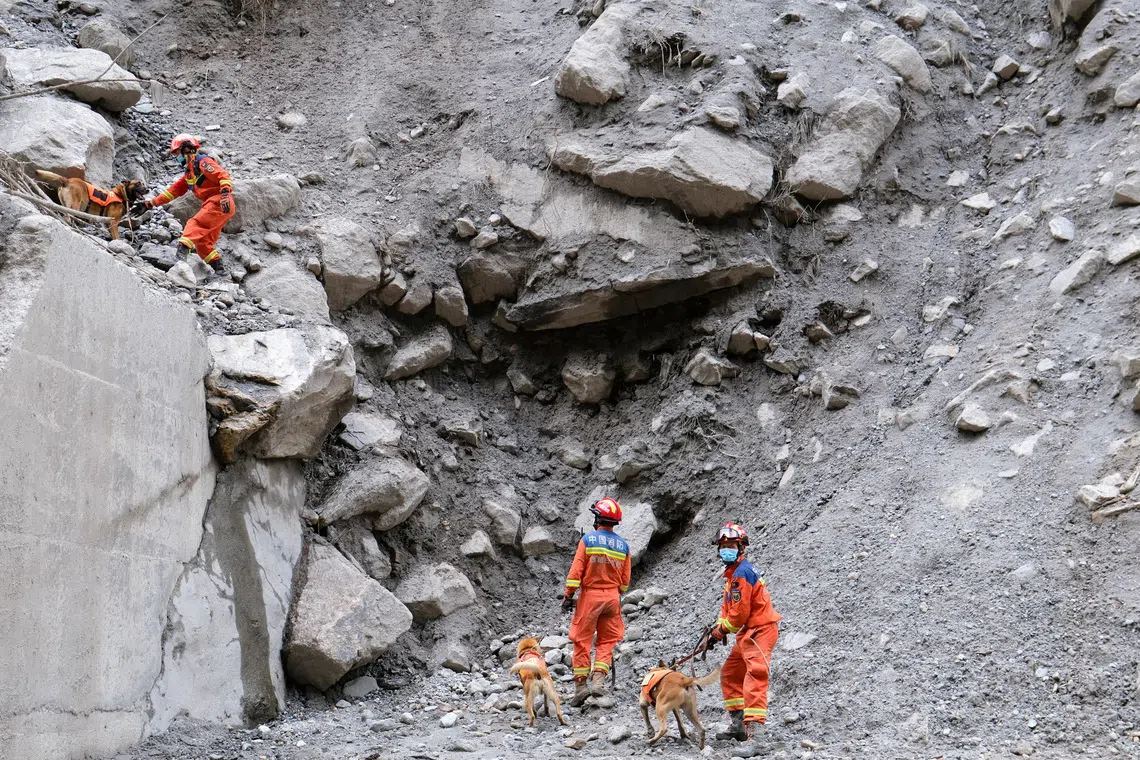
SINGAPORE – A week after a catastrophic mudslide wiped out Gyirong Port on China’s border with Nepal, search and rescue operations there have kicked into higher gear even as survival chances grow dimmer.Following round-the-clock work involving nearly 700 personnel and more than 300 pieces of machinery, road access to the hardest-hit area around the Gyirong border gate was restored in the late morning of Sept 2, clearing the way for emergency supplies and additional rescue workers to be sent in.State broadcaster CCTV reported that heavy equipment have now entered the core disaster zone in the Tibet Autonomous Region in south-western China, clearing large boulders and waist-deep mud as crews continue probing the ruins for any trace of life.For those already on the front line, like Phuntsok Drakpa, that search has meant calling out into deafening silence and looking out for any clue, no matter how small – be it a shoe or a piece of clothing.“There was nothing we could do except call out and look under the rocks,” the police officer said in an interview with China Daily.Mourners attending a memorial service for victims of a mudslide at the Gyirong Port police station in Gyirong County on Sept 1. PHOTO: AFPThe disaster was triggered by the collapse of a glacier on Aug 26 high up in the Himalayas in Nepal that sent a deluge of ice, mud and boulders down mountain valleys and river channels on the border with China, flattening villages, roads and power lines in its path.Chinese Academy of Sciences researchers have calculated that the surface velocity of the debris flow was 19m per second when it struck Gyirong Port.Disaster management experts told The Straits Times that the first 72 hours after the flood would have been considered the “golden window” for rescuers because the chances of finding survivors after that become much slimmer.But past disasters have shown that survivors have been found well beyond this period. For instance, following the 2023 earthquake in Turkey and Syria, rescuers were still pulling people out of the rubble alive close to the two-week mark.Highly complexAkhilesh Surjan, a humanitarian, emergency and disaster management expert at Australia’s Charles Darwin University, said that in a highly complex catastrophe such as the one that China and Nepal are facing now, the search for life should continue wherever there is credible evidence that people may have survived.“The absence of survivors in one location should not automatically be taken as evidence that there are no survivors elsewhere. These decisions carry significant humanitarian and diplomatic weight,” he told ST.As at Sept 2, the official death toll in China from the Aug 26 flood remains at 16 and there are still at least 546 missing, including 261 foreign nationals. These numbers have not been updated since Aug 30.On the Nepal side, at least 1,114 people have died, with nearly 4,000 missing.Chinese People's Armed Police officers on Aug 28 clearing debris near Gyirong Port following a mudslide. PHOTO: REUTERSAccording to media reports, the first Chinese rescuers were able to reach Gyirong Port only two days after the flood on Aug 28, trekking through mountainous terrain for more than 10 hours to get there.The search and rescue effort was temporarily halted in the initial stages amid fears of secondary floods after a barrier lake that formed in the aftermath began to overflow.Local authorities said on Sept 1 that the lake is now fully drained and under control, though a hazard assessment has flagged eight “high-risk geological disaster points” nearby.Since reaching the disaster site, Chinese rescuers have searched a 0.7 sq km area around the Gyirong border gate, said Norbu Tsering, acting mayor of Shigatse city, which has jurisdiction over the district. The search area is the equivalent of 98 football fields.Search operations are now advancing from two directions, the acting mayor told state media, with firefighters moving from the outer edge of the debris field towards Gyirong Port, while search teams in the core area search outward. In all, China has mobilised more than 2,000 personnel to assist in the relief efforts.Winston Chang, former global head of the United Nations’ International Search and Rescue Advisory Group, noted that while China has strong search and rescue capabilities, mudslides can sweep structures several kilometres downstream, leaving search teams uncertain of what lies beneath the deep mud.He said the unstable terrain also poses a “logistical nightmare”.“You will need safety ropes, anchoring points and so on. Safety is a major consideration,” he told ST.Surjan of Charles Darwin University made a similar point, noting that the ongoing rainfall, unstable slopes, poor visibility and the chance of secondary landslides all create significant risks for rescue personnel.While satellite imaging and drones have bolstered Chinese search efforts, he cautioned that such high-tech tools have limits.“Optical and thermal sensors cannot penetrate metres of wet, compacted earth or mud. Drones cannot move heavy debris,” he said. “Therefore, technology should be viewed as a force multiplier, not a substitute.”Grief and solidarityAs the physical race against time continues on the ground in Gyirong, millions in China are paying close watch.While Chinese censors have expectedly put a tight leash on what is being shared online, the Aug 26 flood triggered a wave of grief and solidarity, with hashtags related to the mudslide dominating trending charts on microblogging site Weibo and other social platforms.Many early trending hashtags referenced the scale of the destruction, with posts often accompanied by before-and-after photos, or comparisons with a previous flood in 2025 that left 11 people missing on the Chinese side but with the border gate still standing.Family members also posted photos of loved ones who were thought to be missing.Special attention was paid to the public officers working at Gyirong Port at the time. Footage of a border police officer guiding civilians to safety moments before the disaster went viral.Netizens also left thousands of comments on the official Weibo account of the Gyirong Entry-Exit Border Inspection Station, offering condolences and well wishes.The widespread sorrow culminated in formal memorial services being held on Sept 1 in Tibet for the mudslide victims. Images published by CCTV showed soldiers, doctors and rescue workers with their heads bowed as they observed a moment of silence.Accompanying the public mourning has been an influx of private and corporate aid, with Chinese tech and business giants such as ByteDance, Alibaba, BYD, Xiaomi, Anta, and Chagee pledging donations alongside celebrities such as singer Na Ying and actor Jackson Yee.Most recently on Sept 1, Hong Kong tycoon Li Ka-shing and his business empire – along with Henderson Land Development and the Lee Shau Kee Foundation – each pledged 15 million yuan (S$2.8 million) to support the relief efforts.For Chang, the former UN search chief, the key for rescuers now is to provide proper closure for affected communities, noting that families with loved ones who are missing will continue to hold out hope without official confirmation.“I think the one thing that’s keeping the momentum up for all humanitarians – and that includes responders, the military, and so on – is to keep that hope alive, even that 1 per cent,” Chang said.“Rescues will be few and far between, but if you go in without hope, it is game over.”
‘Without hope, it is game over’: Chinese rescuers cling to narrow survival odds a week after Tibet flood
Full Article
Original Source
Read the full article at Straitstimes →KhanList aggregates and links to publicly available news content. We do not host full articles from third-party sources. Always verify important information with original sources.