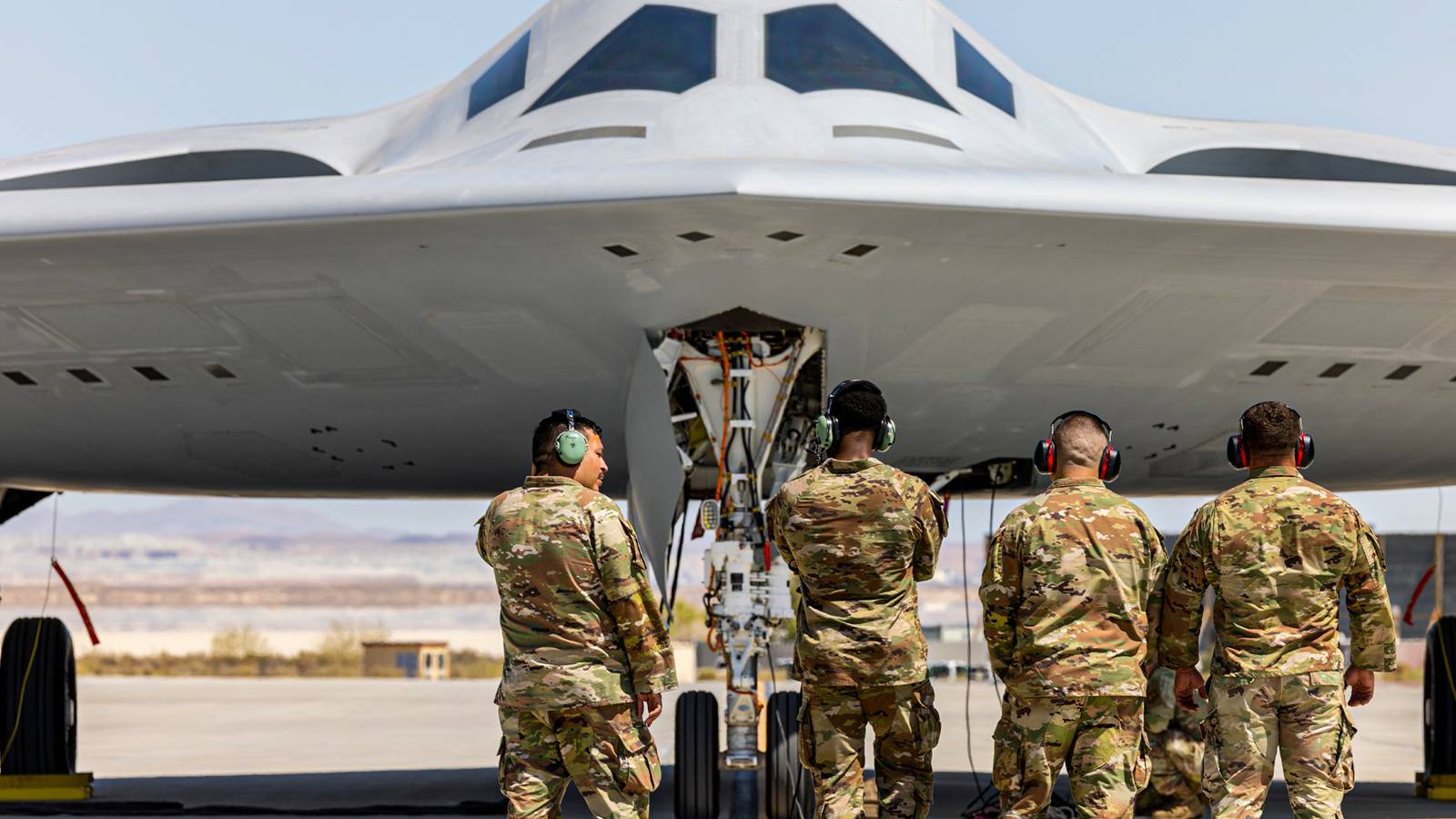
Published May 14, 2026, 1:00 PM EDT Aaron has a burning passion for flying and traveling around the world. He has flown around the world numerous times while making a point of visiting aviation museums around the world. He hails from New Zealand and is well-versed in aviation and other fields. The 1950s era Boeing B-52 comes with a crew of five (pilot, copilot, weapon systems officer, navigator, electronic warfare officer), and the 1970s/80s era B-1 has a crew of four (aircraft commander, pilot, offensive systems officer, and defensive systems officer. The 1990s B-2 Spirit further reduced this to just two (pilot and mission commander). But how many crew will the incoming Northrop Grumman B-21 Raider have? The short answer is two, but really, this appears to be a trick question with the answer being zero, one, or two pilots. The United States Air Force is already test-flying the B-21, and the aircraft is expected to enter service in 2027. The bomber will replace the worn-out fleet of B-1B Lancers and then replace the small fleet of B-2 Spirits. The Air Force initially planned to purchase around 100 examples, but has since discussed purchasing 150 or even 200 of them. A Cockpit For Two With Nuances Credit: US Air Force Much earlier in the Northrop Grumman B-21 Raider development program, The War Zone reported in 2017 that the Air Force confirmed that the B-21 would be optionally crewed. This is a common reporting point for next-generation combat aircraft. For example, the 6th-generation GCAP/Tempest fighter jet in development by the UK, Japan, and Italy is reportedly also planned to be optionally crewed. With that being said, it is known that the B-21 has been designed with a cockpit with two seats. The question is whether those seats are expected to be occupied and what the roles of the officers in those seats will be. The War Zone reviewed document DODIG-2015-170, Audit of the Acquisition of the Long Range Strike Bomber, and said that "the document clearly states that the LRS-B will indeed be optionally crewed as a core requirement." Fast-forward to November 2025, and the Air Force had already received its second flying test, the B-21 Raider. In that month, The War Zone reported that the US Air Force Global Strike Command was recommending that the default crew for the B-21 be just one pilot. However, that doesn't mean it is envisioned to have a crew of one. Instead, the other seat in the cockpit would be a weapons systems officer. A High Level Of Automation Credit: Northrop Grumman This suggests that while both the B-21 and B-2 may have crews of two, the roles of those crews may be different. The B-2 has two pilots (including the copilot), while the B-21 may have a pilot and a wizzo. Wizzos are found on fighter jets like the EA-18G Growler and the F-15 Eagle family. Having only a single pilot suggests the B-21 is achieving a high level of automation and AI-infused autonomy. Such an aircraft, only having a single pilot, would have previously raised security concerns, something it appears to be overcoming. It appears the B-21 is being designed with an AI agent as a 'virtual co-pilot' or something similar. The Air Force has previously spoken about the aircraft being a revolutionary development and upgrade over the existing B-2, despite superficial external similarities. As the aircraft is heavily classified, the Air Force has been unable to disclose exactly what these technological developments are. Having a single pilot could be a peek into its capabilities. A memo by former AFGSC Commander Thomas Bussiere says that "unleashing the Raider’s full potential demands a complex blend of skills: airmanship, weaponeering, electromagnetic spectrum operations, sensor management, real-time battle management and agile replanning in combat. For this reason, the B-21 will be crewed by one pilot and one weapon systems officer." It should be noted that this report was based on pre-decisional statements by the Air Force: the final decision had not yet been made at the time. Related 1st Overhead Shot: US Air Force Unveils Striking New Perspective Of B-21 Raider The B-21 Raider is designed to be more efficient, stealthy, and flexible than its predecessor, the B-2 Spirit. The Prospect Of Fully Autonomous Flight Credit: US Air Force Given that the Air Force appears confident that it can routinely fly the B-21 on combat sorties with a single pilot with early production aircraft, this raises a prospect. It opens the door for future block upgrades to fly fully autonomously without a pilot. The War Zone notes that Raider is already understood to be designed to at least "provide the option of a pilot-optional mode of operation in the future." Like the B-2, the B-21 can be expected to conduct ultra-long combat sorties that are beyond the acceptable endurance of a single pilot. The longest B-2 sorties clock in at 44 hours, although missions over 20 or 30 hours are common. With two pilots, one pilot can rest and take naps to remain vigilant on these long missions. A pilot-optional mode should allow the pilot to rest and sleep during ferry sections of the mission. Northrop Grumman B-21 Raider (per Northrop Grumman) Role Strategic bomber (multirole) Status In testing In service date 2027 (planned) Crew Two (planned pilot & WSO) Payload Unclassified 30,000 lbs (conventional & nuclear) B-2s and B-21s are incredibly high-end and high-profile assets, and it is unacceptable to lose them in combat. Like all aircraft, they are most vulnerable on the ground, especially at forward-deployed bases. During the 2026 air campaign over Iran, the USAF lost a number of assets in the country, including a valuable E-3 Sentry. In an effort to protect them, these bombers are often flown directly nonstop from their home bases in the continental United States with aerial tankers providing a continuous air bridge. Blending Roles Of Combat Aircraft Credit: US Air Force Fighter generations are mostly a marketing strategy, but the real world is much more complicated. For example, a fighter jet may have a stealthy Radar Cross Section but comparatively poor avionics and sensor fusion, like the Su-57, while an aircraft may have a large Radar Cross Section but more advanced avionics and other onboard systems, like the F-15EX. Having noted that, it is of interest that Northrop Grumman calls the B-21 the world's first sixth-generation combat aircraft, a label reserved for fighter jets, not bombers. This could be an indication that next-generation bombers are no longer traditional bombers and fighters are no longer traditional fighters. Fighters and bombers may become multirole to the point that they are starting to overlap in missions and capabilities. It has been touted that the B-21 will eventually be a flying, bombing command center controlling off-board platforms like loyal wingman drones. This is something the F-47 is being designed to do, but the B-21 is not expected to fly with loyal wingman drones initially. Sandboxx News even floated the idea that the B-21 could serve an air superiority role in 2024. They said that "this role, once reserved for only the most aerobatically maneuverable and powerful tactical aircraft, could soon be absorbed by larger and undoubtedly more sluggish platforms that rely on superior stealth, long-range sensors, and advanced new weapons to dominate the skies. Platforms like the B-21 Raider." Crewed Operations Without A Pilot? Credit: US Air Force While the B-21 is designated a bomber and Trump has even termed them "updated B-2s", in reality, they are far more than just bombers in the traditional sense. They are set to rely on an extensive suite of battle management, networking, electronic warfare, Intelligence, Surveillance, and Reconnaissance capabilities, a command center, and more. The older B-52s and B-1s have weapons systems officers, although they are much larger aircraft with little automation. Herein lies an issue: the B-21 has only two seats, ostensibly for pilots. As such, who is going to manage the many mission sets the Raider is expected to carry out? It appears an interim answer is to hand the job of the co-pilot to the computer and replace the seat with a weapons systems officer. In the longer term, as the B-21 matures and takes on more mission sets, the Air Force may look to convert the remaining pilot as well. It is also worth pointing out that the weapons systems officer may still be something of an emergency back-up pilot. For example, in the event that the pilot is incapacitated and the aircraft is malfunctioning, he may be trained enough to fly and land the aircraft. In these scenarios, it is possible that future B-21s could eventually fly with a crew of two, but no dedicated pilot, although the crew would be able to fly in specific scenarios. Related From 19 B-2 Spirits To 145 B-21 Raiders: How Much Bigger America's Stealth Bomber Fleet Is About To Get A $4.5 billion production deal signal the Air Force's commitment to building its next-generation bomber Shield AI's Hivemind Credit: US Air Force Pilots are not obsolete, but the future is dynamic and mixed. Currently, the Air Force appears intent on developing next-generation combat aircraft to be crewed, but also to have the option to be uncrewed for certain missions. It is also looking to Collaborative Combat Aircraft (aka loyal wingman drones) to provide mass and team with crewed fighters like the F-35, F-22, and F-47. However, there are those in the industry who think pilots can be replaced on fighter jets altogether. As the Air Force is focused on MUM-T (crewed-uncrewed teaming), Shield AI has unveiled a concept called the X-BAT, for what it describes as the world's first AI-piloted VTOL fighter jet, and not just another autonomous high-end combat drone. Shield AI says that "X-BAT completely reimagines airpower, from training and logistics to operations and operating costs. This marks the greatest transformation in military aviation since the first airplanes launched and landed from ships 115 years ago." It adds that "Hivemind unlocks AI-powered mission autonomy for X-BAT, (...) [with] no GNSS, no comms, [and] no human input required." Hivemind is already integrated into a range of Air Force platforms, although it's unclear if it's being incorporated into the B-21.
Will The World's Most Advanced Stealth Bomber Have A Co-Pilot?
Full Article
Original Source
Read the full article at Simpleflying →KhanList aggregates and links to publicly available news content. We do not host full articles from third-party sources. Always verify important information with original sources.