
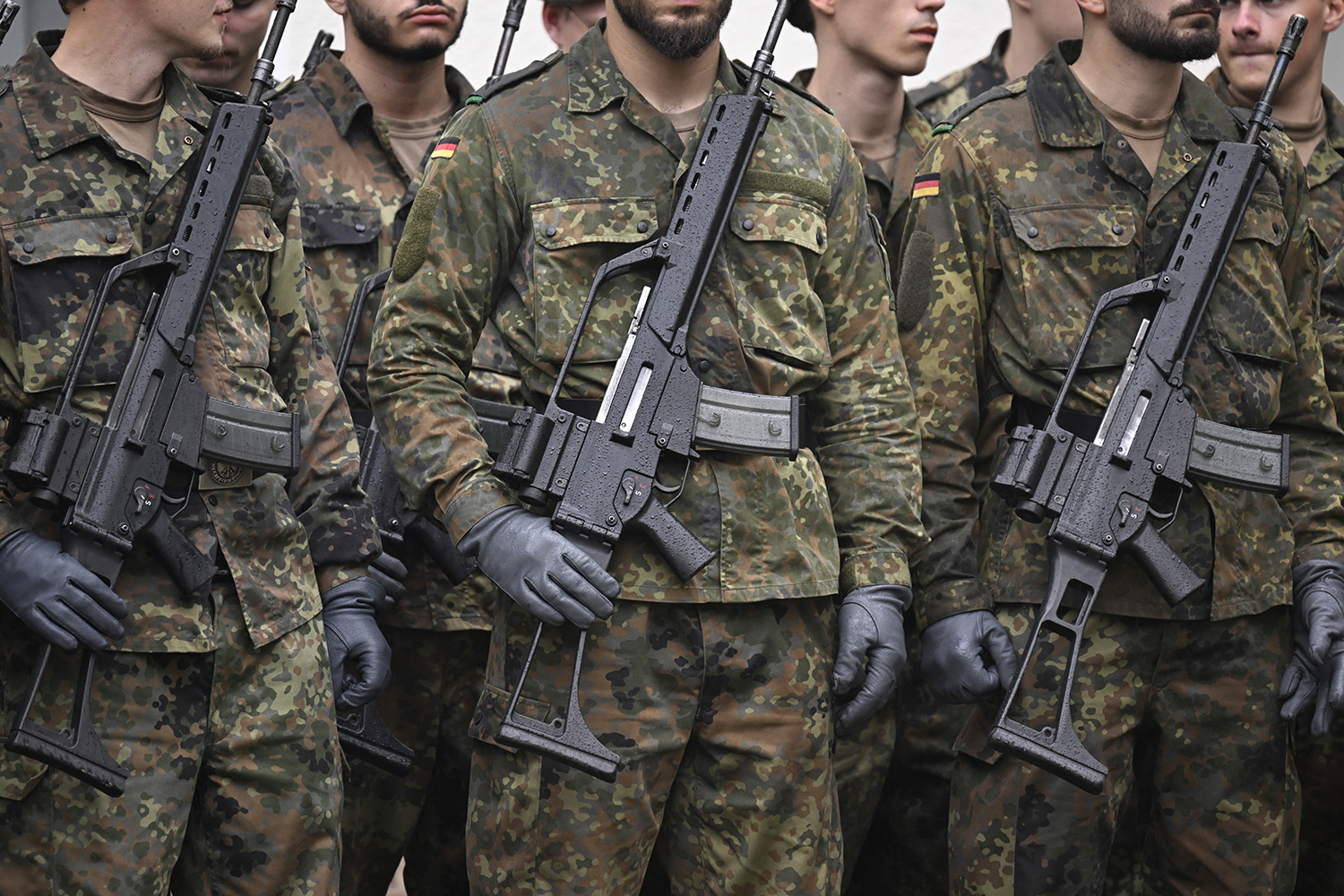
During NATO’s formative years, the U.S. military commitment to the old continent was a tenuous thing. Dwight Eisenhower, appointed the first supreme allied commander of Europe in 1950, argued—amid a vicious debate in Washington over committing additional divisions to Europe—that American forces should only act as a bridge until Europe stepped up to defend itself. If the United States still had troops in Europe 10 years hence, he said in 1951, then the trans-Atlantic project would be a failure. Germany Rearmed: The Return of War and the End of Illusions, Liana Fix, Oxford University Press, 216 pp., .99, November 2026 Germany Rearmed: The Return of War and the End of Illusions, Liana Fix, Oxford University Press, 216 pp., $34.99, November 2026 Ike’s forecast, it seems, was wrong on both counts. Seventy-five years on, roughly 80,000 U.S. troops remain on the continent. Yet few would regard the alliance as a failure. The U.S. military commitment succeeded in guaranteeing Europe’s freedom and keeping the Soviets at bay. But Europe never fully shouldered the burden of its own defense. Old assumptions, however, are finally changing. Squeezed by both a volatile Washington and voracious Moscow, Europe has finally awoken to its security dilemma: Its defense spending has nearly doubled in six years in real terms, from 242 billion euros in 2020 to 454 billion euros in 2026. If by 2035 Europe fully meets its NATO military expenditure target—spending 3.5 percent of GDP on defense (compared to the little more than 2 percent that it spends today)—then the surge in annual spending will rival the scale of the Marshall Plan relative to Europe’s GDP. As Council on Foreign Relations scholar Liana Fix argues in her incisive new book, Germany Rearmed, the central protagonist in this story is Berlin. Germany has doubled defense spending since 2021 and accounts for more than a quarter of the European Union’s increase over that period. Based on its current budget, by 2029, Germany will spend more on its military than France and the U.K. today spend combined. But is a rearmed Germany, in fact, a good thing for Europe and the world? Fix makes a compelling case that Berlin shedding its “myth of pacifism” is in the best interest of both Europe and the United States. But risks abound. A militarily empowered Germany has centrifugal potential, threatening friction with prickly France and anxious neighbors in Central and Eastern Europe if the rearmament is not executed within a broader European framework. And if the far-right Alternative for Germany (AfD) party eventually takes the reins of what will be one of the world’s most powerful militaries, it would reawaken historical nightmares. Germany Rearmed gives proper airing to the consequences and challenges of German rearmament, often left unanalyzed amid general backslapping about surging European defense spending. The U.S. commitment to Europe is ultimately unsustainable at current levels as Washington focuses on growing threats in the Pacific—and given its isolationist spasms at home. And Europe, with Germany as its backbone, has the overwhelming means to check a revanchist Russia—Germany’s economy is roughly two times the size of Russia’s, and the EU’s is nearly 10 times its size. But policymakers in Europe and Berlin should take heed of Fix’s advice. She argues that Germany needs to do a better job of Europeanizing its rearmament—in force structure, spending on a Europe-wide military industrial base, and joint funding—or it risks undermining European cohesion as the United States draws down. In a black-and-white photograph, delegates in suits sit at long, draped tables in a large conference room beneath vertical national flags and a NATO banner as one man stands to speak. West Germany participates for the first time as NATO’s 15th member in Paris, France, on May 9, 1955. AFP via Getty Images Germany’s recent rearmament push, at first blush, may appear as a sudden break from the past. In popular perception, the allied occupation after World War II underwrote an enduring German aversion to military power, just as in Japan—whose own story of U.S. occupation and political transformation is beautifully told in John W. Dower’s Pulitzer-winning Embracing Defeat. The Western security architecture during the Cold War then reinforced German passivity: Lord Hastings Ismay, NATO’s first secretary-general, allegedly described NATO’s purpose as to “keep the Russians out, the Americans in, and the Germans down.” This “myth of pacifism,” according to Fix, has permeated German history ever since: from Chancellor Willy Brandt’s Ostpolitik of the 1970s to the Wandel durch Handel (“change through trade”) approach to Russia and China adopted under both Chancellors Gerhard Schröder and Angela Merkel. At seemingly every opportunity, Germany prioritized diplomacy and economic engagement over military power, believing the former to be more attuned to the future. This belief hardened after 1989, when Germans concluded (correctly) that the Soviet collapse owed more to Mikhail Gorbachev’s reforms than to U.S. President Ronald Reagan’s military flexing. Crucially, as Fix observes, the German body politic has no grand military tradition to lean on, unlike its European neighbors. The United Kingdom can look back nostalgically to its days of ruling the waves. France’s defiant Gaullist military tradition is having its moment in the sun in the wake of Julian Jackson’s masterful book De Gaulle, adapted into a recently released blockbuster biopic. Germany, for obvious reasons, can’t draw from its 20th-century military history; even Prussian militarism is viewed skeptically with the hindsight of what followed. But Fix provides nuance to this myth of pacifism, arguing that Germany was in fact no stranger to hard power after WWII. West German defense spending surpassed 3 percent of GDP through the mid-1970s, and even after the Cold War, the Bundeswehr fought in out-of-area operations in both the Balkans and Afghanistan, where it lost 55 soldiers—a fact little remembered in Germany today. Quibbles aside, Germany has undeniably entered a new relationship with its military. In addition to the doubling of defense spending over the past five years, polling from fall 2024 showed that 73 percent of Germans wanted to invest more money in European security and 65 percent supported a spending target of 3 percent of GDP or higher. Merz and Trump in dark suits, Merz on the left wearing glasses and a blue tie and Trump wearing a red tie, stand facing each other with open mouths and pointing their fingers while speaking. German Chancellor Friedrich Merz and U.S. President Donald Trump speak at the G-7 summit, in Evian, France, on June 16.Christian Hartmann / POOL / AFP via Getty Images While many commentators would gladly attribute this wake-up call to Russian President Vladimir Putin’s brutal invasion of Ukraine, Fix inconveniently but convincingly credits U.S. President Donald Trump’s return to the White House as the real catalyst. After Russia’s 2022 invasion of Ukraine, German Chancellor Olaf Scholz claimed grandiloquently in his “Zeitenwende” speech that “the world … will no longer be the same as before.” But while his 100 billion euro special defense fund was a good first step, disbursement was slow, and it wasn’t followed by other bold moves. Only in 2025, with Chancellor Friedrich Merz facing a hostile Washington, did Germany finally turn a corner. Between 2025 and 2029, Germany plans to spend a total of 649 billion euros and reach annual spending of 3.5 percent of GDP—up from just 1.15 percent in 2015, the year after Russia’s annexation of Crimea. Referring to Russia’s second invasion of Ukraine in 2022 and the United States’ reelection of Trump in 2024, Fix memorably writes that “history had to repeat itself twice for Germany to abandon the ‘myth of pacifism’ and to seriously begin rearmament.” It’s a remarkable feature of our turbulent era that the breakneck rearmament of Germany is considered, in the main, a beneficent thing. Economists surveying the many challenges of slowing European growth and flagging competitiveness point to continental rearmament as a sole bright spot: a fiscal stimulus surpassing COVID-era spending that may boost sagging European productivity growth by 0.25 percent per every 1 percent of GDP spent on defense, if focused on research and development as well as equipment rather than military pensions and personnel, according to estimates from the Kiel Institute. And Germany is undoubtedly the most consequential player in the story of Europe’s broader rearmament. With French bond markets quaking, Germany is one of the only countries with the fiscal headroom to spend, with a debt-to-GDP ratio of 64 percent. Germany’s contribution to increased spending will also invariably be Europe’s largest, given that its economy is a third larger than that of the U.K. and 50 percent larger than France. And its industrial prowess positions it well to play the role of Europe’s arsenal. But what kind of military power will Germany be? Here Fix rightly throws up notes of caution. Thus far, Germany’s rearmament has largely been a national one, with spending at the German rather than EU level and funding largely going to German defense players. This trajectory risks fragmenting Europe’s military production, while also enhancing Germany’s own preeminent power within the continent—inviting suspicion and potentially exacerbating European divisions. It’s hard to envision outright conflict between Germany and its neighbors, but a more assertive Germany backed by hard power may more forcefully push its own foreign agenda over, say, Poland or France. The U.S. security blanket helped keep a lid on these rivalries since World War II; if Washington retreats from the continent, competing national priorities may sharpen with the steel of military spending. Fix’s solution, which is a compelling one, is for Germany to rearm inside either a more European NATO or a broader European security architecture: spending at European level where possible on shared platforms, inside a more integrated European command, and across a continent-wide military industrial base. Such “Europeanized” spending would allay concerns about the contortions in power caused by German rearmament. It would also reassure allies wary of an AfD ascension in Berlin: tied into a NATO or European architecture, a remilitarized Germany would have a harder time pursuing an overtly nationalistic military agenda. The question of Washington’s future role on the continent still presents a broad conundrum. Fix wrote Germany Rearmed in 2025 and early 2026, and the rawness of the Trump administration’s provocations on trade and Greenland shines through. She argues that Washington is “never going back” and that the future trans-Atlantic relationship under either Democrats or Republicans will resemble “a patron-client relationship more than an alliance, with no preferred treatment for Europeans.” This likely over-indexes on the wrecking ball of the Trump administration’s first two years. After the Republicans’ drubbing in the midterms, and considering that Trump’s favoritism toward Putin’s Russia and Xi Jinping’s China is idiosyncratic even within his party, the possibilities of U.S.-European reconciliation are higher than she lets on. Brussels and Washington will still have overwhelming shared interests come a new U.S. administration in 2029, especially as Europe finally awakens to the threat of surging Chinese exports and barrels into a trade conflict with Beijing over the coming years. More likely is a United States that is less bullying and extractive, whether a Republican or Democratic administration, and remains committed to NATO and Article V—even if it pushes for Europe to shoulder more of its defense burden while gradually winding down its troop commitment. Eight soldiers in camouflage uniforms and helmets covered with leaves walk while carrying rifles down the slope of a hill in a scattered formation across a dry field of yellowed tall grass under a clear sky. New reservists of the Bundeswehr train at Camp Aulenbach near Baumholder, Germany, on Sept. 15. Andreas Rentz/Getty Images This matters because it should inform how Europe rearms. Replacing core U.S. enablers, such as space-based intelligence and integrated air and missile defense systems, would be a costly endeavor that would eat up a tremendous amount of European capacity and take up to a decade. The International Institute for Strategic Studies puts the cost of fully replacing US capabilities at more than $1 trillion. A more prudent wager is that a future United States will maintain its nuclear umbrella over Europe and the backbone of critical NATO capabilities while Europe builds capacity in complementary areas such as ground forces, missiles, unmanned systems, and munitions. Betting on even limited U.S. staying power may seem foolhardy at the moment, but the alternative would be an expensive distraction that Europe can ill afford. The greater threat to European security and cohesion is more likely to come from within. The AfD now leads every national poll in Germany, averaging 29 percent to the Christian Democratic Union/Christian Socialist Union’s 19 percent. Its path to the chancellery as German elections approach in 2029 remains narrow given that Germany maintains a strong political firewall against the party in light of history. But the AfD agenda should terrify us: The party has an affinity for Russia and China, and it advocates for even greater defense spending of 5 percent of GDP in pursuit of national sovereignty. However unlikely an AfD-run Germany may be, populist convulsions within Europe are certain. Fix spends little time on the rise in France of the far-right National Rally, which appears poised to win the French presidency in the spring. How a right-wing France in the engine room of Europe would affect broader rearmament is a question that should be top of mind in Brussels today. The implications of German rearmament are vexing, and the recent surge in spending represents easy yards. But for a remilitarized Germany to truly enhance European security, it must surrender more of its own power, decision-making, and even defense-industrial spending to the rest of Europe. Otherwise, Europe will have answered Eisenhower’s challenge 75 years on only to produce a more fractured continent as the United States pulls back.
Will German Rearmament Save Europe?
Full Article
Original Source
Read the full article at Foreignpolicy →KhanList aggregates and links to publicly available news content. We do not host full articles from third-party sources. Always verify important information with original sources.