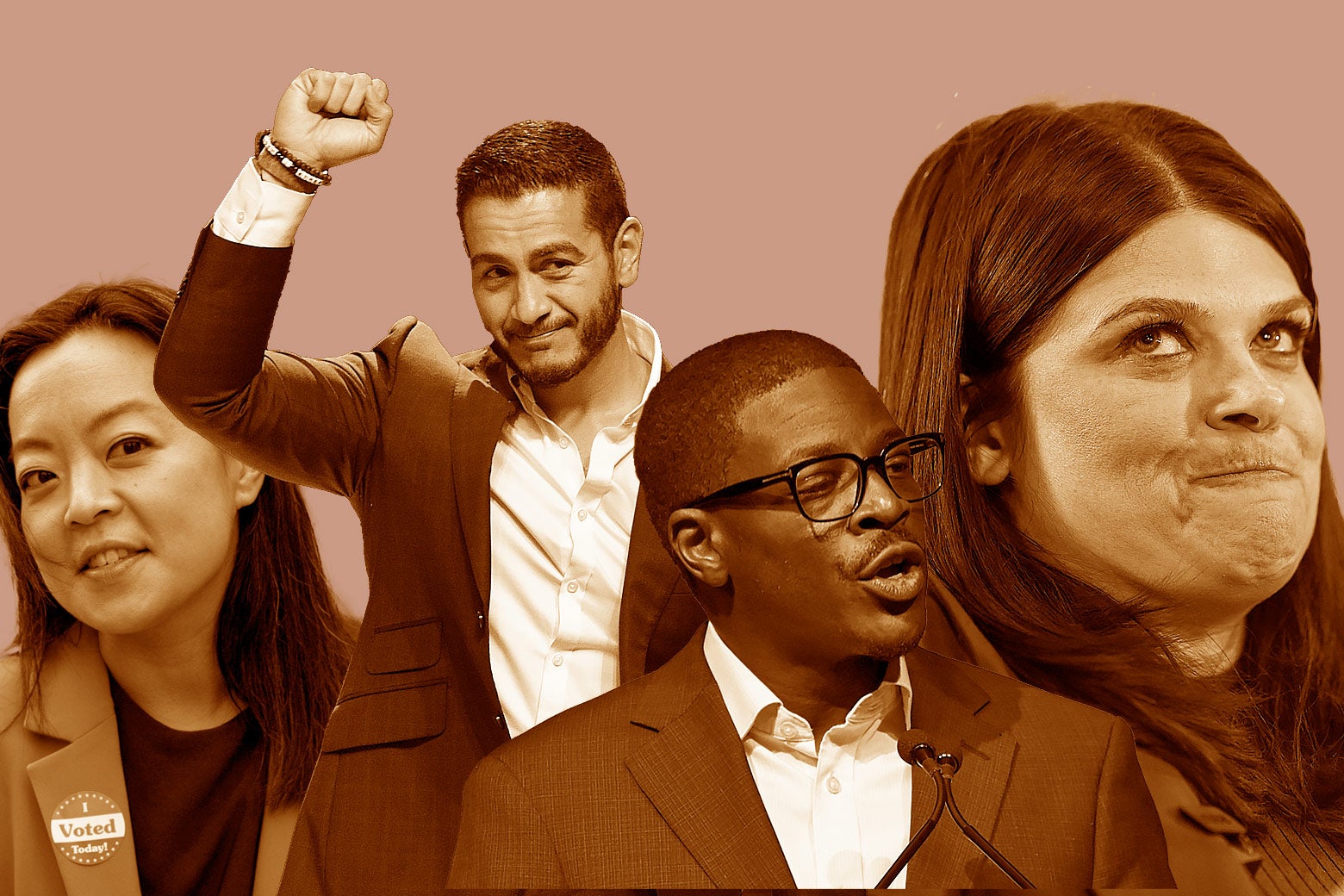
The Slatest The party is spending its summer mired in a series of acrimonious primaries. Will it hurt them when it’s time to take on Republicans? Photo illustration by Slate. Photos by Scott Olson/Getty Images, Daniel Boczarski/Getty Images for WisDems and Finn Gomez/Getty Images. This story is adapted from the Slatest newsletter. You can sign up here to get it in your inbox every day. As regular Slatest readers know, we usually spend this newsletter answering questions about the news. Sometimes, though, it’s worth taking the time to pose big questions we don’t currently have answers to. So after yet another bitter primary election this week that pitted Democrats’ progressive and moderate wings against each other, let’s explore one crucial question that confronts the party going forward: Will all these rancorous nominating contests hurt Democrats’ chances against Republicans in November? Healing those wounds is no small challenge. Democratic divisions have been front and center this year. (Losing another presidential election to Donald Trump will do that to a party.) Some of the divides are over ideology and policy; in last week’s Michigan Senate primary, Abdul El-Sayed, a progressive supporter of Medicare for All, narrowly beat Rep. Haley Stevens, a pro-Israel centrist. Others—including Tuesday’s Wisconsin governor primary, in which the moderate David Crowley even more narrowly defeated Francesca Hong, a democratic socialist—are about which candidate is better equipped against Republicans or is advocating exciting new ideas. Divisive primaries happen for a reason; they can help parties work out policy disagreements or stress-test candidates’ mettle. But bridging those divides isn’t easy, and this year’s primary season could haunt Democrats in key races this fall. Political science research suggests that longer and more competitive primaries can ultimately cost the party’s nominee votes in the general election. Only one candidate can win, after all, which leaves plenty of room for hurt feelings among the losing contender’s supporters—some of whom might choose to stay home rather than vote for someone who wasn’t their first choice. Several of this year’s bitterest primaries so far also involved more than two candidates; this can split the vote such that no one gets a majority. That’s what happened in Michigan (where El-Sayed won with 49 percent of the vote) and in Wisconsin (where Crowley emerged victorious despite earning less than 40 percent). A 2024 study that looked at both parties’ House, Senate, and gubernatorial primaries from 2010 to 2022 found that candidates who win only a plurality of the vote tend to underperform in general elections relative to expectations. For plurality winners in closely divided parts of the country (like, say, Michigan and Wisconsin), “this translates into a reduced likelihood of winning,” the paper concludes. Acrimonious primaries can hurt victorious candidates in other ways, too. Sometimes the positions they take to court their party’s base actively repel the wider pool of voters, whose support they may need in the fall. Contentious primaries often bring media scrutiny, which can expose damaging truths about a candidate’s past; Hong’s years-old criticisms of policing and Thanksgiving probably helped doom her in Wisconsin. Extended primaries also eat up resources. Dollars spent on attack ads against a fellow Democrat over the summer can’t be spent on attack ads against a Republican in the fall. But just because divisive primaries can be fatal in general elections doesn’t mean they have to be. Democrats have a choice about whether to let the wounds of primary season hamstring their nominees. How the winning and losing candidates—and those candidates’ supporters—treat each other over the next few months will help determine whether those divides heal in time for November. There’s already evidence that at least some Democrats are trying to mend fences. Stevens, the centrist congresswoman who previously accused El-Sayed of wanting to “blame all of your problems on Jewish Americans,” is already campaigning for him. El-Sayed, who called Haley “the least capable candidate in America” in the race’s final days, has since praised her at a unity rally the two held together. A similar spirit of reconciliation seems to be afoot in Wisconsin. On Wednesday, Crowley posted a chummy-looking photo of a breakfast meeting that included Hong and was captioned “Wisconsin Democrats are united.” Not every erstwhile Democratic nominee has been so helpful, though. Rep. Jasmine Crockett of Texas, who lost the primary for U.S. Senate to state Rep. James Talarico in March, quickly endorsed him. But so far she hasn’t stumped for him, instead lobbing veiled criticisms of Talarico’s efforts to win over Black voters. There’s some evidence that Crockett’s reticence may be having an effect. An Emerson College poll on Thursday found Talarico slightly lagging among Black voters compared to Texas Democrats’ nominee for governor. Ultimately, though, it’ll be up to Democratic voters, not just elected officials, to decide if they want to forgive and forget enough for their party’s battle-scarred nominees to win this fall. Republicans, meanwhile, are trying their best to prevent that. In Michigan, after some Democratic voters threatened to withhold their support from El-Sayed over his decision to campaign with controversial progressive activist Hasan Piker, former Rep. Mike Rogers, the GOP Senate nominee there, urged them to join his campaign. “You have a home with us,” Rogers said. Last week, Michael LaRosa, a former Jill Biden spokesman who harshly criticizes his party’s left flank, appeared to endorse the idea of Democrats voting for Rogers. If anything can get quarreling Democrats to put their differences aside, though, it’s probably a common enemy. That’s what happened after Joe Biden beat Bernie Sanders for the party’s presidential nomination in 2020 and went on to defeat Trump. Yet just four years later, some prominent progressives refused to endorse Kamala Harris over the war in Gaza even though Trump was the alternative. But with the president’s popularity in the toilet, bringing back the spirit of 2020—without pretending that the divisions of 2026 don’t exist—would seem to be Democrats’ best bet for a good November. “We’re not all going to agree on everything,” Crowley conceded to Politico on Thursday. “But I think we agree that the ultimate goal is making sure that we don’t have a MAGA extremist and congressman Tom Tiffany sitting in the governor’s office.” Tolga Akdoğan OK, that’s a lot of thinking about the future. Time to think about the here and now—like how you’re going to enjoy the rest of your day. My colleagues recommend: A nostalgic pop culture podcast: Do you remember McGruff the Crime Dog? He was a hallmark of 1980s public safety PSAs, and he left an indelible impression on America’s youth. On Decoder Ring, host Willa Paskin analyzes McGruff’s bizarre yet catchy anti-drug songs to make sense of the strange afterlife of PSAs. An investigation into the unsung hero of condiments: Relish is the ideal summer ingredient. It’s sweet, tangy, and pickley—the perfect complement to backyard cookouts. So why is it disappearing from the shelves? Nadira Goffe makes the case for a relish comeback. An ode to the ecstasy of Scrabble: Do you love hearing someone talk about something they’re really passionate about and know very well, in great intimate detail? Then you’ll love Stefan Fatsis’ essay on everything that can make playing Scrabble “a borderline mystical experience, and impossible to quit—an inexplicable meld of timing, skill, serendipity, and enough improbability to keep a statistics class busy for a semester.” And speaking of word games … For a juicy twist on a game involving the letters of the alphabet, may we recommend Slate’s Pears? You get six letters that you must turn into as many words of four letters or more as you can; as you create words, you’ll uncover fun little asides and notes. For every fifth word, you’ll get thrown a new pair (pear!) of letters that you must combine with your existing set to make the longest word you possibly can. Give it a try! That’s all, folks! Have a great rest of your day.
Will Democrats’ Bitter Primaries Hurt Them When It Matters Most?
Full Article
Original Source
Read the full article at Slate →KhanList aggregates and links to publicly available news content. We do not host full articles from third-party sources. Always verify important information with original sources.