
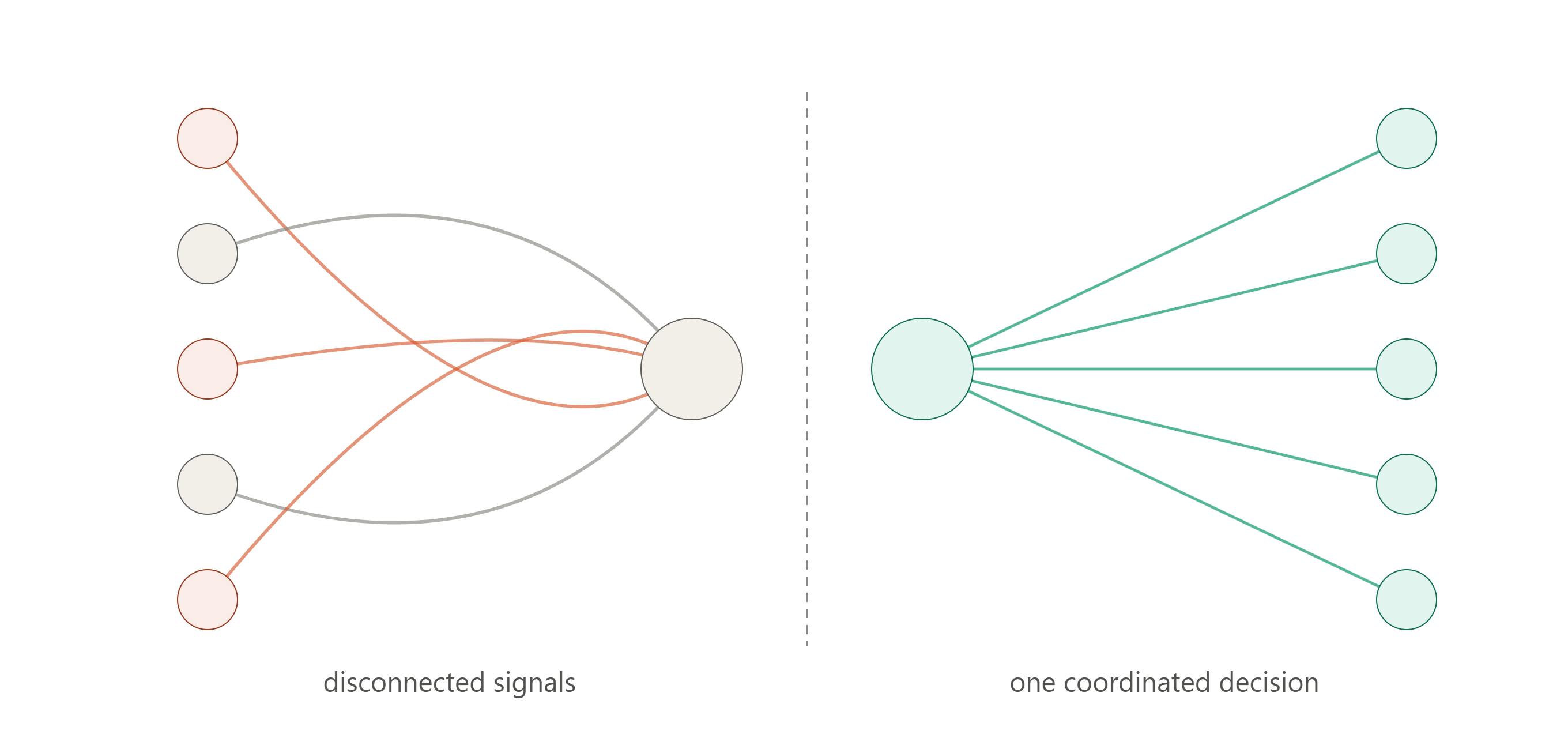
Every Automation Worked. The Journey Did Not During a lifecycle audit, I found a system in which nothing appeared to be broken. The abandoned cart emails were triggered correctly. SMS messages were being delivered. Promotional campaigns went out on schedule, and the post-purchase flow started after an order. Yet the customer experience told a different story. The same person could receive a cart reminder, a general promotion, and a welcome offer within the same day, because a purchase stopped one email sequence but not every related message. Each automation followed its own rules, responded to its own trigger, and reported its own results. Technically, every flow was doing exactly what it had been built to do. Every automation was working. The customer journey was not. I design and audit lifecycle systems for e-commerce and digital businesses, and I see this pattern repeatedly: individual messages are automated long before the decision system that should coordinate them is designed. What looks like an email problem is usually an architecture problem. A Collection of Flows Is Not a Lifecycle System The fragmentation rarely begins with a bad decision. It usually begins with a series of perfectly reasonable ones. A company launches a welcome flow to convert new subscribers, then adds an abandoned cart sequence to recover lost revenue. A post-purchase flow follows, then win-back emails, SMS reminders, and push notifications — each addition solving a visible problem and producing a measurable result, which is exactly why nobody stops to ask whether the system underneath is still coherent. Channels are usually planned independently, sometimes by different teams or agencies, while customer data sits scattered across an ESP, a CRM, an e-commerce platform, a support desk, and an SMS provider. Each system sees one part of the customer's behavior and makes a decision based on that partial view: the ESP knows a customer abandoned a cart but not that the same customer has an unresolved support case about the same product, and the SMS platform holds a phone number and a scheduled reminder but may never receive the purchase event in time to cancel it. Entry logic tends to be well defined — a subscription starts the welcome flow, an abandoned cart starts a recovery sequence — but exit logic gets far less attention. A purchase might stop one email while leaving an SMS, a push notification, or a promotional campaign completely untouched, because ownership is fragmented too: one team manages campaigns, another manages automation, a third controls customer data, and each optimizes its own metric while nobody owns the journey that runs across all of them. Add up enough well-intentioned tools, and you don't get an omnichannel strategy. You get several teams politely talking over each other in front of the same customer, each one convinced their message landed. Design Around Customer State, Not Around Channels Traditional campaign planning usually starts with a channel question: what email should we send next? That question narrows the decision before it's even been made — it assumes a message is necessary, that email is the right response, and that the only real task left is choosing the content. Lifecycle architecture starts one step earlier, with a different question: what state is the customer in now, what has changed in their behavior, and what response — if any — would be appropriate in this context? A customer state describes where a person currently stands in their relationship with the business: new subscriber, first-time buyer, active customer, repeat customer, at-risk customer, reactivated customer. These aren't just labels for a dashboard; they give the system context for interpreting new behavior. This is also where states differ from segments and events, three terms that get used almost interchangeably even though they mean different things. A segment is a group of people who meet a defined set of conditions. A state is where one person currently stands in the lifecycle. An event is a time-specific signal — a completed purchase, a renewed subscription, an opened support case — that may change that state. Take the event product_added_to_cart. In a channel-led system, it translates directly into an instruction: send an abandoned cart email. In a state-led system, it opens an evaluation instead. Has the customer already completed the purchase through another session? Is there an unresolved support case tied to the same product? Has this exact event already been processed once? Does the person have valid consent for the channel in question? Each answer can change what happens next, and the outcome might be an email, an SMS, an on-site reminder, a deliberate delay, or no message at all. The event should trigger a decision, not automatically dictate a message. Five Layers of a Coordinated Lifecycle System None of this requires an enterprise-grade technology stack. It does require five distinct functions working together — whether one platform handles all of them or the logic is distributed across several tools matters less than whether information can move between them without losing context. Layer 1 — Behavioral data. The system needs signals connected to intent, transactions, service, and product use, not just email opens and clicks: product_viewed, checkout_started, purchase_completed, support_case_opened, feature_adopted. Each event should describe what happened, who did it, when, and with what properties: { "event": "product_added_to_cart", "customer_id": "84721", "timestamp": "2026-08-11T09:30:00Z", "properties": { "product_id": "P-1048", "price": 89, "currency": "EUR", "quantity": 1 } } Without consistent naming, timestamps, and identity fields at this layer, every layer above it is forced to guess. Layer 2 — Identity and customer profile. An event has limited value until it's connected to a person, so this layer links anonymous browsing to a known profile once someone signs in, subscribes, or buys, and tracks which channels, consent, and lifecycle state apply to them. It's also worth separating events from attributes: purchase_completed is an event — something that happened at a moment in time — while last_purchase_date is an attribute that event updates, and days_since_last_purchase is a calculated attribute that keeps changing on its own. Layer 3 — Decision and orchestration. This is the layer most fragmented lifecycle systems are missing entirely, and the one I spend most of an audit reconstructing, because it usually doesn't exist as a single place — it's scattered across five tools that each assume they're in charge. It decides whether the business should respond at all, which journey has priority, which channel fits the context, and which competing automation should be paused. An abandoned cart event might qualify for a reminder, unless an unresolved payment issue makes a service message more urgent instead. Separately, a completed purchase should terminate the entire cart journey rather than merely cancel the next scheduled email — the two are different conditions, and conflating them is exactly the kind of gap that lets a customer get both a service alert and a cart reminder in the same hour. In practice, this layer is a small set of explicit rules rather than a mood or a principle: IF purchase_completed = true THEN exit cart journey across all channels IF support_case_opened = true THEN suppress promotional messages IF sms_consent = false THEN evaluate other consented and available channels Without this layer, adding channels doesn't create an omnichannel experience; it just creates more systems capable of sending overlapping messages, each one certain it has the customer's full attention. This logic can live in a CDP, inside the CRM, in a marketing automation platform's rule engine, in a dedicated event-processing layer, or in custom middleware — the location matters less than whether the rules are consistent, centrally governed, and shared across every system that acts on them. Layer 4 — Channel execution. Once a decision is made, the channel layer carries it out. Email tends to carry explanation and richer content, SMS is reserved for urgent or high-value moments, push works for timely reminders, on-site personalization handles the current session, and in-app messaging guides the customer while they're actively using the product — which matters as much for SaaS and digital products as it does for e-commerce. These roles aren't absolute — a high-value cart may justify SMS while a lower-intent action needs nothing more than on-site personalization — but the channel itself never makes the strategic call. It only delivers what the system upstream has already decided. Layer 5 — Measurement and feedback. The final layer returns outcomes to the system: conversions, lifecycle-state changes, journey completion, suppression reasons, experiment results. This exists for more than attribution reporting — a purchase should move the customer into post-purchase communication, a suppression reason should reveal that a rule is too broad, and an experiment should change what the system does next time. When feedback only shows up in a dashboard, the system observes the customer without ever learning from them. Rebuilding an Abandoned Cart Journey In audits, I usually find that teams can list every active flow but can't explain which one should win when two of them qualify for the same customer at once. I ran into this exact problem while reviewing an abandoned cart journey for an e-commerce business. On paper, the setup looked functional: adding a product triggered an email sequence, SMS reminders ran through a separate automation, and promotional campaigns continued on the marketing calendar regardless of whether a customer was already mid-journey. The problem only became visible once these systems started responding to the same person independently — a purchase could stop the next cart email without cancelling the already-scheduled SMS, a customer adding the same product twice could re-enter the automation twice, and a promotional campaign could slide in between two cart reminders with a third, unrelated offer. Rebuilding the journey started with the event, not the message. When product_added_to_cart fired, the system recorded a structured behavioral event — customer identifier, timestamp, cart contents, deduplication key — rather than immediately starting the journey. After a defined inactivity period, it checked whether the cart was still active, whether a purchase had occurred in the meantime, and whether the customer remained eligible for communication on any channel. Only once those conditions held did orchestration logic evaluate the wider context: was this cart event a duplicate, was the customer already in a higher-priority journey, and which channel actually fit the moment? Email stayed the default first channel, since it could present the cart contents without creating urgency that the customer's behavior didn't yet justify. SMS was no longer an automatic second step — it was reserved for customers who'd shown stronger intent, met the company's own cart-value threshold, and had explicitly opted in. The most consequential change concerned completion. purchase_completed no longer stopped just the next email — it ended the abandoned cart journey across every connected channel at once, moved the profile into a post-purchase state, and let promotional communication adapt to reflect the purchase instead of ignoring it. What changed the system wasn't a better cart email. It was giving every channel access to the same decision. The Coordination Rules Most Systems Are Missing A journey can't be coordinated if its logic only exists inside individual automation builders — it needs to be documented explicitly and applied the same way across every connected channel. The first artifact I build in an audit is never a campaign calendar. It's a map of events, states, owners, and the conflicting decisions each team's automation would make about the same customer at the same moment. For each journey, I define seven rules: Entry rule — which event starts the journey, and what else has to be true (identifiable, marketing-eligible) before it does. Suppression rule — when communication would be inappropriate, redundant, or prohibited, whether because of consent, an open support case, or a higher-priority journey already running. Exit rule — which action ends the journey immediately, across every channel it touches, not just the next scheduled message. Priority — which journey wins when several are active for the same person at once. Re-entry rule — when the customer can enter the same journey again, and what has to reset first. Deduplication rule — how the system tells a genuinely new event apart from the same one arriving twice. Frequency rule — how much communication a customer can receive across the entire system, not just within one flow. A workable hierarchy might rank security and service above transactional, transactional above lifecycle-critical, and lifecycle-critical above behavioral and promotional messaging — so a payment issue outranks a cart reminder, and an order confirmation is never delayed by a promotional frequency cap. The exact order depends on the product and the regulatory risk involved; what matters is that a shared hierarchy exists at all and can resolve conflicts the same way every time, instead of leaving it to whichever automation fires first. A Practical Roadmap: Fix the Architecture Before Adding Channels None of this requires rebuilding the entire lifecycle system at once. A more realistic approach is to build the architecture around the journeys that move the most customers. Inventory the current system — document every event, flow, campaign, channel, and owner in place, and note where decision-making authority actually changes hands between teams. Define customer states — identify the main states in the relationship and the events that move someone between them, from new subscriber to first-time buyer to at-risk. Standardize behavioral events — give every critical event a name, source, set of properties, timestamp, identity field, deduplication logic, and a named owner, so different systems stop interpreting the same behavior differently and no one has to guess who's responsible when it breaks. Map coordination rules — starting with three to five journeys with the biggest commercial impact (onboarding, abandoned intent, first purchase, post-purchase, reactivation), define entry, suppression, exit, priority, re-entry, deduplication, and frequency rules for each. Build the feedback loop — track progression to the next customer state, journey completion, repeat behavior, and retention, not just opens and attributed revenue, and where a valid control group exists, measure incremental uplift rather than assuming every conversion in the journey was caused by it. Architecture Before Automation When lifecycle performance starts slipping, the instinctive response is almost always to add something: another flow, another channel, another platform, another layer of personalization — as if the fragmentation could be solved by adding more of whatever fragmented it in the first place. A new tool doesn't create coordination. It adds one more system capable of making an isolated decision about a customer whose experience is already being shaped by five other disconnected systems. The problem was never that the messages failed to send. It's that each one responds to a fragment of behavior without knowing what already happened, what matters right now, or what should happen next. Lifecycle maturity doesn't come from automating more touchpoints — it comes from building the shared logic that lets data, customer states, journeys, and channels operate as one system, instead of as disconnected decision-makers. A continuous customer journey isn't a sequence of messages. It's a sequence of coordinated decisions based on the customer's changing state — and the architecture is working when every channel knows not only when to speak, but when another message is no longer needed.
Why Working Automations Still Create Broken Customer Journeys
Full Article
Original Source
Read the full article at Hackernoon →KhanList aggregates and links to publicly available news content. We do not host full articles from third-party sources. Always verify important information with original sources.