
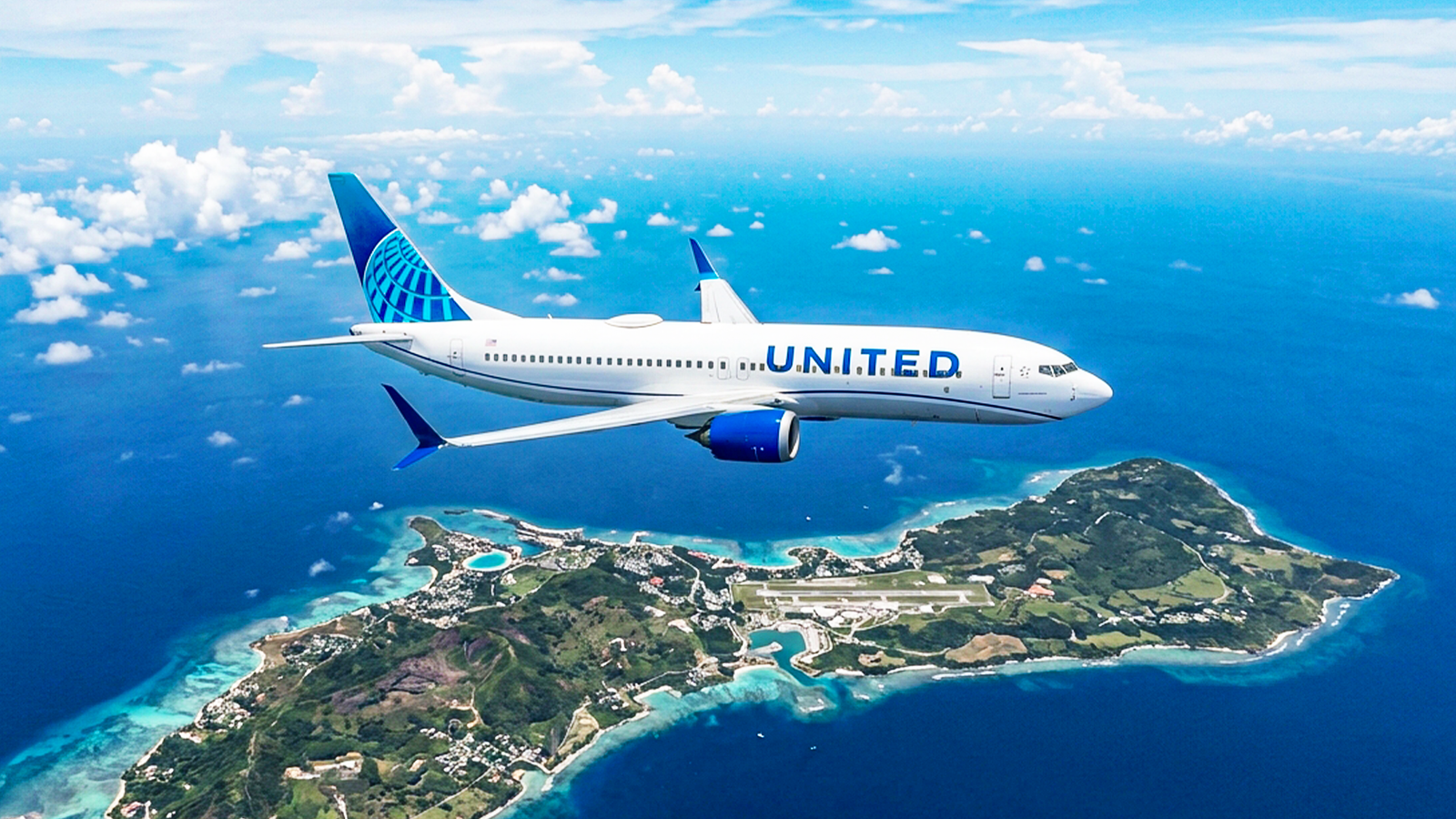
In general, the US legacy carriers primarily operate their networks within the continental US. All of American Airlines' ten hub airports are located within the continental US, as are all of Delta's nine hub airports. United Airlines, however, has seven hub airports in the continental US, as well as a hub in Guam, an overseas territory of the US located thousands of miles away from Washington. It's the only such operation by any US airline, and it carries on the legacy of an operation that goes back nearly 60 years. United currently operates up to 12 daily flights to 15 different destinations in five countries out of Guam Antonio B. Won Pat International Airport (GUM). It is the start/end for the carrier's famous 'Island Hopper' service, and the airline also runs direct services from GUM to San Francisco with a stopover in Honolulu. This route uses a Boeing 777-300ER, while the rest of the GUM routes use the Boeing 737. United is by far the largest airline serving Guam, and it also serves as a vital link connecting Guam to the outside world. The Background Of The Micronesia Operations In 1968, Continental Airlines and regional shareholders established Air Micronesia, initially headquartered in the Northern Mariana Islands. Operating under the callsign 'Air Mike', the airline initially operated Boeing 727s and became a crucial component in the region's economic development during the late 20th century. Air Micronesia held a near monopoly in the market, and its 727s were crucial in connecting what were previously remote islands to the outside world. Continental would eventually own 100% of Air Micronesia, rebranding the airline to 'Continental Micronesia' while the headquarters eventually shifted to Guam. While other airlines attempted to connect Guam to the US at certain points and others served Micronesia from foreign countries, Continental Micronesia was by far the largest airline in this market. Among its most famous routes was the 'Island Hopper', connecting Guam to Honolulu with five stopovers, and the airline also had a substantial international network. In 1999, Continental Micronesia began transitioning from using the 727 to the 737NG for most operations, and in 2003, the Guam International Airport Facility pushed commuter airlines out of GUM's Commuter Terminal and leased the facility to Continental. The airline would become Guam's largest private-sector employer, while connecting GUM to over 20 destinations. In 2010, Continental Airlines announced that it would merge with United Airlines, keeping the United name. In 2017, Continental Micronesia was formally merged into United Airlines (it had previously operated as a subsidiary of United Continental Holdings), and today, all Guam flights are directly operated by United. Where Guam Fits In United's Network Credit: HarrisonKim1 I Shutterstock Airlines are hardly afraid of shutting down unprofitable hubs, and United itself dehubbed the Cleveland hub that it also inherited from Continental during the merger in 2014. However, the Guam operations were making money for the airline, and they're a vital link to the communities served. In addition, United absolutely dominates Guam, and the hub offers a unique strategic position within the carrier's network that couldn't otherwise be replicated by another hub. Guam itself is a hub for lucrative military and government activity, and United's position in Guam means that it essentially receives all government travel contracts. Because of the airline's dominance in GUM, it can also charge high fares due to the lack of competition. Altogether, Guam is actually one of United's most lucrative hubs, even if it is also one of its smallest. The operation makes the airline money, and so it will remain a United hub, even as other US legacy carriers have dehubbed their hubs outside of the US mainland. United Airlines Hub Airports Chicago O'Hare International Airport (ORD) Los Angeles International Airport (LAX) Denver International Airport (DEN) Newark Liberty International Airport (EWR) Guam Antonio B. Won Pat International Airport (GUM) San Francisco International Airport (SFO) Houston George Bush Intercontinental Airport (IAH) Washington Dulles International Airport (IAD) In March 2026, the carrier began transitioning from using the 737-800 to the 737 MAX 8 for its Guam operations, with the switch having been completed in October. These ten aircraft feature a significantly upgraded interior compared to the old 737-800s, and they feature signs in English and Japanese rather than English and Spanish, while the front row of economy can be collapsed to accommodate a stretcher for medevac flights. In addition, two United First seats are blocked on the Island Hopper to be used as a pilot crew rest facility. The Fate Of The Other Overseas Hubs Operated By US Airlines Credit: Markus Mainka I Shutterstock Going into the 2010s, United Airlines and Delta Air Lines both operated hubs at Tokyo Narita International Airport (NRT). These hubs had operated for decades (Delta inherited NRT operations from Northwest Airlines, while United acquired the NRT routes from Pan Am) and essentially connected US passengers to Asia, serving as a central hub. But in the mid-2010s, United gradually discontinued intra-Asia routes out of NRT, and Delta exited NRT entirely in 2020 (it will return in 2027 with a single route from Seattle). Whereas United's Guam hub primarily serves the local market, the NRT hubs operated by United and Delta mainly existed for connections. However, the arrival of the Boeing 787 and Airbus A350 allowed these airlines to serve more destinations in Asia nonstop from the US, and nonstop flights typically earn a fare premium over one-stop options. As such, the NRT hubs weren't necessary anymore, since they were essentially set up due to range limitations of older widebodies like the Boeing 747-200. In addition to the improved economics of new widebody aircraft, United announced a joint venture with All Nippon Airways in 2011, while Delta announced a joint venture with Korean Air in 2017. With these, the intra-Asia routes are covered by their joint venture partners, eliminating the need to operate these flights with their own metal. In other words, United's NRT hub has been replaced by nonstop flights to Asia and ANA's operations out of Tokyo, while Delta's NRT hub has been replaced by Korean Air's hub in Seoul. The Routes Operated By United Out Of Guam Credit: Markus Mainka I Shutterstock Apart from the carrier's one-stop flight from GUM to San Francisco via Honolulu with the 777-300ER, all of United's Guam routes now use the 737 MAX 8. There are currently ten of them stationed in GUM, and they operate to Taipei, Manila, Airai, Saipan, Yap, Pohnpei, Chuuk, Tokyo Narita, Tokyo Haneda, Osaka, and Nagoya. In addition, the airline's flight to Airai continues to Manila on some days of the week, while the flight to Chuuk is part of the Island Hopper, flying from Guam to Honolulu via Chuuk, Pohnpei, Kosrae, Kwajalein, and Majuro. Several of these routes do not operate daily, as local demand is ultimately limited and the 737 MAX 8 is a relatively large aircraft, able to carry up to 166 passengers in United's configuration. Japan is United's largest market out of GUM, as it connects the airport to four airports in Japan while operating up to five daily flights between GUM and Japan. Notably, United does not serve Nagoya from the mainland US nonstop. Some of these routes can be extremely long, which makes the fuel savings of the 737 MAX 8 over the 737-800 highly impactful. Meanwhile, the 777-300ER is flown to Guam almost entirely due to strong demand for cargo, as this is the aircraft in United's fleet with the highest cargo capacity. The airline only has 22 of these planes, which make up less than 10% of its overall widebody fleet, and yet the cargo revenue is strong enough to justify its use on the San Francisco-Honolulu-Guam route. Adapting To Struggles In Guam Credit: Markus Mainka I Shutterstock While United's Guam operations have generally been successful, the hub has been facing difficulties in recent years due to the COVID-19 pandemic as well as a decline in demand from Japan, the largest market for the hub. Ordinarily, United may simply shift capacity to another hub, but that isn't easy to do with Guam. The airport is thousands of miles away from any of United's other hubs, the carrier has a pilot and flight attendant base in Guam, and the ten 737s are specially configured for these services. What United has done with these assets is move them back to NRT. In recent years, the carrier has launched new fifth freedom routes from NRT to Cebu, Kaohsiung, and Ulaanbaatar, using the flight numbers of the carrier's nonstop flights to NRT from the mainland US and operating the flights with Guam-based 737s. Crucially, these destinations are not served by ANA, which means that United is expanding the joint venture's Asia coverage while deploying assets that would have otherwise been underutilized. It's one of the most creative ways to utilize assets when the standard operation is no longer producing the returns that it once did. Not only that, but the airline has generated tremendous excitement and publicity over these routes, with the Ulaanbaatar route standing out in particular, and this is beneficial for loyalty program and credit card sign-ups, which is where the carrier makes its real money.
Why United Airlines Is The Only US Carrier Left With An Overseas Hub
Full Article
Original Source
Read the full article at Simpleflying →KhanList aggregates and links to publicly available news content. We do not host full articles from third-party sources. Always verify important information with original sources.