
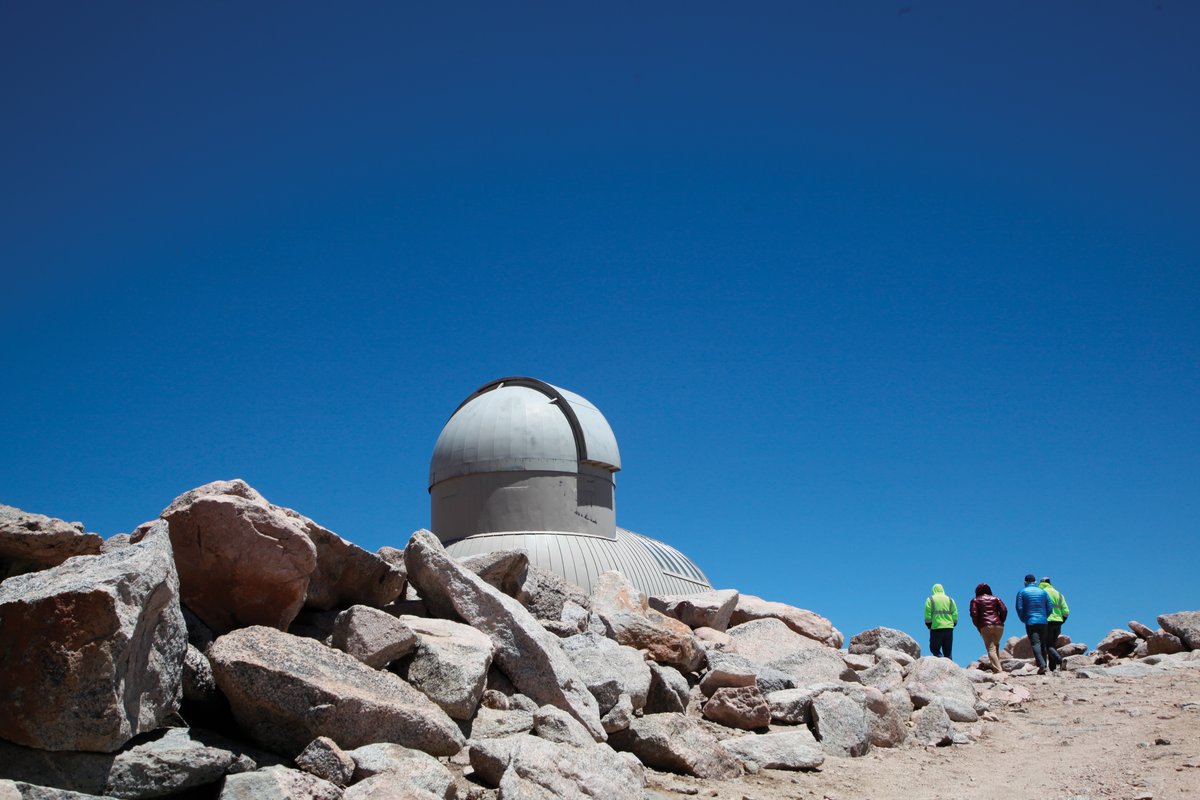
In the high Rockies, the field season for testing relativity is short. From the spring thaw until the snowpack returns in fall, researchers from the National Institute of Standards and Technology have about 15 weeks to run an optical lattice clock near the summit of Mount Blue Sky, more than 4,300 meters above sea level, and compare it with a nearly identical clock in their Boulder laboratory some 2,500 meters below. Rain or wildfire smoke can block the laser link between them. Equipment breaks. The safety plan notes still more risks, from lightning and high winds to snow and altitude sickness.But Mount Blue Sky gives the experiment something a lab cannot: a large vertical separation with road access, enough to produce a measurable difference between the clocks’ ticking rates. There is no optical fiber directly connecting the summit and NIST. Instead physicists Andrew Ludlow and Laura Sinclair use a laser beam to cross the open air between the mountain and a telescope on the roof of a school district building north of Denver; optical fiber carries the signal the rest of the way to NIST.The challenge is to preserve laboratory-grade precision in a portable clock and the open air. If the system works, the two clocks could make one of the most accurate measurements yet of gravitational redshift, an effect in which time passes more slowly deeper in a gravitational field. This effect, predicted by Einstein’s general theory of relativity and confirmed on Earth in experiments beginning in 1959, appears as a shift in the frequency of light. Light sent upward seems to arrive at altitude with a lower frequency and a longer, redder wavelength. The speed of light remains constant; the shift reflects how time passes at the different altitudes. A clock higher up ticks faster than one below, so it counts fewer wave peaks per second. Across the roughly 2,500 vertical meters between Boulder and the summit, the higher clock gains about 25 nanoseconds—or 25 billionths of a second—per day. That sliver is what the team has gone to the mountain to capture.On supporting science journalismIf you're enjoying this article, consider supporting our award-winning journalism by subscribing. By purchasing a subscription you are helping to ensure the future of impactful stories about the discoveries and ideas shaping our world today.Optical lattice clocks can achieve up to 18 digits of precision, making them sensitive to differences in gravitational potential equivalent to about a centimeter of elevation. That same sensitivity could one day turn clock comparisons into a new way to measure Earth. But getting such clocks out of the lab is still a new technical frontier; researchers began building transportable systems only about 10 years ago. To date, only two other teams, at the National Metrology Institute of Germany and RIKEN in Japan, have developed operational versions.This past summer marked the third season for the Relativistic Redshift Peak-to-Plains collaboration, or R2P2, on Mount Blue Sky. Ludlow’s group builds NIST’s ytterbium clocks; Sinclair’s specializes in transferring the clocks’ signals. The year before, they managed to operate both the optical clock and the time-transfer hardware on the mountain. By this time they were ready to collect data. Or just about. In the week before they had hoped to start the experiment, the team members had to locate and repair damaged optical fiber in one of the transceivers. They also had to realign lasers in the clock that had been knocked off-kilter during the trip up the mountain. “Every time we deploy, there’s some kind of interesting adventure to solve,” Sinclair says.When I visited in mid-June, Boulder was baking. Inside NIST’s Katharine Blodgett Gebbie Building, beneath an electromagnetic shield and on a vibration-isolated concrete slab, Ludlow’s optical lattice clock sprawled across an optical table. Lasers, mirrors and fiber-optic cable surrounded a fishbowl-size metal housing for a vacuum chamber whose windows flashed with colored light. Nothing about the apparatus looked much like a clock.All clocks count the repetitions of an oscillator. In an old mechanical clock, a pendulum provides the beat. The atomic clocks that currently define the second use a transition between energy levels of cesium atoms, at a microwave frequency of about nine billion oscillations per second. Optical clocks use atoms with transitions at much higher frequencies. The ytterbium transition in Ludlow’s clock corresponds to a light frequency of about 518 trillion cycles per second, giving researchers much finer “ticks” for measuring time.At NIST in Boulder, Andrew Ludlow’s optical lattice clock sprawls across an optical table. Lasers cool and trap ytterbium atoms; a clock laser is then locked to the frequency of an atomic transition, about 518 trillion cycles per second.Rich Press/NISTThe best cesium clocks might drift by a second over about 300 million years; the most accurate optical lattice clocks would take around 30 billion years. That leap in accuracy has put the second itself up for redefinition. At its October meeting, the international body that defines the meter, the kilogram and the second adopted a resolution calling for continued work toward replacing the cesium-based second with an optical one, with a decision on a new definition expected at its 2030 meeting. Ytterbium is among the contenders.The clock’s operation begins with a tiny oven that heats ytterbium into a dilute gas. “It’s almost like a teakettle of ytterbium where we’re shooting a vapor out the end,” Ludlow says. The vapor fills the vacuum chamber, where a blue laser slows the hot atoms and a green laser cools them to around a millionth of a degree above absolute zero. The sluggish atoms are then trapped in an optical lattice, a standing wave of red laser light that confines thousands of them in tiny pockets, limiting interactions that could alter their ticking. Once the atoms are cool and stable, a yellow “clock laser” drives a coherent oscillation between their ground and excited states. An electronic feedback loop keeps the laser locked to the atoms’ transition frequency. Every second or so, the cycle starts over with fresh atoms.A laser doesn’t tick, of course. Sinclair and her team use a frequency comb, a special kind of laser that produces a series of precisely timed pulses of light. “You can think of those as the second hand looping around each time,” Sinclair says, “except that they do 200 million ticks a second, and the spacing is set exactly to the ytterbium.”The clocks at both ends of the Mount Blue Sky link use the same atomic species, ytterbium. “Nature made the atoms identical,” Ludlow says. If the researchers account for every other influence correctly, the remaining difference between the clocks should come from their different positions in Earth’s gravitational field. The clock on the mountain should tick slightly faster. But first the clocks must get out of the lab.The drive from NIST to the observatory takes about two hours, with pauses along the way to acclimate to the altitude. We leave Boulder early in Ludlow’s Subaru, pass the old mining town of Idaho Springs and begin the 2,000-meter climb past the tree line to the summit of Mount Blue Sky. The scenic byway has two lanes, vertiginous drop-offs and no guardrails. Sinclair crochets a sock in the back seat. “I like to have a fidget,” she says. Near the top, pudgy marmots scuttle among the rocks, and mountain goats cluster around parked cars to lick minerals from their wheels.Sinclair unlocks a chain, and we drive up a steep dirt driveway to the University of Denver’s decommissioned Meyer-Womble Observatory. Inside, under a tent of translucent plastic, sits a compact version of the clock in Ludlow’s lab. The tent offers some temperature stability, but its more urgent purpose is to keep the observatory’s thriving moth population out.At the Meyer-Womble Observatory, the portable clock’s hardware fits into three chest-height racks under a plastic tent. Researchers use smaller components to make the clock movable, which introduces new vulnerabilities to heat and altitude—not to mention the ride up the mountain.Rich Press/NISTThe mountain clock performs the same functions as Ludlow’s laboratory system in about 10 to 20 percent of the volume. The timekeeping hardware fits into three chest-height racks, with compact components replacing equipment that fills an entire room at NIST. But making the apparatus portable means giving up some of what makes the lab version so good. The cavity-stabilized clock laser cannot match the larger one at NIST, and the smaller lattice laser has less optical power. Moving the apparatus also exposes problems hidden in the lab. Commercial components shed heat differently at altitude. The ride can knock lasers out of alignment. During our visit, the team is struggling to cool the ytterbium atoms enough to load them reliably into the lattice. “Even the stuff that’s commercially purchased doesn’t cool itself off the same way it does in the lab,” says Eric Swiler, a University of Colorado Boulder doctoral student and NIST associate in Ludlow’s group.On a covered platform outside the observatory, Sinclair opens the metal box that houses the free-space optical terminal. A matching telescope at the relay site receives and returns the optical signal; fiber connects that site to the laboratory clock at NIST. Keeping the telescopes aligned is a constant fight. Atmospheric conditions bend the beam’s path. At this precision, even someone walking near the relay telescope can make the light wobble. Sinclair’s job is to account for anything that could corrupt the comparison of the clocks. She calls herself the experiment’s “bean counter of the year.”The team hopes to operate both clocks and the link for 12 to 24 hours at a time. Rain anywhere along the beam path can interrupt a run, as can low clouds or a thunderstorm over the summit. If the equipment behaves and the sky cooperates, Sinclair says, they may collect data for a week or two.Cesium clocks might drift by a second over about 300 million years; an optical lattice clock would take around 30 billion years.Looking over the valley, Sinclair explains why the experiment is possible only now. Optical clocks and time-transfer technology have only recently become precise enough for such a demanding test of gravitational redshift, and Mount Blue Sky offers a high site reachable by road. “This observatory even has this little nook in the right direction to head down toward NIST,” she says.Previous tests of gravitational redshift traded one advantage for another: large changes in altitude paired with less precise clocks, or optical clock precision across much smaller height differences. After two Galileo navigation satellites accidentally entered eccentric orbits in 2014, researchers used their atomic clocks and large swings in altitude to get the most precise measurement of gravitational redshift to date. In 2020 a team connected optical lattice clocks at the base and the 450-meter observation deck of the Tokyo Skytree, the tallest tower in Japan, demonstrating an 18-digit frequency comparison and producing the most accurate terrestrial test at the time.The Mount Blue Sky installation extends the terrestrial separation to more than 2,500 meters. The signal must also travel 70 kilometers through fiber and open air. “Andrew’s group has turned the clock-performance knob up, and we are helping them turn the height knob up with the free-space link,” Sinclair says. “God willing and the creek don’t rise, we set a record.”On the roof of a school district building north of Denver, a relay telescope sends an optical signal to Mount Blue Sky, visible in the distance, and receives it back. Optical fiber carries the signal between the relay and NIST. Even someone walking near the telescope can make the light wobble.Laura Sinclair/NISTAchieving that performance requires keeping the comparison between the clocks in the optical domain throughout the whole time transfer. “The blessing and the curse of optical timekeeping,” Ludlow says, “is that the high frequency gives you amazing precision, but anytime you try to translate it outside of that domain, it degrades that precision.” So the team shifts the clock signal to another wavelength of light. The ticks generated by Sinclair’s frequency comb are carried on a telecom-standard wavelength of 1,560 nanometers, which travels efficiently through fiber. The light passes through several fiber segments to the relay telescope, then crosses open sky to the mountain. At the observatory, the process runs in reverse. Sending the signal both ways over the same path lets the researchers measure and cancel much of the noise it picks up in fiber and open air. Even Sinclair’s and Ludlow’s labs, just down the hall at NIST, are connected through a dedicated noise-canceling station. “When we care about these levels of precision, you can’t be sloppy even about a couple meters,” Sinclair says.There is no neutral observer floating between Boulder and the summit to declare which clock is running faster. Each site instead uses its local clock to make a ruler against which to compare the signal arriving from the other. “We make a ruler on Blue Sky,” Sinclair explains. “Then we use it to measure the ticks coming up from Boulder and see how much we need to stretch out or shrink to line up the ticks.” The mismatch, or offset, is the measurement.Sergei Kopeikin, a theoretical physicist at the University of Missouri in Columbia who works on experimental tests of general relativity, calls the researchers’ effort “among the most demanding precision-measurement experiments currently being undertaken.” The difficulty, he says, is having to control the atomic physics, lasers, communications, atmosphere and relativistic modeling all at the same time.Because the researchers are comparing the clocks rather than trying to synchronize them, they can process the data afterward to identify and correct some errors. Even so, constantly paying attention to the level of precision that each stage of analysis requires is “a real challenge,” Sinclair says. “And I’m winning the competition to make the most precision errors on this experiment.”A successful comparison could also turn the clock into a surveying instrument. Derek van Westrum, a gravity scientist at the National Oceanic and Atmospheric Administration, leads a team providing data for the North American-Pacific Geopotential Datum of 2022, NOAA’s upcoming gravity-based reference system. Once approved, it will replace the decades-old framework used now to establish elevations for surveying and mapping across the country. The system will also include a model of the geoid—the undulating surface that approximates where sea level would lie beneath the continents under the influence of gravity. That gravitational surface, not just the visible contours of the land, determines where water will go. For floodplain mapping and civil engineering, the difference is critical. “When you’re constructing a levee, you want to make sure it’s parallel to the actual geopotential surface, not just flat,” van Westrum says.Geodesists today determine geopotential by combining satellite data with ground-based and airborne measurements of gravity and height. Researchers can also compare geopotential between locations by using the ticking rates of optical clocks. “The magical thing about the clocks,” van Westrum says, “is you don’t have to measure the height and the gravity separately.” This approach is known as relativistic geodesy or chronometric leveling.Outside the mountaintop observatory, a free space optical terminal sends and receives the signal across open sky. Sending light both ways over the same path allows researchers to measure and cancel much of the noise the signal picks up along the way.Rich Press/NISTLinking ultraprecise clocks in a sufficiently dense network could fill critical gaps in floodplain modeling. Existing models perform well at local scales, van Westrum says, whereas satellite gravity data are accurate at very large ones. “It’s in the middle lengths of hundreds of kilometers—measuring how gravitational potential is changing across the entire Mississippi Valley, for example—where we have the biggest error bars.” Optical clocks could complement GPS and other tools to build what van Westrum calls “a big North American–scale picture of where water’s going to flow in places where it may not have flowed before.” A Gulf Coast superstorm could push water far up the Mississippi into areas that have never flooded.If clocks become cheap enough and can be connected reliably, van Westrum says, a permanent network could track the slow deformation of the land, from subsidence along the Louisiana Gulf Coast to postglacial rebound along the U.S.-Canada border. “You could quantify exactly how the shape of North America is changing through natural processes,” van Westrum says.The key now is getting more optical clocks into the field and reliably connecting them. Christian Lisdat, who heads the optical lattice clocks group at Germany’s National Metrology Institute and has helped deploy a transportable clock for geodesy, says moving the clock is hard enough. Its lasers are “extremely delicate instruments,” he says, and away from the lab and its diagnostic equipment, “you’re really on your own.” That’s just the clock; the link raises another problem. Fiber connections, he says, are “quite well under control” over distances of hundreds of kilometers. “Free space is a different story.”Van Westrum is blunter. “The linking of the clocks is still the thing we’re waiting for at NOAA,” he says. “If you miss a tick, the whole thing is off now by a centimeter. If you miss 10 ticks, you’re off by a decimeter, which is almost as bad as the old height system. Everybody is hoping that people like Laura can solve this on a massive scale.”Two weeks after our trip, Sinclair reports a less subtle disturbance. “We literally had bugs in our system,” she says. Moths had entered the telescope box, which was not fully sealed, and the team temporarily lost control of the free-space link. A day later she removed the moths and resealed the box with tape and cling wrap. “We haven’t had a problem since,” she says. The team still managed to collect days’ worth—not minutes—of high-quality data. “That bodes well for us,” she says. The analysis will show whether the comparison reaches the precision the scientists are after. The summer has already shown that a clock and its link can keep running on a mountain, in that weather, long enough to make the measurement at all.
Why time runs faster on mountains, and how optical clocks could map Earth
Full Article
Original Source
Read the full article at Scientificamerican →KhanList aggregates and links to publicly available news content. We do not host full articles from third-party sources. Always verify important information with original sources.