
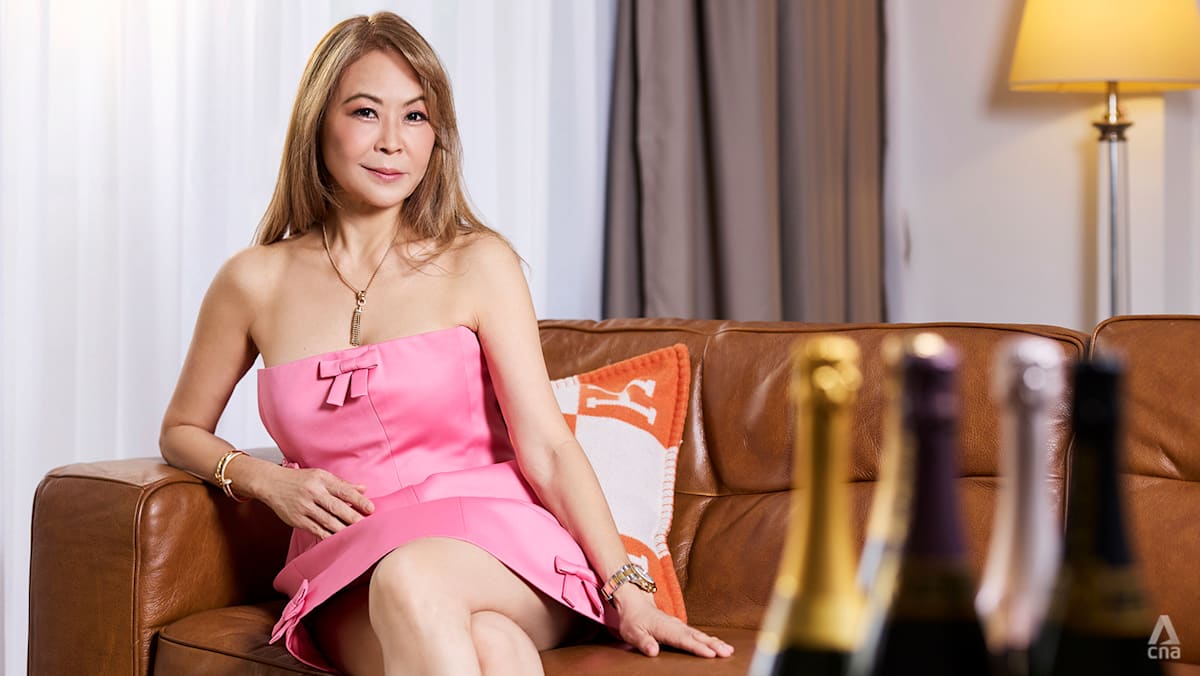
Alicia Thian can still name the bottle that started it all: Chateau Latour from Pauillac, poured at her father’s dinner parties for as long as she can remember. Her father’s circle of friends was mostly European, so Thian grew up around German and Swiss cooking alongside that one recurring red.Of course, she was too young to understand what she was drinking. Chateau Latour, prized for producing some of the most powerful, long-lived wines in Bordeaux, isn't a bottle most children would remember. What she noticed instead was how seriously the adults around her talked about it, and how long the conversation lasted after the glasses were poured.That early curiosity followed her to university. Thian studied Business Administration at the University of California, graduating magna cum laude with a minor in statistics, and later completed a private banking diploma at NTU. While her CV reads like a finance career in the making, her summer and winter breaks tell a different story: she used them to take electives in cognitive neuroscience, psychology, coding and, once she discovered her university offered it, oenology."I have an engineering mindset, defined by structural curiosity, systematic breakdown of problems, and continuous iteration,” she said. “I will do research till I know how and why things work under the surface.” Thian's approach to wine is highly systematic, combining tasting, note-taking and sensory training with vineyard visits and study. (Photo: Alicia Thian) She approached wine the same way, wanting to understand geology, fermentation and sensory evaluation rather than simply developing a taste for good bottles. Back in Singapore after graduation, she kept the habit going: tastings with visiting winemakers, sessions with the local chapter of the International Wine & Food Society, and classes with Tan Ying Hsien, one of the country's few Masters of Wine.“He advised me to journal notes at every tasting, visit vineyards, attend Master of Wine classes, read, and widen my palate to include other grape varietals,” she said. That advice pushed her towards Burgundy while deepening her interest in Bordeaux, particularly the St Julien appellation.It also set the template for how she travels today. While many collectors buy through merchants or at auction, Thian hires Masters of Wine to accompany her through Bordeaux, Burgundy and further afield, treating vineyard visits as study sessions rather than holidays. The wines Thian keeps at home form a smaller “picking” stash, while most of her collection is stored offsite. (Photo: CNA/Kelvin Chia) “My rationale for hiring a Master of Wine for my trips is akin to learning from the specialists,” she said. “I really enjoy conversations about wine with an MW, as they have depth. It's not about showing off a bottle one drank the previous night.”She draws an analogy from an unlikely place: financial television. “I do not fancy smooth talkers at all," she said. “CNBC's Jim Cramer is vastly popular, but I much prefer Bloomberg's Jonathan Ferro's down-to-earth type of news iteration.” Similarly, merchants, in her view, are in the business of pitching. Masters of Wine are in the business of teaching.That approach was put to the test on a trip to the Rhone Valley, arranged mainly because her fiance favours the region's wines. Thian told her Master of Wine, Celine, that she was only tagging along and had little interest in the wines themselves. Celine pressed ahead anyway, working through terroir and varietals, handing out written questions to answer, and taking the group to a local herb farm to study the aromas that show up in a glass of wine.At one point, Celine produced more than 60 glass vials, each holding a single aromatic note, fruity, floral, vegetal, animal, toasty, and had Thian and her fiance work through them blind, training their noses to pick out what their palates alone might miss. A 2021 visit to Maison Krug helped deepen Thian’s appreciation for Champagne, which today makes up a large share of her collection. (Photo: Alicia Thian) “Celine was strict but extremely passionate about passing on her knowledge,” Thian said. “Till today, although I am still not a fan of Rhone, I remember fondly her enthusiasm and teaching style.”Champagne entered her life by a stranger route. A BBC documentary about Winston Churchill and his well-known devotion to Pol Roger set off Thian’s first champagne-buying spree. A visit to Maison Krug in 2021 drew her further into the world of Champagne houses.Burgundy, meanwhile, gave her one of her most memorable encounters. One trip took her to Domaine Armelle et Bernard Rion in Vosne-Romanee, where she met Nelly Rion, one of three sisters from the family’s fifth generation now involved in the estate. For Alicia Thian, anticipation is part of the pleasure of collecting wine – sometimes for years before a bottle is opened. (Photo: CNA/Kelvin Chia) “Nelly was such a terrific hostess, and made sure we understood the terroir that makes up the local area,” Thian said. The visit ended in the family cellar, where Thian tasted a Clos de Vougeot Grand Cru with Nelly’s parents, Bernard and Armelle. “The family is warm and inviting. I love their sincerity.”It is this kind of relationship, built over years and countless vineyard visits, that shapes what ends up in Thian’s cellar. Her collection is built on patience more than volume. She buys young Bordeaux, often en primeur before the wine is even bottled, and puts it away for a decade or two, waiting for the tannins to soften and the fruit to develop into something more layered. “Wines aged 10 years and beyond show dramatic transformations from their youthful character,” she said. “Drinking it feels like reading many pages of a book, rather than one loud sentence." She looks for aromas of leather, tobacco and cigar box in older St Julien and Pauillac wines, and prizes the silkiness that comes once fruit intensity fades. These days, she's working through a Domaine Armelle Bernard Rion Clos de Vougeot Grand Cru 2014 and a Krug Rose, 28th edition. A selection from Thian’s Champagne collection, spanning different houses, vintages and styles. (Photo: CNA/Kelvin Chia) Her current collection runs to roughly 600 bottles of still wine and nearly 1,000 bottles of champagne, stored mostly in an offsite warehouse, with a smaller “picking” stash at home. The oldest surviving bottle is a 1988 Domaine de Chevalier – a run of treasured 1982s did not survive Singapore’s COVID-19 lockdowns nearly as well. “I consumed many cases of my wine, including some prized 1982s, during the lockdown,” she admitted. “Oops.”Thian is also the managing director at Bank of Singapore, a position reached after more than two decades advising wealthy families across Asia and Europe. She sees a clear line between that work and her cellar. “Having seen the volatility in financial cycles, and the hype around occasional sexy instruments, the importance of buying blue-chip wines matters to me,” she said.Asked what she feels when she looks at her collection, her answer has nothing to do with spreadsheets. “Anticipation, and it’s TGIF,” she said. “I look forward to weekends with my fiance, going to our regular haunts and trying new restaurants, matching the cuisine with wine and champagne.”It’s a habit that traces back, in a way, to her father’s table: the long dinners, the good company, and a bottle worth lingering over. The only difference now is that she’s the one who can tell you exactly why it’s worth talking about.
Why this Singapore wine collector would rather learn than show off a bottle
Full Article
Original Source
Read the full article at Cnaluxury →KhanList aggregates and links to publicly available news content. We do not host full articles from third-party sources. Always verify important information with original sources.