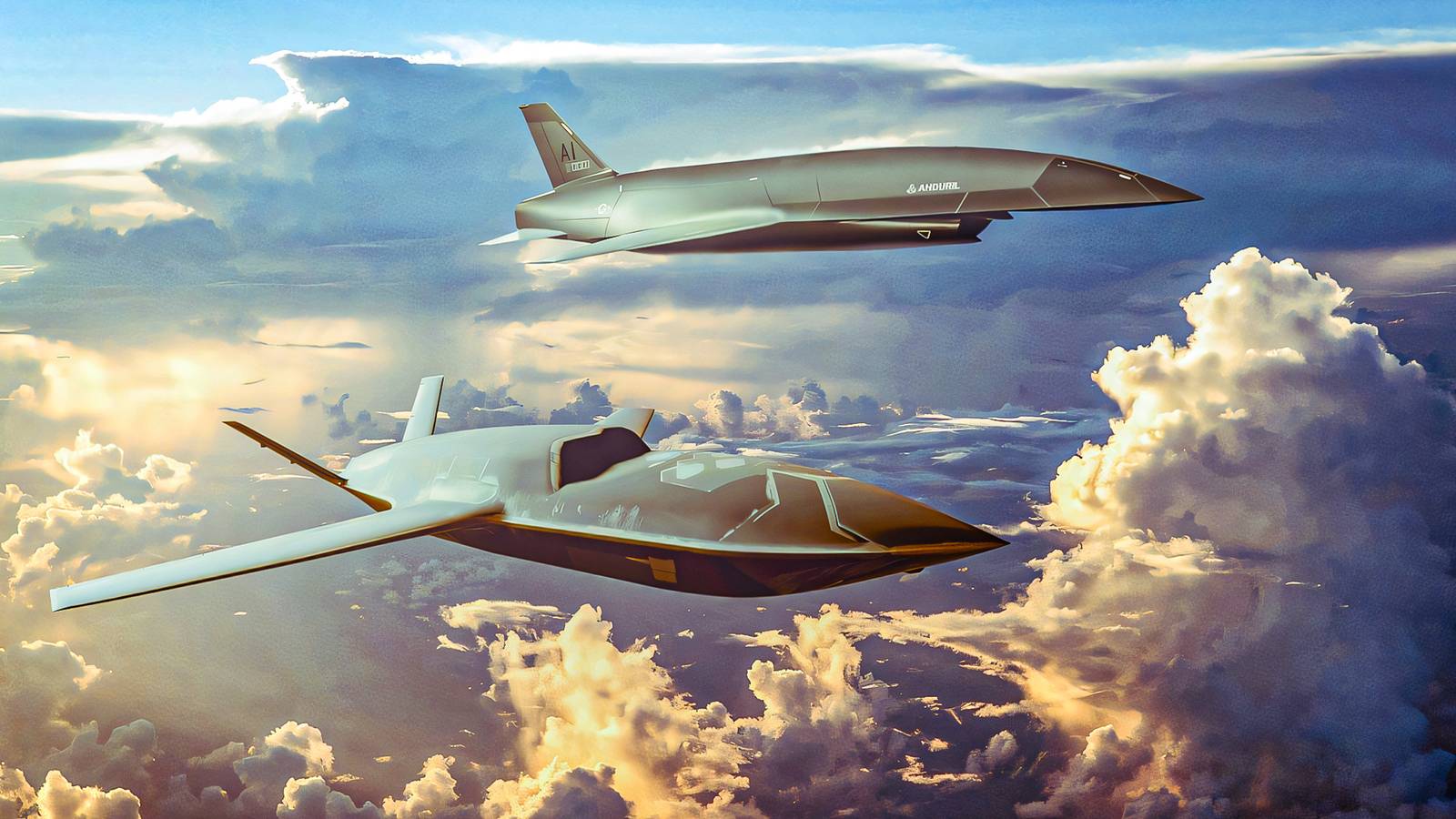
Published Jul 30, 2026, 3:00 PM EDT Luke Diaz is a freelance military writer with experience with active duty experience in the US Navy as well as defense and industrial engineering. He is a former Naval Flight Officer who performed tactical air control on the carrier-based E-2 Hawkeye. The Next Generation Air Dominance will be more than just the next evolution of stealth fighter technology. It will be a full paradigm shift in air warfare. Boeing has officially begun work on the F-47 since it was awarded the NGAD contract in 2025 to make the US first sixth-generation stealth fighter. Yet long before this jet takes to the skies, another advanced aircraft that will fly alongside it is already in low-rate production. That plane is the Loyal Wingman drone, or the Collaborative Combat Aircraft. There are currently two CCAs approved for low-rate production, the General Atomics FQ-42A Dark Merlin and Anduril Industries FQ-44A Fury. These advanced fighter-like drones will fill a vital role in the Air Force of the Future, and the USAF wants a lot of them - 1,000 to be precise. CCAs will act as extra, disposable missile bays, sensor nodes, and more. The Air Force can only afford to buy about 185 to 200 F-47s at the projected $300 million unit cost. That will mean they simply do not have enough airframes to fulfill every mission in a major near-peer conflict with the 'exquisite' NGADs alone. The F-47 will rely on a screen of attritable CCAs worth a fraction of its hefty price tag. During an engagement, a Fury will fly directly toward an enemy aircraft. The pilot in the NGAD, sitting safely miles behind, sees the target on their screen via the drone's data feed. The pilot designates the target and transmits a firing command. Maximizing Software To Enhance Warbirds Credit: US Air Force The Fury will be the 'eyes' of the NGAD pilot by scouting ahead; its payload will be a remote arsenal to command at will. The CCAs form an automated, airborne mesh network, and the FQ-44A can also act as a shield in the worst-case scenario. They are designed to intentionally draw the enemy’s surface-to-air missiles, forcing enemy air defense batteries to waste their limited, multi-million dollar ammunition stockpiles on expendable targets. The Fury was developed with a software-first approach that leveraged Anduril's Lattice for Mission Autonomy and Shield AI’s Hivemind autonomy programming. Instead of being completely automated or remotely piloted at all times, it is semi-autonomous, and it does not need a continuous data link connection to carry out its mission. If its connection to the F-47 or a satellite relay is broken, the FQ-44A can continue operating within the bounds of established mission parameters and emergency procedures. Fury solves the problem of cognitive load on aircrew by using task-based autonomy to fluidly integrate with the pilot of an NGAD at the time when they are needed and fly itself safely and effectively when they are not. Simultaneously, this reduces the burden on the pilot to interact with the FQ-44A frequently during operations, and it also cuts down on the amount of bandwidth required between the NGAD and the Fury, which frees up computing power and upload capacity to the wider 'combat cloud.' The NGAD's Loyal Wingman: Dynamic Duo Credit: US Air Force The F-47 flies in receive-only, passive sensor mode with its radar completely turned off to remain totally invisible. It pushes a flight of two to four CCAs miles ahead into the enemy's Anti-Access/Area-Denial bubble. The CCAs can use Infrared Search and Track optics and digital Electronic Support Measures antennas or even turn on their radars. The CCAs map the battlespace, and beam that targeting data backward to the F-47 via secure, directional Low Probability of Intercept data links. On mission, the NGAD and the Fury continuously track each other's physical coordinates by keeping radio beams pointed directly at one another, which also transmit sensor data. The FQ-44A communicates with the F-47 in full emission control, or EMCON 1, via an advanced derivative of the Multifunction Advanced Data Link, operating in the Extremely High Frequency bands. This link uses highly directional, narrow-beam signals. The Fury's data is compressed and transmitted to the F-47, where the pilot's mission computer displays this target as a track file on a tactical map. When the pilot authorizes the strike, the F-47 transmits a single, cryptographic signal packet. The FQ-44A's mission computer validates the cryptographic key, closes the firing circuit, transfers the target state vector to the missile’s internal guidance system, and commands weapon release. Because the radio frequency energy does not spill out in all directions, an enemy electronic intelligence system cannot intercept the transmission. By alternating the CCAs between passive and active, the combat pair completely breaks the sensor-to-shooter loop of a modern air defense network. Inside Fury: Deceptive Simplicity Credit: US Air Force It is easy to oversimplify the nuanced and complex inner workings of the NGAD and CCA because of how the autonomy, stealth, and computing technology of both platforms make the surface-level appearance of operations seamless. The most advanced integrated air defense systems, or IADS, developed by near-peer adversaries like Russia and China have been built to detect low-observable aircraft. Still, the F-47 and the FQ-44A have been engineered to exploit their limitations. Advanced IADS networks utilize low-frequency early-warning radars to detect the generalized presence of stealth shapes. The air missile batteries also utilize frequency-hopping radars that can saturate a vast spectrum of frequencies thousands of times per second. Simultaneously, coherent radar processing allows these anti-aircraft systems to analyze the exact phase, frequency, and timing of the radio waves they emit. They use ultra-wideband Digital Radio Frequency Memory paired with cutting-edge active electronically scanned arrays to inundate the air with radar waves and instantly scrutinize every 'blip' that comes back. The technology of these systems, such as Russia's S-400 and S-500 SAM batteries, is very lethal, but the core strength of these IADS lies in the interconnected network of distributed sensors and 'shooters.' When one radar station detects a threat, every other site and missile launcher receives the same data almost instantaneously. Yet, the NGAD and Fury are built to break every link and even the best chain of air defense networks. Air Force Of The Future: Overcoming The Odds Credit: US Air Force For decades, the fundamental problem of stealth aviation was that the moment a pilot turned on their primary radar to locate an enemy, they effectively lit a spotlight on themselves. Compounding this vulnerability, advanced air defense systems are too smart for basic radio static jamming; they can just burn right through it. The FQ-44A drone beats them by being a digital copycat. The drone's AI observes the enemy's radar emissions in real-time, copies it perfectly in less than a millisecond, alters it slightly, and shoots it back to mask itself. The F-47 acts as a hidden arsenal manager, while the FQ-44A drones carry extra munitions directly into the hot zone. The NGAD's supercomputer avionics suite can also deploy active cyber warfare tactics to support the Fury drones. It can intercept enemy communication networks and inject false data into the enemy's integrated command-and-control network. This allows the drones to act as forward shooters, striking heavily defended SAM sites as soon as they are exposed. The Fury bounces the signal off the enemy's air defense missiles, and the F-47 pilot sits back in the shadows and watches where the reflections go. When the FQ-44A goes active, the enemy thinks the drone is the only thing out there, so they point all their weapons at the drone. The crewed F-47 will act as an airborne command center or 'quarterback,' staying at a safe stand-off distance. For heavily fortified IADS, the NGAD can deploy next-gen munitions at this point, like the AGM-158D JASSM-XR missile, from over 1,000 nautical miles (1,852 km). The Battlespace Of Tomorrow: One Solution Credit: US Air Force Beyond replacing the legacy 'Wild Weasel' mission as the ultimate suppression of enemy air defenses solution, the F-47 and Fury will be an inseparable repair for missions across all combat domains. During defensive or offensive Combat Air Patrol missions, a single NGAD fighter can command a picket line of multiple Fury drones. Fury drones can rotate in and out of the patrol zone to refuel or rearm while the NGAD fighter remains on station. In highly contested battlefields where traditional Close Air Support aircraft like the A-10 or F-35 cannot safely loiter, the unmanned Fury can hover directly over friendly ground troops. The Fury’s onboard AI continuously filters sensor data. It automatically ignores background clutter and highlights high-priority threats. When it comes to maritime patrol over vast ocean expanses, Fury drones fly low ahead of the NGAD fighter to scan past the radar horizon. They can detect, track, and identify enemy surface warships, amphibious assault fleets, or surfaced submarines. In every one of these scenarios, the Fury serves as a valuable sensor node but also an off-board arsenal because fifth- and sixth-generation stealth fighters have limited internal weapons bays. The NGAD pilot can remotely command a nearby Fury drone to fire its own air-to-air missiles at targets designated by the pilot. Free from the physical G-force limits of a human pilot, the Fury can execute extreme, aggressive maneuvers to intercept incoming enemy air-to-air missiles, acting as a kinetic shield for the crewed NGAD jet. Finally, and most importantly, the Fury directly preserves the lives of aircrew by removing humans from the highest-risk combat zones, eliminating pilot fatigue, and preventing the catastrophic loss of a crewed aircraft. In the event that all technology and tactics fail, an FQ-44A Fury can even intercept a missile bound for a crewed F-47 jet, sacrificing itself to save the pilot.
Why The YFQ-44A Is A Glimpse Of How The F-47 Will Fight
Full Article
Original Source
Read the full article at Simpleflying →KhanList aggregates and links to publicly available news content. We do not host full articles from third-party sources. Always verify important information with original sources.