
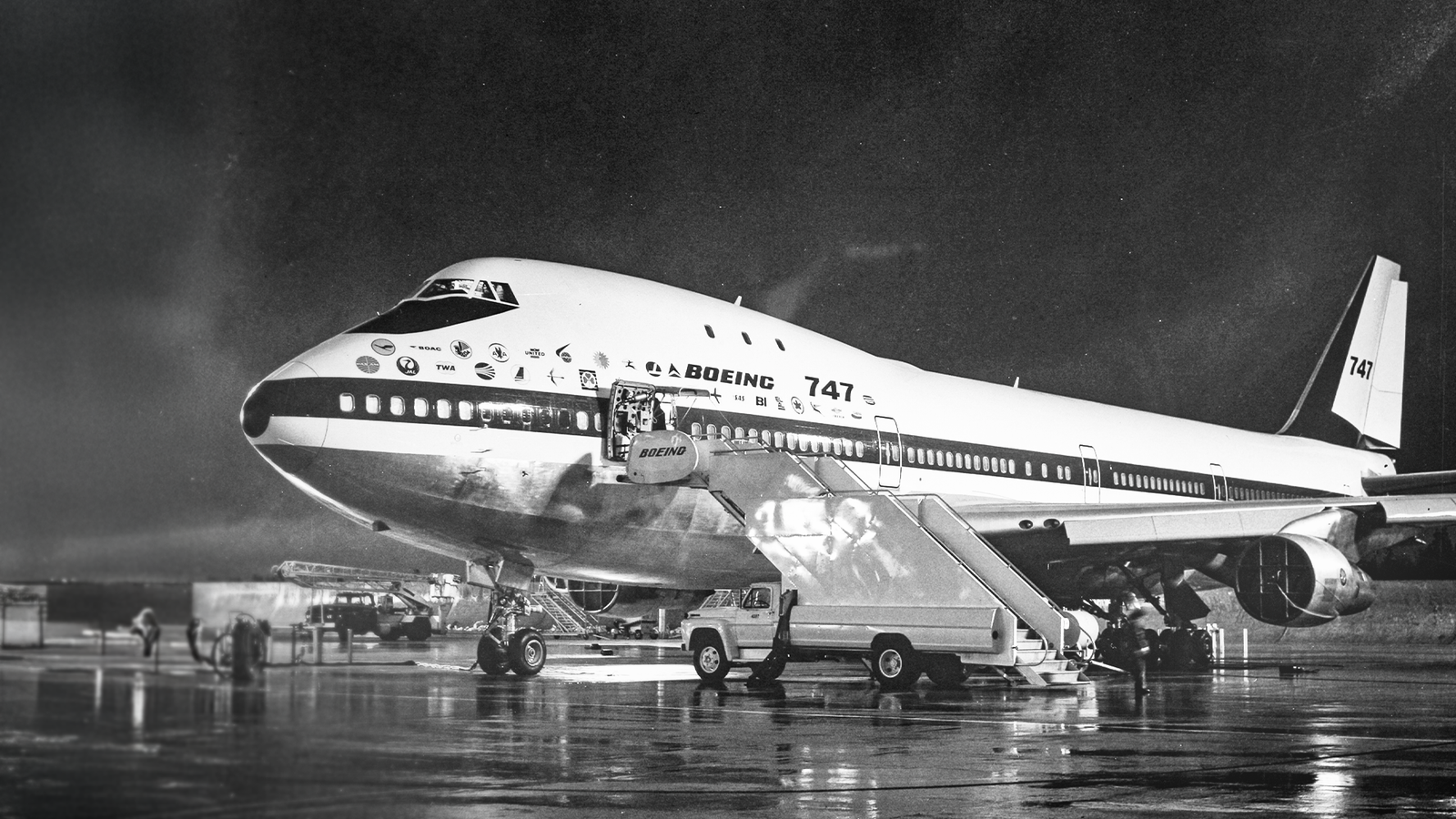
Published Nov 18, 2026, 8:00 PM EST Based in the UK, Josh is a keen writer with a degree in Military History. Having worked previously as a financial journalist, he has covered the aviation industry extensively, reporting on airlines' results and monthly passenger statistics in the aftermath of the pandemic, alongside the likes of regulation around sustainable fuels, and the prospects for hydrogen-powered commercial flight. He joins Simple Flying with a lifelong love of all things aviation. Sign in to your Simple Flying account The Boeing 747 has earned its title as one of the most iconic airliners ever built for several reasons. It was the first widebody aircraft, easily distinguishable by a humped second deck, a key enabler in opening up aviation to the masses, and it enjoyed roughly fifty years of production. But equally as impressive as the Queen of the Skies itself is how it came about. Boeing took the 747 from the drawing board to rollout remarkably quickly. That is, notably faster than the Airbus A380 program took to churn out its first model after officially launching, and quicker than both Boeing and Airbus took with their latest widebodies. What is more, Boeing pulled it off decades ago in the late 1960s. Boeing 747’s 29-Month Development Cycle Just 29 months separated the 747 project’s official launch and the rollout of the first model. Boeing announced on April 13, 1966, that it would build the 490-seat passenger transport that would come to be known as the 747. Exactly two years, five months, and 17 days later, on September 30, 1968, the first 747-100 ceremoniously rolled off the production line at a new purpose-built assembly plant in Everett, Washington. Less than five months later, on February 9, 1969, the aircraft took off for its maiden flight. Test pilots Jack Waddell and Brien Wygle, accompanied by flight engineer Jess Wallick, took the controls, and the jumbo jet passed the major test with flying colors, paving the way for its introduction into service just under a year later in January 1970. All told, that saw the Queen of the Skies go from a mere concept to carrying passengers in under four years. While that is no doubt a rapid turnaround by today’s standards, the reasons behind the pace are plentiful and clear-cut. Pan Am Piled Pressure On Boeing Over 747 Behind it all was keen interest from Pan American World Airways, which had set out to source a jet two and a half times larger than the existing Boeing 707 against the backdrop of an increasingly busy market. Though the industry was mulling whether supersonic flight would come to dominate in the years ahead, there remained appeal for a huge, versatile airliner that could handle cargo operations rather than passenger services in the future, if needed. As it turned out, Boeing had already looked into something similar, having lost out in a 1965 military transport design competition to the Lockheed C-5 Galaxy. Although the 747 was ultimately largely built from scratch, research into high-bypass engine technology and the thinking behind the 747’s distinctive hump can be traced back to the military project bid. As such, when Pan Am head Juan Trippe and then-Boeing president William Allen met that same year for initial discussions about the 747, something of a basis was already there. Boeing 747-100 specifications: Wingspan 195 feet, 7 inches (59.60 meters) Length 231 feet, 8 inches (70.60 meters) Height 63 feet, 4 inches (19.30 meters) Range 5,300 nautical miles (9,815 km) Max takeoff weight 735,000 lb (333,500 kg) Cruise speed Mach 0.84 Engines 4 x P&W JT9D-7A or 4 x P&W JT9D-7F or 4 x GE CF6-45A2 It was Trippe himself who is said to have pushed so heavily for the 747. He had spent years beforehand attempting to open up aviation to the masses, overseeing the introduction of the world’s first economy fare in 1958, for instance. Given that an ambitious project like the 747 would only aid in reaching that goal, Trippe reportedly told Allen in 1965: “If you’ll build it, I’ll buy it.” By April 1966, the commitment was solidified through a $525 million deal — worth almost $5.5 billion today — for 25 of the new jumbo jets. This set an ambitious deadline of 1969 for the first delivery, though. The Incredibles And The Huge Workforce Behind The 747 Project Nonetheless, Boeing did not waste any time in dwelling on the task at hand. After signing the contract with Pan Am, the design team of just a few hundred workers conceptualizing and writing up requirements for the 747 ballooned to 4,500 almost instantaneously. These workers, who would later become part of a group known as The Incredibles, were led by Joe Sutter, who would similarly earn the title of the Father of the 747 over time. Sutter himself enjoyed a 40-year-long career at Boeing, although he recalled in a 2013 interview fearing for his job as he and his team rushed to get the 747 ready. Without public backing, Boeing found itself racking up debt on the back of the project, leaving Sutter under pressure to cut jobs. Instead, he requested hundreds more engineers. “I figured that was the day I lost my job at Boeing,” he said, “but I went to work the next day, and nobody said anything, so I kept working." According to Boeing, some 50,000 employees ultimately ended up working on the jumbo jet over the course of its development cycle. Armed with an eye-watering 75,000 drawings, physical assembly of the first model got underway in September 1967, a year prior to its initial presentation to the world and only 16 months before the first flight. All of this, of course, required a specialized facility for production to actually be carried out. No Time Wasted In Setting Up 747 Factory Such a factory did not exist when Boeing first unveiled plans for the 747, so it had to be built almost in conjunction with the first model. Among the battles Sutter fought in his bid to steer the project to a timely conclusion was one over where his team would be based. Faced with the proposal of being sent to California, Sutter argued against it and insisted his engineers stay close to where those who would eventually build the aircraft would work. This turned out to be Everett, which was far from Boeing’s first choice to house the 747 program initially, but prevailed on similar fears that key personnel would not relocate in great numbers to a new facility elsewhere. Regardless of where the 747 would be built, a new building would have to be constructed to accommodate such a vast aircraft and all the equipment needed to build it. Under the tight deadline set by the deal with Pan Am, Boeing set about clearing forest and then building the facility in 1967. Work began just before assembly of the first 747 started, but the two efforts overlapped, meaning the prototype was under construction in an incomplete factory for a period. When the former was eventually completed, it took the crown as the largest building in the world by volume — a title it retains to this day and a reflection of the mammoth undertaking by Boeing to get the project off the ground. The 747 Program’s Vast Financial Backing Naturally, such an effort required vast financial backing, and it took a monumental amount of risk on Boeing’s part to get the first 747 successfully turned around at such a pace. Boeing had secured $525 million — or $21 million per aircraft — under its deal with Pan Am. This covered barely half of the program's total $1 billion costas it transpired; however, adjusted for inflation, it would exceed $10 billion today. As a result, Boeing faced financial pressure and was forced to turn to the banks, which explains Sutter being asked to cut engineers midway through the program. He said in 2013 that “it was a big gamble,” adding, “I think the only reason that it happened is that Bill Allen was a forward-seeking guy, and Juan Trippe from Pan Am also had that characteristic.” Core Boeing 747 variants: Aircraft 747-100 747-200 747SP 747-300 747-400 747-8 Entry into service 1970 1971 1976 1983 1989 2012 Approx range 5,300 nautical miles (9,815 km) 6,865 nautical miles (12,715 km) 6,650 nautical miles (12,315 km) 6,691 nautical miles (12,392 km) 7,260 nautical miles (13,445 km) 8,000 nautical miles (14,816 km) Typical seating (three-class) 366 400 276 412 416 467 Despite racking up debt, the gamble paid off, and the 747 was a resounding success. Not only did the first model get built and delivered on time, but the factory Boeing built for the jumbo jet has enjoyed decades of service since. Some 1,574 747s rolled out of the site over the life of the program, culminating in the delivery of a final 747-8 Freighter variant to Atlas Air in 2023. Notably, this saw production of the 747 end just a year before that of its primary challenger, the A380, despite its initial introduction decades earlier. Airbus A380 And Other Rivals Took Longer The A380 is an impressive feat of engineering in its own right. The industry moved in a different direction, and while Boeing hit a sweet spot with the 747, the appetite for huge quad jets was by no means as strong as it was at the A380’s commercial entry in 2007. All told, this saw the 254th and final A380 completed in 2021. Airbus grappled with a string of delays between officially launching the A380 in December 2000, unveiling a prototype in January 2005, and then making the initial delivery to Singapore Airlines in 2007. How severely these impacted the A380’s long-term success is up for debate. Either way, the A380’s stretched timeline offers some context for how impressive Boeing’s effort was in getting the 747 up and running so quickly. And it is not just the A380. Boeing itself took three years and six months to show off its first 777 after launching the program in October 1990. Its 787, despite going from concept to prototype in three years and three months, then took an additional two years and five months to first take off in December 2009. As for Airbus, the A350 and its answer to the clean-sheet 787 went from launch to initial rollout in six years and five months. Similarly, the 777X project took more than five years after launching in 2013 to produce a prototype, with certification still not secured today.
Why The World's Debut Boeing 747 Was Built In Half The Time Of Other Aircraft Of Its Size In 1968
Full Article
Original Source
Read the full article at Simpleflying →KhanList aggregates and links to publicly available news content. We do not host full articles from third-party sources. Always verify important information with original sources.