
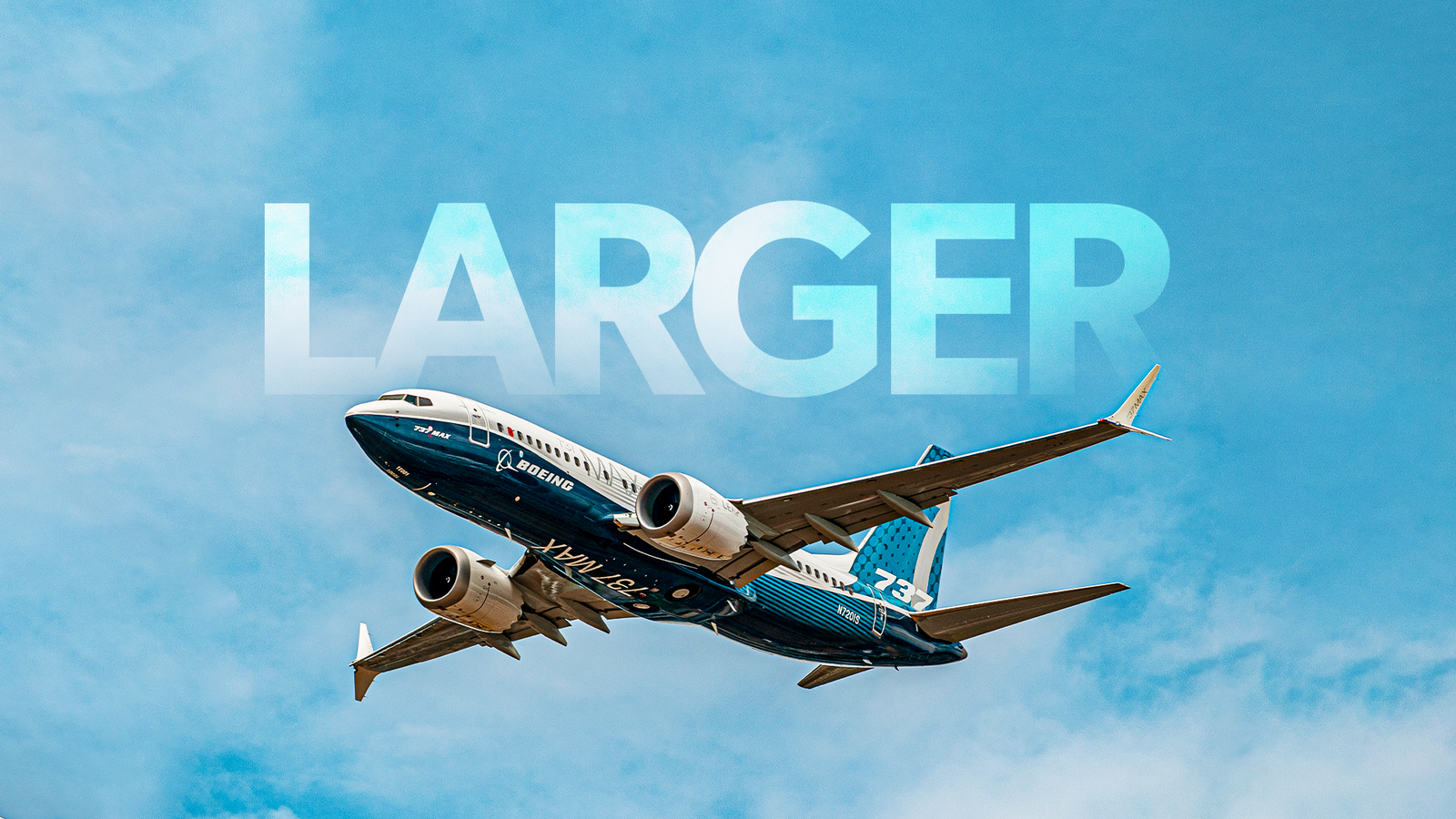
The Boeing 737 MAX 7 finally received airworthiness certification from the Federal Aviation Administration (FAA) on August 3, allowing it to enter production and succeed the legacy 737-700 Next Generation. Aside from being a modernized replacement with better fuel efficiency and superior technology throughout the airframe, the MAX 7 is quite a bit larger than its predecessor. It is essentially the direct result of specific requests from the type's best customer, Southwest Airlines. Although the MAX 7 first flew in March 2018, its rollout stalled following the 737 MAX groundings. Southwest Airlines holds roughly 237 to 264 firm orders for the Boeing 737 MAX 7, accounting for nearly 90% of the model's entire order book. Since Southwest operates an all-737 fleet and is the world's largest 737 customer, Boeing essentially custom-built the MAX 7's stretched dimensions to keep Southwest from defecting to Airbus. Adding two rows of seats lowers the cost per seat-mile, making the jet far more profitable on high-frequency domestic routes than a direct size-for-size replacement would have been. Those make the plane six feet longer than the 737-700 NG, while its wingspan is nearly identical, but it weighs over 20,000 lb (10,000 kg) more. It boasts the longest range in the entire 737 MAX lineup as a result of its shorter, lighter airframe using the wing, fuselage center, and gear of the larger 737 MAX 8. How Southwest Forced Boeing To Redesign The 737 MAX 7 Credit: Robin Guess | Shutterstock Boeing initially marketed the 737 MAX 7 as a direct, one-for-one replacement for the 737-700, keeping nearly identical length, seat capacity, and layout. However, the heavier CFM LEAP-1B engines added dead-weight drag without increasing passenger capacity. As the launch customer whose massive, single-fleet 737 commitment gave it overwhelming leverage, Southwest was not impressed and threatened defection to the clean-sheet Bombardier CSeries, now the Airbus A220-300. SWA has even joined WestJet in demanding lower seat-mile costs from the smallest member of the 737 MAX line. In response, Boeing scrapped the original blueprint it debuted at the 2016 Farnborough International Airshow and stretched the fuselage by 76 inches (1.93 meters), adding 30 inches (0.76 meters) forward of the wing box and 46 inches (1.17 meters) aft. That increased the MAX 7's two-class capacity to 153 passengers. Paired with twin LEAP-1B turbofans and larger fuel tanks, the heavier airframe stretched its unrefueled range out to 3,850 nautical miles (7,130 kilometers). The new cabin gave Southwest a dozen additional revenue-generating seats on every flight without adding cockpit crew. Stretching the fuselage brought the jet's seat-mile costs down to competitive levels. While the 175-seat MAX 8 is Southwest's workhorse on major trunk routes, it is too large to fly profitably multiple times a day on thinner point-to-point routes or off-peak business schedules. Getting Boeing to stretch the MAX 7 gave Southwest A220-level capacity while keeping a 100% 737 fleet. Resisting The Airbus A220: Why Southwest Stuck With An All-737 Fleet Credit: BlueBarronPhoto | Shutterstock Certification delays for the 737 MAX 7 left launch customer Southwest Airlines unable to build reliable schedules around its order book of roughly 300 jets meant to replace aging 737-700s. To keep new aircraft arriving, Southwest converted large blocks of slots into 175-seat 737 MAX 8s, creating network imbalances as the larger jets flew half-empty on thinner routes while 25-year-old 737-700s required costly structural overhauls. During these delays, Airbus saw an opportunity and made a strong pitch for the clean-sheet A220-300. The A220-300 is built with carbon-fiber composite wings, aluminum-lithium fuselage panels, and Pratt & Whitney geared turbofans. Its operating empty weight is about 81,790 pounds (37,100 kilograms), about 17,600 pounds (7,983 kilograms) lighter than Boeing's all-metal MAX 7. This results in a significantly lower trip fuel burn on 130-seat missions. Despite the A220-300's clean-sheet fuel efficiency, Southwest and Boeing resolved to preserve the carrier's 50-year single-fleet business model. Breaking its all-737 discipline to introduce an Airbus jet would have forced Southwest to build separate pilot training pipelines, split spare-parts inventories, and sacrifice the operational flexibility to swap aircraft seamlessly during weather disruptions. Boeing optimized the extended MAX 7 to use raw gross weight, range, and seating density to offset the structural advantage of the A220. The MAX 7 provided equivalent seat-mile economics while maintaining uniformity for all pilots, mechanics, and gate crew on a single aircraft family by carrying up to 12 more passengers in high-density single-class layouts and traveling 400 nautical miles (741 kilometers) farther than the A220-300. MAX 7 Versus MAX 8: How Each Jet Fits Southwest's Flightline Credit: BlueBarronPhoto | Shutterstock Following its August FAA certification and planned March 2027 passenger debut, the MAX 7 takes over missions from Southwest's nearly 290 retiring 737-700s. Its smaller size relative to the MAX 8 means Southwest can offer multiple daily flights between mid-sized cities without having to cut ticket prices just to fill the plane. The 150-seat-count cabin also lets the airline fly with three flight attendants instead of four, saving on crew costs while still carrying more passengers than its predecessor. Already numbering over 340 jets in Southwest's active fleet, the MAX 8 is found flying high-demand routes between major focus cities such as Dallas, Denver, Las Vegas, Chicago Midway, and Baltimore. With 175 seats, it delivers the lowest cost per seat-mile in the fleet and maximizes revenue at slot-controlled or congested airports where adding extra daily flights is not possible. Notably, the MAX 7 also handles tough flying conditions better than its bigger sibling. Specification Boeing 737-700 (NG) Boeing 737 MAX 7 Difference Overall Length 110 feet, 4 inches (33.63 meters) 116 feet, 8 inches (35.56 meters) +6 feet, 4 inches (+1.93 meters) Wingspan 117 feet, 5 inches (35.79 meters) 117 feet, 10 inches (35.92 meters) +5 inches (+0.13 meters) Typical Seating (2-Class) 126–140 seats 138–153 seats +12 to 13 seats Max Seating (1-Class) 149 seats 172 seats +23 seats Max Takeoff Weight (MTOW) 154,500 lb (70,080 kg) 177,000 lb (80,286 kg) +22,500 lb (+10,206 kg) Maximum Range ~3,010–3,365 nmi (5,575–6,232 km) 3,800–3,850 nmi (7,038–7,130 km) +435 to 840 nmi (+806 to 1,556 km) Engines CFM56-7B CFM LEAP-1B ~14–15% better fuel burn Pairing the lighter body of the MAX 7 with the MAX 8's wings, engines, and fuel tanks gives it extra climbing power and range. That makes it a great plane for serving fields with short runways or high-altitude airports, or for long trips to Hawaii and the Caribbean, where a heavier MAX 8 might have to leave passengers or bags behind to take off with enough fuel. How the MAX 7 Powers Southwest’s Shift Toward a New Model Credit: Robin Guess | Shutterstock Southwest’s recent transition from a traditional low-cost carrier into a more conventional, legacy-style airline was distinctly marked by ending its 54-year open-seating policy in January. SWA has since added extra-legroom sections, introduced checked bag fees, and is now planning airport lounges. This paradigm shift in the identity of the airline directly shapes how the MAX 7 fits into its network. Flying a heavier jet changes the economics of Southwest's schedule. Because airports base landing fees on aircraft weight, the 22,500-pound (10,206-kilogram) jump over the 737-700 makes short, cheap regional hops less profitable. To offset those higher airport charges, Southwest has to put the MAX 7 on longer routes where its fuel-saving engines and higher-priced extra-legroom seats earn enough to cover the extra weight. The trade-off of the MAX 7's design gives Southwest the cabin space, amenities, and long-haul capability to compete with Delta, United, and American Airlines of the 'Big Three.' The stretched cabin allows the airline to carve out a dedicated extra-legroom section without sacrificing total seat count or adding a fourth flight attendant. The MAX 7 gives Southwest the right-sized tool to attract higher-spending business and leisure flyers. Still, even after Boeing hands over the first jets in late 2026, Southwest needs roughly three months of ferry flights, maintenance checks, and FAA-monitored proving runs before carrying paying passengers in March 2027. Clearing The Storage Lots: Boeing Ramps Up The MAX 7 Credit: Coby Wayne | Shutterstock Following extensive test flights across the western United States, the Federal Aviation Administration granted final certification for Boeing to begin full production of the MAX 7 in August. Roughly 30 completed MAX 7 jets are finally preparing to depart long-term storage to enter service since earning FAA approval. Technicians are now unwrapping those stored jets and installing the anti-ice upgrades ahead of deliveries to Southwest, setting the stage for passenger flights in early 2027. The Max 7s have been waiting at the main plant as Boeing spent years clearing out the massive 'shadow factory' of hundreds of grounded MAX 8s and MAX 9s in Moses Lake, Washington. At the same time, mechanics are reworking the parked inventory; Boeing has been overhauling its manufacturing footprint to build new MAX 7s alongside the rest of the MAX family. Newly built MAX 7s are scheduled to start rolling off the Renton line for Southwest in February 2027. To break years-long supply-chain bottlenecks as it ramps up toward a target of 47 MAX jets per month, Boeing activated a fourth 737 assembly line dubbed the North Line. Yet, getting the MAX 7 has also turned the spotlight in Renton directly toward the largest member of the family, the 737 MAX 10. Southwest anchors the MAX 7 order book with more than 300 orders through 2031, but major carriers like United, Delta, and WestJet are counting on the 230-seat MAX 10 to rival the Airbus A321neo on high-capacity routes around the globe. Yet the stretched flagship remains stuck in regulatory limbo over flight management software flaws, unique telescoping landing gear, and strict cockpit alerting rules. Until the FAA signs off on those final design changes, airlines across North America are left waiting to see if Boeing can break the last remaining logjam in the MAX lineup and finally close out its troubled narrowbody certification saga.
Here's How Much Larger The Boeing 737 MAX 7 Is Over The Jet It Directly Replaces
Full Article
Original Source
Read the full article at Simpleflying →KhanList aggregates and links to publicly available news content. We do not host full articles from third-party sources. Always verify important information with original sources.