
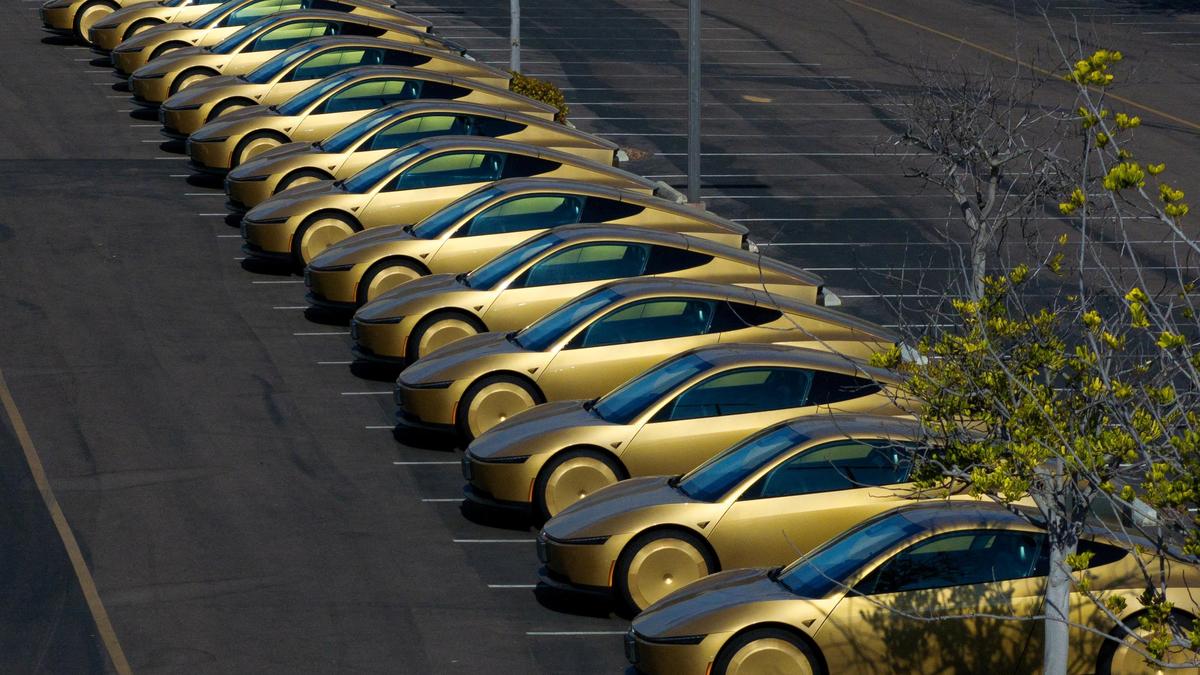
The story so far: On September 3, 2026, Tesla announced the rollout of its new electric robotaxis, offering services in designated parts of Austin, Texas. According to news reports, the self-driving cars are almost impossible to ignore as their gold exterior and ‘Cybercab’ branding catch the eye. But the near-empty interior has sparked questions about the safety of passengers and their ability to intervene in case of emergencies.What are the features of Tesla’s Cybercab?The Cybercab is a self-driving car that has seating for two people. The ‘butterfly’ doors open upwards and the body boasts a sleek, cyberpunk-inspired design that contrasts sharply with the chunkier camera-mounted cars from rival Waymo. The golden exterior is meant to represent a “literal” golden age of transportation, according to Tesla CEO Elon Musk.There are no steering controls or pedals inside the Cybercabs. Mr. Musk has declared that the cars were built for “maximally efficient autonomous operation.” On the absence of brake pedals, he said this would help in reducing the complexity of a hydraulic system, and that “plumbing” would not have to be routed all around the car. Regulators will need to confirm if Mr. Musk’s design choices comply with their safety requirements.Mr. Musk described the Cybercab as “basically a super comfortable lounge on wheels with a great TV and epic sound”. With upcoming Starlink integration, users would be able to watch 4k live video while riding in the Cybercab, he said.Switches under the touchscreen allow users to lower the windows. A cabin camera monitors the vehicle’s interior. The Tesla Cybercab seats two and does not have a steering wheel or pedals [File] | Photo Credit: REUTERS A Tesla Cybercab promotional video showed passengers sleeping, watching movies, playing games, teaching children, holdings dogs, and handling conference calls while they were taking a ride.A major perk for loyal passengers is that their climate and media settings are saved in a profile, and will apply to new rides as well.Children under the age of 13 are not permitted to ride in a Cybercab vehicle.Passengers can stop a ride by either pressing a ‘Pull Over’ button on the touchscreen or a ‘STOP’ button overhead for non-emergency situations. In the event of an emergency, users will be able to pull the door lever to trigger an emergency mechanical release. The Cybercab is designed to also pull over instead of instantly braking, based on its surroundings.Passengers can reach Tesla representatives through the car’s communication system.Have regulators approved the Tesla Cybercabs?While the U.S. National Highway Traffic Safety Administration (NHTSA) is the regulator that enforces vehicle performance standards across the country, car makers have the option to self-certify their offerings.The NHTSA confirmed it has opened an investigation into Tesla’s Cybercab self-certification, to see if it meets the applicable Federal Motor Vehicle Safety Standards (FMVSS).“When certified vehicles appear to not adhere to these requirements, NHTSA conducts an investigation,” stated the regulator.The NHTSA explained that existing standards would remain in force even as the agency reviews rules related to standards for brake pedals, windshield wipers, lighting, and rearview mirrors, to enhance American innovation in automated vehicles.The NHTSA is currently evaluating the Tesla Full Self-Driving (FSD) feature that is built into over three million vehicles. The assessment is related to impaired camera functions that have allegedly caused accidents in poor weather conditions.In July, the NHTSA issued a more general warning about driverless automated vehicles “interfering,” as it noted that the cars drove into emergency scenes, blocked the way of ambulances and fire rescue vehicles, and was unable to respond properly when detecting flashing lights, fire, and traffic cones.“This is unacceptable. To state it bluntly: an AV [automated vehicle] that cannot safely interact with first responders is a danger to the general public,” stated the NHTSA’s letter.Cybercabs are not the first robotaxis launched by Tesla. The EV maker has already deployed its Model Y cars in Tampa and Miami, in Florida, and Austin, Dallas, and Houston, in Texas. Cybercabs are currently available in limited areas only in Austin.What are some concerns surrounding robotaxis?Robotaxis or self-driving taxis have been hailed for a variety of reasons. They are often viewed as a safer option for female passengers, people who cannot communicate verbally, or passengers in vulnerable situations.Supporters of robotaxis claim that they help lower accident rates (when compared to human-operated cars), prevent rash/fatigued/drunken driving, and that the AI systems supporting these cars are rapidly advancing.Robotaxis have also been pitched as a win for accessibility and inclusion, as some customers complained that human-operated cabs cancel rides when passengers disclose disabilities, health conditions, and the use of wheelchairs or service animals. In fact, Tesla’s own Cybercab ad showed users of wheelchairs and crutches being able to store their belongings in the car boot. (This ad, however, did not cover how a non-mobile user would be able to make their way unassisted into the driverless car without their mobility aid.)Still, robotaxis can pose safety risks when facing unexpected circumstances. Videos and posts shared on social media have recorded instances of driverless taxis being unable to move when held up by men blocking their path, leaving passengers fearful inside. Minor crashes and intrusions into protected areas have also been documented.
Why Tesla’s steering-less Cybercab is under investigation | Explained
Full Article
Original Source
Read the full article at Thehindu →KhanList aggregates and links to publicly available news content. We do not host full articles from third-party sources. Always verify important information with original sources.