
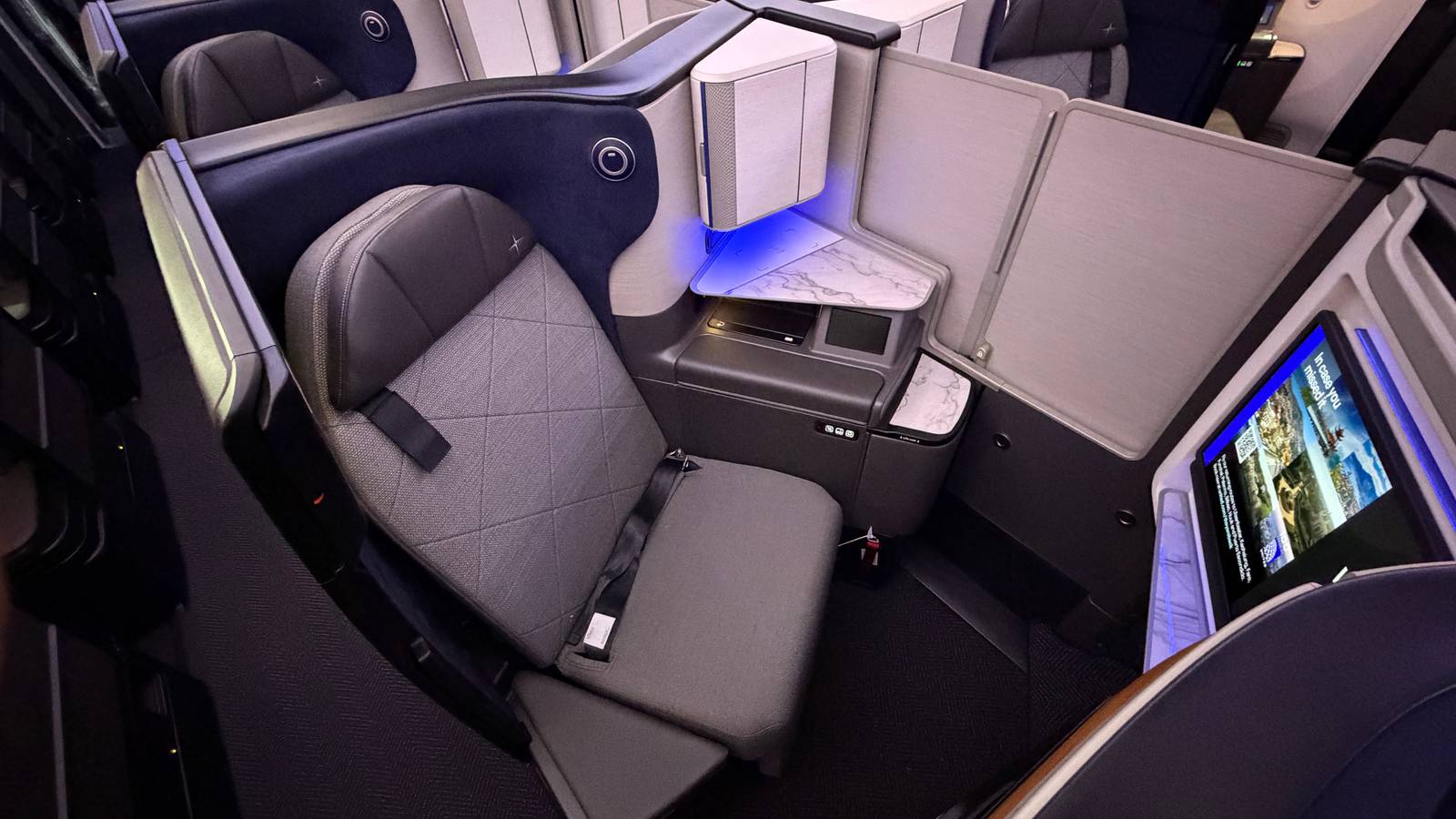
Published Nov 8, 2026, 10:00 AM EST Brandon's passion for aviation started at a young age. He became involved in the flight simulator and VATSIM communities, which sparked his interest in aviation and eventually led him to earn his private pilot license. Outside of work, he continues to build flight hours, explore new airports, and stay involved in the aviation community. More than 50 airlines operate the Boeing 787-9 Dreamliner, and the overwhelming majority stop at business class. Nothing about the airframe requires a first class cabin or prevents one, which makes its presence a configuration decision rather than an aircraft property. British Airways fits eight first class seats in a 1-2-1 herringbone across two rows. Etihad Airways offers first class on its three-class 787-9 while running other versions of the same aircraft with business and economy only, meaning a passenger may find the cabin or may not depending on which airframe operates the route. The more revealing figure is where the premium seats went instead. Head for Points found United carrying 99 premium seats on its 787-9, more than any other operator of the type, ahead of Japan Airlines at 87 and British Airways at 85. United sells no first class at all. It reaches that number through 64 Polaris suites, including eight enlarged Polaris Studios sold at a premium, plus 35 Premium Plus seats. British Airways' A380 retrofit shows the same shift inside one aircraft, cutting first class from 14 seats to 12 while raising business from 97 to 106 and premium economy from 55 to 84. Which 787-9s Actually Have First Class? Credit: British Airways The Boeing 787-9 is operated by more than 50 airlines, and the overwhelming majority of them stop at business class. The aircraft was never designed around a first class cabin, and nothing about the airframe requires one or prevents one. What determines whether a passenger finds first class on a 787-9 is the configuration the operating airline chose, which means the answer varies not just between airlines but within them. British Airways is the most prominent operator fitting first class to the type. Its 787-9 carries eight first class seats arranged in a 1-2-1 herringbone layout across two rows, which makes the cabin noticeably more private than the carrier's larger first class cabins elsewhere in the fleet. BA fits 14 first class seats on its 747, 777, and A380, so the 787-9 cabin is roughly half the size. The airline offers first class on the 777, 787-9, 787-10 and A380, and does not offer it on the A350-1000 or the 787-8, which is a reminder that even within a single carrier's widebody fleet the cabin appears selectively. Etihad Airways is the other notable case, and its approach is the clearest demonstration of how optional the cabin is. The airline operates four distinct 787-9 configurations, only one of which includes first class. That three-class layout carries eight first class suites in rows one and two, with the suites alternating forward- and rearward-facing because of the 787's relatively narrow cross-section. Passengers booking an Etihad 787-9 may find themselves on an aircraft with a First cabin or on one without, depending entirely on which airframe operates the route that day. British Airways Just Showed What The Shift Looks Like Credit: British Airways, Simple Flying British Airways announced a full A380 retrofit on October 5, 2026, and the before-and-after numbers document the industry's direction inside a single aircraft. The 2013 configuration carried 14 First, 97 Club World, 55 World Traveller Plus, and 303 World Traveller, totaling 469 seats. The 2026 configuration carries 12 First, 106 Club Suites, 84 World Traveller Plus and 215 World Traveller, totaling 417. The comparison is unusually clean because it is the same airline operating the same aircraft type on the same routes, with no change in competitive position or market to account for the difference. Every cabin moves, though not in the direction most people would expect. First class falls by two seats. Business rises by nine. Premium economy rises by 29, more than half again its previous size. Economy falls by 88, absorbing the entire seat reduction on its own. The aircraft loses 52 seats overall while gaining 36 premium seats, which means British Airways is flying fewer passengers at a higher average fare rather than more passengers at a lower one. Head for Points calculated the resulting premium ratio at 48%, up from 35% in the 2013 layout, which it identified as the highest of any A380 operator. Lufthansa's A380 sits at 26% with 8 first class, 68 business, 52 premium economy and 371 economy. Etihad's sits at 16% with 11 First, 70 Business, no premium economy and 415 Economy. British Airways did not reach the top of that table by expanding first class. It got there by shrinking it slightly and building out everything immediately behind it, which is the same calculation driving 787-9 configurations across the industry. The 787-9 With The Most Premium Seats Has No First Class Credit: United Airlines, Simple Flying Head for Points compiled premium seat counts across 787-9 operators and found United Airlines at the top with 99. Japan Airlines follows at 87, and British Airways takes third at 85. The ranking is notable because BA reaches its figure while still selling first class on the type, and United reaches a higher one without offering first class at all. More than 50 airlines operate the 787-9, and the one carrying the most premium seats on it has no first class cabin. Head for Points noted this was the only aircraft type in its comparison where British Airways did not lead on premium seating. United gets there by building the front of the aircraft out rather than up. Its Elevated 787-9 carries 64 Polaris business suites, of which eight are Polaris Studios, alongside 35 Premium Plus seats in a 222-seat aircraft. The Studio suites are 25% larger than standard Polaris and carry a 27-inch (68.58 cm) 4K OLED screen, an additional ottoman seat, exclusive entrée options and Ossetra caviar service. United sells them through an additional seat selection fee on top of a Polaris booking, which makes them a first class product priced inside a business class cabin. That structure is the point. A conventional three-class layout places a small, expensive first class cabin ahead of business, consuming floor space at the front of the aircraft where it is most valuable. United's approach fills the same space with eight enhanced business suites priced above the rest of the cabin, then adds 35 Premium Plus seats behind. The result is 99 seats the airline can sell at a premium against the 85 British Airways achieves while running an actual first class cabin. Whether passengers consider a Polaris Studio equivalent to First is a separate question from whether the configuration earns more. What Replaced First: Better Business And Premium Economy Credit: Alaska Airlines The pattern visible in the A380 retrofit explains why most 787-9 operators never fitted first class in the first place. First class consumes prime floor space at the front of the aircraft, demands the most expensive service standard onboard, and sells to the smallest pool of passengers of any cabin. An airline evaluating a new widebody delivery is deciding whether that floor space earns more as a small, costly cabin or as additional business and premium economy seating. On a 787-9, which is smaller than a 777 or A380, that floor space is proportionally more valuable still, because there is less of it to allocate across four cabins. Business class has absorbed most of what first class used to offer. Privacy doors, direct aisle access, enclosed suites and large personal screens were first class differentiators a decade ago and are now standard in competitive business cabins. United's Polaris Studio takes it further, offering a suite 25% larger than standard Polaris with a 27-inch (68.58 cm) screen, an additional ottoman seat and caviar service, sold at a premium above a regular business fare. That is a first class product positioned inside a business class cabin and priced accordingly, without the separate galley, crew ratio, and service standard a true first class cabin requires. Premium economy is the newer half of the answer and the faster-growing one. It captures passengers who will pay above an economy fare but not a business one, a segment that barely existed as a distinct product twenty years ago. On the 787-9, a configuration running a strong business cabin and a substantial premium economy section produces more sellable premium seats than one devoting the nose to eight first class suites, which is the arithmetic behind United's 99 premium seats. First Class Is Still Contracting Credit: Etihad Etihad shows what happens when an airline retains first class and skips premium economy entirely. The carrier offers no dedicated premium economy cabin, and Head for Points identified that absence as a significant reason its A380 premium ratio sits at 16% against British Airways' 48%, despite Etihad dedicating substantial upper deck space to The Residence and First Class Apartments, both considerably larger than BA's first class seats. Prince of Travel found Etihad's first class deployment narrow in practice, available on four routes connecting Abu Dhabi with Casablanca, Geneva, London and Washington, all operated by the 787-9. The reviewers flew Etihad 787-9s on both legs of a trip and found the Malé to Abu Dhabi sector had no first class cabin at all. That reporting is more than two years old and the route list will have changed, but the structural point holds. An airline can build the most elaborate first class suites in the world and still end up with a smaller premium cabin than a competitor that removed its own. That is the calculation behind the business-topped 787-9 configurations that now dominate the type.
Why Some Boeing 787-9s Offer First Class While Others Stop At Business
Full Article
Original Source
Read the full article at Simpleflying →KhanList aggregates and links to publicly available news content. We do not host full articles from third-party sources. Always verify important information with original sources.