
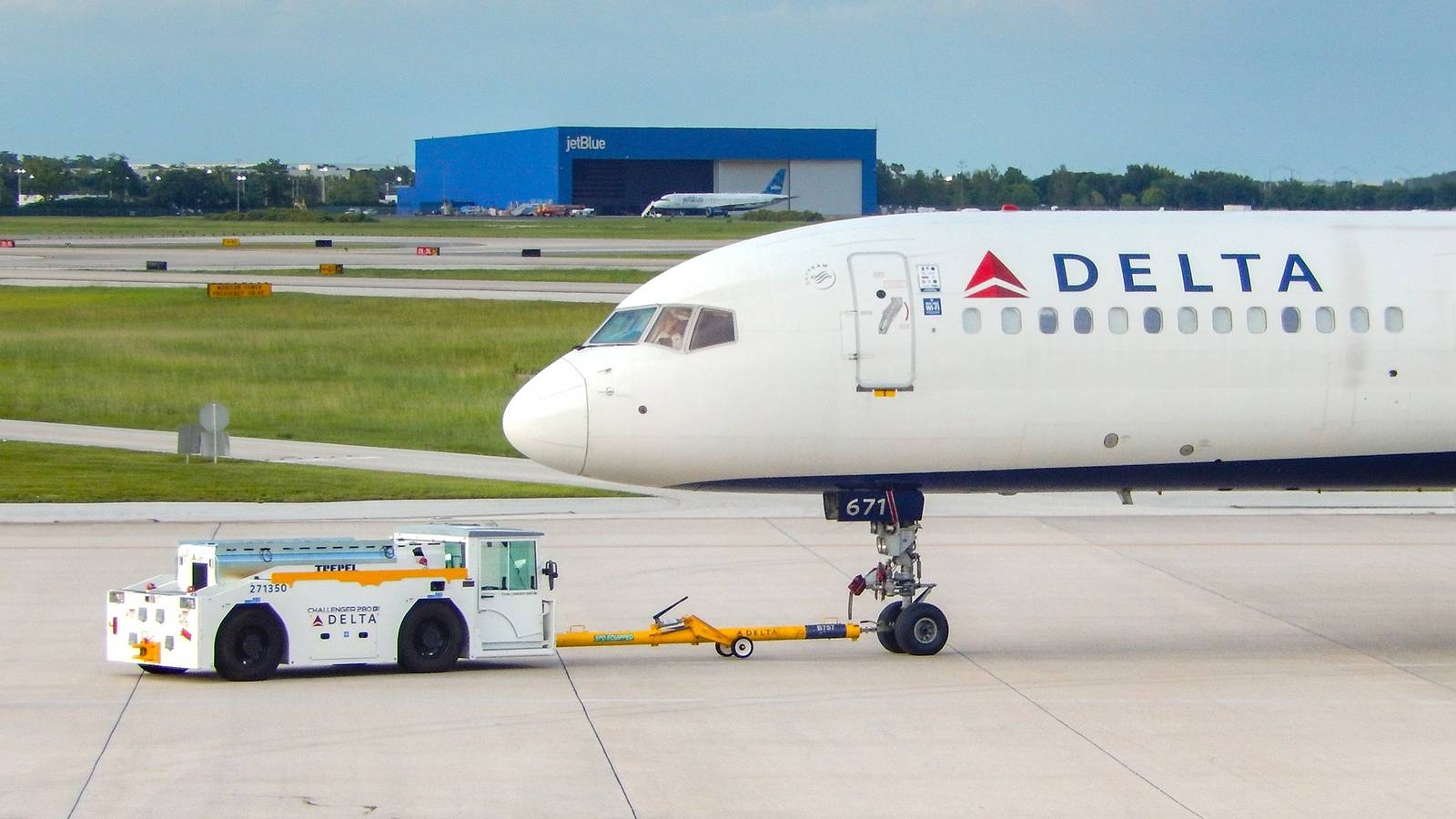
It is one of the more curious sights in commercial aviation: an aircraft weighing hundreds of thousands of pounds, equipped with engines capable of producing tens of thousands of pounds of thrust, sitting helplessly at an airport gate while a relatively small tractor pushes it backward. Despite their enormous power, most passenger aircraft cannot reverse away from the terminal and taxi towards the runway. Instead, airlines rely on specialized ground vehicles to perform one of the most routine parts of every departure. However, this was not always the case. Some older jetliners, including the Boeing 727, Douglas DC-9, and McDonnell Douglas MD-80, could move backward using their own engines. Known as a powerback, the procedure was once used by several major airlines, including American Airlines and Northwest Airlines. So why did this capability largely disappear, and why do modern aircraft manufacturers not design their airliners to reverse independently? Why Airliners Need A Tug To Leave The Gate Credit: Terence Toh Chin Eng | Shutterstock The reason most commercial aircraft cannot reverse out of a gate is surprisingly simple: their landing gear wheels aren't powered. Unlike a road vehicle, an airliner does not have a conventional transmission connecting its engines to its wheels. The landing gear supports the aircraft's weight, absorbs landing forces, and allows it to roll along the airport surface. It does not provide the propulsion needed to drive the aircraft backward. According to AirHelp's explanation of aircraft reversing, an aircraft can theoretically move backward using its engines, but it requires a different approach than simply selecting reverse gear in a car. Jet engines are designed primarily to generate forward thrust, and their thrust reversers are intended to help slow an aircraft after landing. They redirect some of the engine's airflow forward, creating a force that opposes the aircraft's direction of travel. This system was used to move an aircraft backward from a parking stand. However, a thrust reverser is not a conventional reversing mechanism. It does not change the direction in which the engine rotates, nor does it make the aircraft's wheels turn in the opposite direction. Instead, it redirects airflow to move the aircraft backward. Although this sounds simple, the engines' location, the direction of the redirected airflow, and the environment around an airport gate all determine whether the procedure is practical. This raises an interesting question: if powerbacks were possible, why did some airlines once use them routinely and then abandon the practice? The Powerback Era: When Boeing 727s And DC-9s Reversed Independently Credit: Airlinephoto | Shutterstock Powerbacks were once a recognizable feature of commercial aviation, particularly among airlines operating older aircraft with rear-mounted engines. The Boeing 727, Douglas DC-9, McDonnell Douglas MD-80 family, BAC 1-11, Fokker 100, and the large Soviet Ilyushin IL-62 were among the aircraft associated with the procedure. Their engine configurations and thrust-reverser designs made it possible to redirect exhaust in a way that allowed the aircraft to move backward from approved airport gates. These aircraft generally used bucket-style, or clamshell, thrust reversers. When deployed, the reverser doors redirected exhaust forward and outward, allowing the engines to generate reverse thrust. With engines mounted toward the rear of the fuselage rather than underneath the wings, these aircraft offered a configuration that made powerbacks easier to manage. The procedure was particularly associated with American Airlines' extensive MD-80 fleet and Northwest Airlines' DC-9 operations. According to Boltflight's historical account of the powerback maneuver, American Airlines, Northwest Airlines, Eastern Airlines, AirTran Airways, and Alaska Airlines were among the US carriers that used the technique. However, it was not an unrestricted procedure. Airports and airlines had to approve specific parking stands, and ground personnel needed to ensure the area behind and around the aircraft was clear. The procedure also required coordination between the pilots and ground crew, including visual guidance from personnel positioned around the aircraft. One of the most significant developments came in 2005, when Northwest Airlines discontinued powerbacks, citing fuel conservation. The decision reflected a broader change in airline operating priorities: saving the time and ground equipment associated with a conventional pushback was no longer necessarily worth the additional fuel consumption. But fuel was only one part of the problem. As commercial aircraft evolved, their engine placement introduced another, more serious complication. Why Modern Wing-Mounted Engines Make Powerbacks Risky Credit: Kyle Lee | Shutterstock The biggest difference between older powerback-capable aircraft and most modern airliners is where their engines are mounted. Aircraft such as the Airbus A320 family, Boeing 737 family, Boeing 777, and Airbus A350 use engines mounted beneath their wings. This configuration offers aerodynamic and structural advantages, but it creates significant difficulties when reverse thrust is used close to a terminal building. The problem is the direction and distribution of the airflow. Unlike the rear-mounted engines of aircraft such as the DC-9 and IL-62, under-wing turbofans sit relatively close to the airport surface. Their thrust reversers redirect airflow forward and outward, potentially creating powerful turbulence across the ramp. This can disturb loose debris, expose ground personnel to dangerous airflow, and send objects towards nearby aircraft, vehicles, and terminal infrastructure. Foreign object debris (FOD) is a major concern. Small stones, loose baggage straps, discarded materials, and other objects on the apron can become dangerous when exposed to powerful engine airflow. Debris can be blown toward nearby equipment or ingested into an engine, potentially damaging expensive components. The risk is especially non-negligible at busy airports, where several ground vehicles and aircraft may be operating in close proximity. Engine operating conditions also pose a risk. Reverse thrust is not a particularly economical engine mode, and repeated use adds operating cycles to the thrust-reverser system. Depending on the engine and operating conditions, inappropriate use of reverse thrust can also contribute to engine operating problems and increased fatigue. Meanwhile, pilots have limited visibility behind the aircraft, making it difficult to judge obstacles without assistance from ground personnel. Even if a modern airliner can technically generate reverse thrust, is there any compelling reason for an airline to accept these additional risks? Why Airlines Prefer Pushback Tugs To Using Their Own Engines Credit: K-FK | Shutterstock For airlines, the financial argument against powerbacks is probably as important as the safety considerations. Starting engines and producing reverse thrust consumes fuel, while a conventional pushback can be completed using a ground vehicle without requiring the aircraft to generate significant propulsion. Powerbacks burn considerably more fuel than conventional tug-assisted pushbacks, making them an unattractive option for airlines operating large numbers of daily departures. Northwest Airlines’ decision to end powerbacks was clear in 2005, when it stopped using the procedure to conserve fuel. The change was notable because Northwest still operated a large fleet of DC-9s, which were well suited to the maneuver. The airline began relying more on conventional ground equipment to move aircraft away from gates instead of using thrust reversers. American Airlines and other operators also phased out powerbacks in the mid-2000s as fuel costs, operational concerns, and the risks of reverse thrust outweighed the benefits. Additional operational costs were also worth considering. Repeated use of thrust reversers introduces additional demands on components that airlines must inspect and maintain. Powerbacks also generate considerably more noise than tug-assisted movements, potentially affecting airport noise management and nearby communities. Meanwhile, pilots cannot directly see the area behind the aircraft, so ground personnel would still be required to monitor clearances. If airlines must retain ground staff while also burning more fuel, the original advantage of eliminating the pushback vehicle becomes far less attractive. Nevertheless, an important exception still exists: some large aircraft can still reverse under their own power. The Boeing C-17 Shows That Self-Powered Reversing Is Still Possible Credit: EvrenKalinbacak | Shutterstock Although commercial passenger aircraft have largely abandoned powerbacks, the maneuver has not disappeared from aviation altogether. One notable example is the Boeing C-17 Globemaster III. Operated by several air forces, this military transport aircraft has specially designed thrust reversers that let it move backward without a conventional pushback tug. Unlike most commercial airliners, the C-17 was specifically engineered to operate from austere airfields and perform missions where ground support equipment may be limited or unavailable. The US Government Accountability Office explained this capability in its 1991 report, Military Airlift: Cost and Complexity of the C-17 Aircraft Research and Development Program. According to the report, the C-17's thrust reversers redirect both fan and core thrust, allowing the aircraft to back up on a 2% slope. Its reverser system also directs airflow upwards, helping protect ground personnel operating around the aircraft. This feature is important for military transport designed to operate in environments where conventional airport infrastructure cannot always be taken for granted. The C-17 shows that reversing using engine thrust isn't inherently incompatible with large aircraft or wing-mounted engines. Instead, it depends on how the aircraft and its thrust-reverser system have been designed. Military transports have different operational requirements from passenger airliners, including the need to operate from remote locations with limited ground equipment. For commercial airlines, however, the economics and safety considerations remain very different. The question is whether future commercial aircraft could adopt alternative technologies to reduce their dependence on conventional pushback tractors. Why Conventional Pushback Remains The Industry Standard Credit: Tneumanas | Shutterstock The continued reliance on pushback tractors reflects commercial aviation's prioritization of predictable, controlled ground operations. A conventional tug can move an aircraft backward at relatively low speed while ground personnel monitor the wings, tail, and surrounding equipment. The pilots remain in communication with the ground crew through a headset, and the operation is coordinated with airport authorities or air traffic control. According to Fly Away Simulation's explanation of aircraft pushback, this arrangement provides precise movement while avoiding the jet blast and debris risks associated with using reverse thrust near terminal buildings. Modern ground equipment has also evolved considerably. Conventional towbar-equipped tractors remain widely used, but towbarless tugs can grip and lift an aircraft's nose wheels, allowing the vehicle to maneuver the aircraft without a traditional towbar. These vehicles provide a practical solution for moving large aircraft around crowded airport aprons. For airlines, investing in efficient ground-handling equipment is generally more attractive than redesigning aircraft engines and thrust-reverser systems to accommodate a procedure most major operators have already abandoned. Some airport layouts also eliminate the need for pushback altogether. Some remote stands and specially designed parking positions allow aircraft to taxi forward after departure clearance, provided there is a suitable route and sufficient clearance. Nevertheless, conventional nose-in terminal gates remain common, meaning that most commercial aircraft will continue to require external assistance when leaving the terminal. As long as under-wing turbofans remain the dominant configuration, the traditional pushback tractor is unlikely to disappear.
Why Most Airliners Can’t Reverse Out Of The Gate On Their Own
Full Article
Original Source
Read the full article at Simpleflying →KhanList aggregates and links to publicly available news content. We do not host full articles from third-party sources. Always verify important information with original sources.