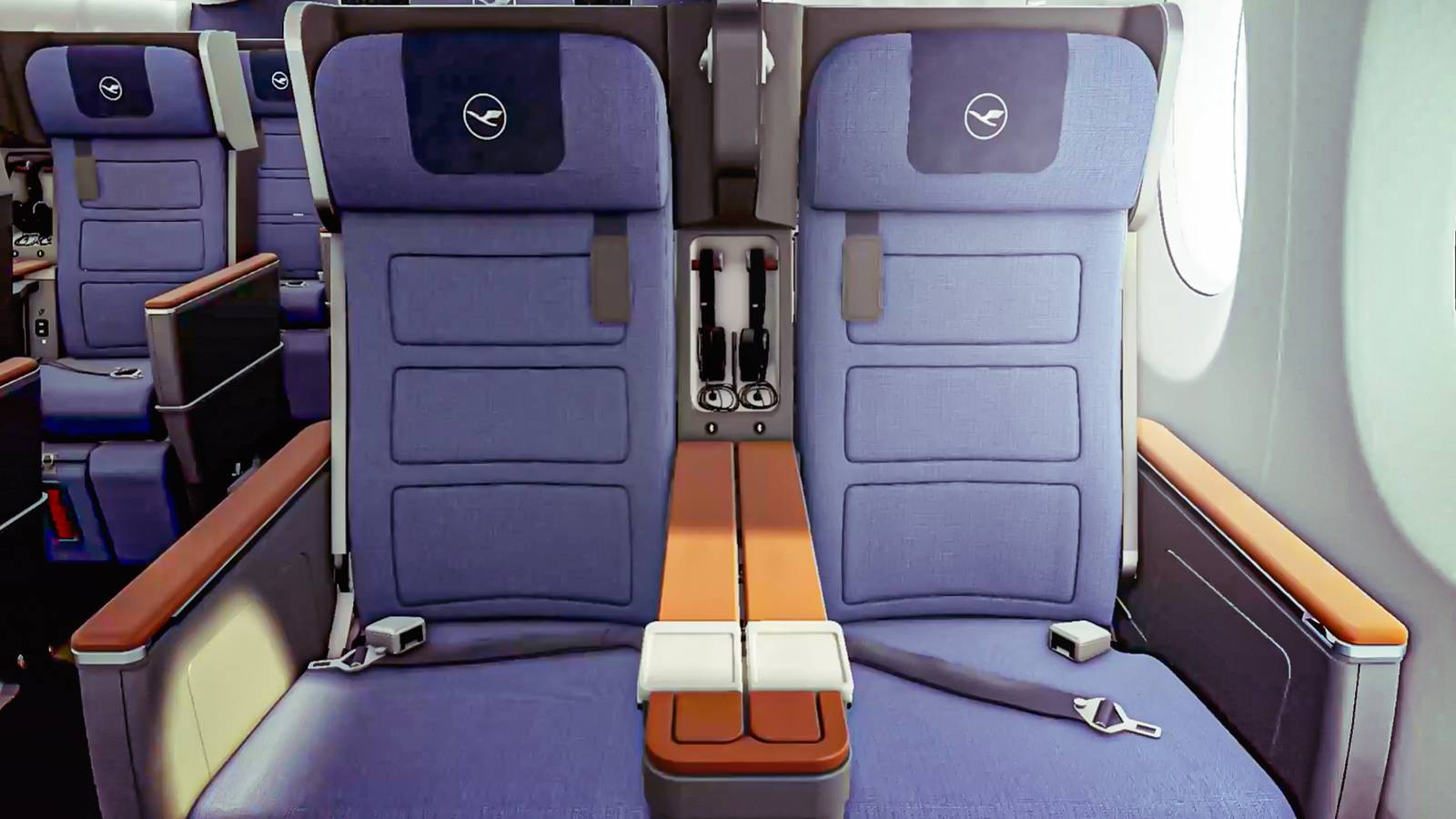
Published Jul 31, 2026, 6:00 PM EDT Airline and Airport Management Graduate, Student Commercial Pilot and Commercial Aviation Writer. Based in London & Nagoya Over the past few years, cash prices for long-haul business class seats have surged across major US to Europe routes, driven by relentless premium demand and dynamic pricing algorithms. At the same time, standard economy cabins remain notoriously crammed on 8- to 11-hour transatlantic crossings. For travelers paying out of pocket or working within strict corporate travel policies, the decision is now to endure an uncomfortable overnight flight in economy, or fork over upwards of $4,000 for a lie-flat bed. Lufthansa's Airbus A350-900 equipped with the brand-new Allegris cabin solves this exact problem. Lufthansa created a long-haul option that delivers nearly 80% of the functional comfort of business class at a fraction of the cost, introducing a dedicated fixed-shell seat and elevated service amenities to back it up. Positioning this product on high-density US routes creates a genuine sweet spot for travelers who want space, sleepability, and premium comfort without paying four-figure fare markups. Privacy Even In Premium Economy Credit: Lufthansa The foundation of the Allegris premium economy experience is its architecture and how the airline has included it within an already highly refined cabin concept. Flying on Lufthansa's A350-900, the cabin features a seven-abreast, 2-3-2 seating arrangement, and is a significant step up from standard economy's nine-abreast, 3-3-3 setup. The layout leaves only one middle seat per row and dramatically widens the central aisle. Engineering-wise, the seat itself measures 19 inches (48 cm) wide and offers 39 inches (99 cm) of pitch, providing roughly 50% more personal space than standard economy. However, the true game-changer is the fixed-shell recline mechanism. Instead of pivoting backward and crushing the knees or laptop screen of the passenger behind, the seat slides forward within its own hard shell. When you recline on an overnight eastbound flight, your personal space remains entirely protected, and the traveler in front of you cannot lean into your workspace. Every seat also features an integrated leg rest, a fold-down footrest, and an adjustable headrest with privacy wings. On the technology front, passengers receive a massive 15.6-inch (39.6 cm) 4K touchscreen monitor equipped with Bluetooth audio pairing, allowing you to stream in-flight entertainment directly to your personal noise-canceling headphones. Dedicated AC power sockets alongside USB-A and USB-C ports are also present to make sure every device stays fully charged throughout the journey across the Atlantic. Real Price Disparities Credit: Shutterstock The Lufthansa Group has been quick to implement dynamic, market-linked pricing models across revenue fares and award redemptions, but this has meant the cash gap between business class and premium economy has widened to unprecedented levels. A round-trip business class ticket between major US gateways like New York (JFK) or Chicago O'Hare (ORD) and Munich Airport (MUC) frequently sits at $3,800 to $5,500 or more, whereas premium economy on the same flight regularly prices between $1,400 and $2,100. This $2,000+ price delta per direction makes all the difference to the value proposition for transatlantic flying. Business class offers a fully flat bed and lounge access, but premium economy delivers the essential elements required to arrive rested: a comfortable recline, zero space invasion, a wide seat, and a dedicated workspace. For couples or families traveling together, selecting premium economy over business class yields net cash savings exceeding $4,000 on a single round-trip itinerary. When business class fares jump to double or triple the price of premium economy, the incremental benefit of a flat bed over a wide, fixed-shell recliner becomes difficult to justify on seven- to nine-hour daytime or evening flights. Premium economy, therefore, captures the vast majority of tangible passenger comfort for less than half the financial outlay. Entering The Realms Of Business Like Premium Economy Credit: Lufthansa To make a premium economy product really stand out, the soft product is where airlines usually put plenty of focus. Lufthansa elevates the Allegris premium economy experience through soft product inclusions that border on business class standards. The perks begin at check-in with a doubled baggage allowance as passengers receive two free checked bags weighing up to 50 lb (23 kg) each. For travelers heading on extended European vacations or carrying heavy gear, this added allowance removes $150 to $200 in excess luggage fees. Once onboard, passengers receive a welcome drink, bottled water at their seat, and a refreshed amenity kit complete with travel socks, an eye mask, and dental items. Meals arrive on real porcelain tableware accompanied by metal cutlery, cloth napkins, and beverage service in glassware, a sharp contrast to plastic-wrapped economy trays that are not too far behind. Ground benefits further add to the journey, as premium economy passengers have access to priority boarding ahead of main economy cabin groups. Additionally, travelers transiting through Munich Airport (MUC) or Frankfurt Airport (FRA) can purchase discounted entry passes to Lufthansa's business lounges, granting access to hot buffets, showers, and quiet workspaces during layovers. Efficient Onboard And Off Credit: Shutterstock Lufthansa has concentrated its initial fleet of A350-900s equipped with the Allegris cabin at its Munich (MUC) hub. For US-based passengers, this decision means transatlantic routes originating from key American gateways have a significantly higher probability of featuring the newly designed premium economy product rather than older, legacy cabin interiors. Major gateways including Chicago O'Hare (ORD), Newark Liberty (EWR), New York (JFK), San Diego (SAN), and Miami (MIA) regularly host daily A350 Allegris flights connecting directly to Bavaria. Munich operates as the primary base for the A350-900, but Lufthansa also deploys newly delivered Boeing 787-9 aircraft with Allegris cabins out of Frankfurt Airport (FRA), which are equally as noteworthy. The best way to be absolutely sure that a flight has the updated experience is through checking seat maps, as seven-abreast seating in a 2-3-2 configuration confirms the presence of the updated Allegris premium economy product. US Gateway Airport Flight Numbers Munich Hub Frequency Aircraft & Cabin Type Primary Long-Haul Distance New York (JFK) LH 410 / LH 411 Daily Airbus A350-900 (Allegris) 4,031 miles (6,487 km) Newark (EWR) LH 412 / LH 413 Daily Airbus A350-900 (Allegris) 4,050 miles (6,518 km) Chicago (ORD) LH 434 / LH 435 Daily Airbus A350-900 (Allegris) 4,420 miles (7,113 km) San Diego (SAN) LH 466 / LH 467 Five times weekly to daily Airbus A350-900 (Allegris) 6,024 miles (9,695 km) Miami (MIA) LH 460 / LH 461 Daily (Seasonal) Airbus A350-900 (Allegris) 4,980 miles (8,015 km) Transiting through Munich Airport is also something that deserves some attention as it provides additional operational advantages for international travelers. Voted among the most efficient transit airports in Europe, Munich features streamlined security checkpoints and compact terminal layouts that make short connections manageable. Selecting a Munich-bound A350 flight allows passengers to have a quiet, modern widebody cabin on the long-haul leg and also avoid the heavier congestion often associated with larger European hubs. Worth Making The Upgrade To Business? Credit: Shutterstock Determining whether to purchase premium economy or step up to business class is one of those common decisions that travelers can never make. For Allegris in particular, the decision really comes down to evaluating flight timing, fare spreads, and sleep requirements. On overnight eastbound flights departing the US East Coast, flight times often range between seven and eight hours and typically leave passengers feeling far more exhausted. When the cash price difference between cabins exceeds $1,500, paying that premium yields diminishing returns for a brief five-hour rest window. The fixed-shell seat in premium economy does provide ample enough recline and support to arrive rested without incurring business class costs, so ultimately, the value proposition does favor premium economy in this sense. Conversely, specific commercial scenarios flip the value equation in favor of business class. During promotional fare sales, consolidator ticket releases, or off-peak travel windows, the fare gap between premium economy and business class can narrow to under $400 each way. In those instances, the incremental upgrade cost unlocks full lie-flat beds, lounge entry, and multi-course dining, making business class the superior purchase. Daytime westbound flights returning to North America present an even stronger case for premium economy, mainly because passengers remain awake for most of a 9- to 11-hour daytime flight, and the need for a lie-flat bed decreases significantly. The fixed-shell design creates an effective mobile office environment, allowing travelers to work on laptops, stream content on the 4K displays, and enjoy personal space without paying thousands more for unused sleeping hardware. Bringing True Value To Premium Economy Credit: Shutterstock Finally, getting a seat in Lufthansa's A350 Allegris Premium Economy can be accomplished through several strategic booking paths. Travelers holding Miles & More status or Star Alliance frequent flyer points can use miles to upgrade from standard economy fare classes. Additionally, Lufthansa routinely issues fixed-rate cash upgrade offers through its app and website during the 24-hour online check-in window, allowing passengers holding discount economy tickets to get premium economy seats for $300 to $500 per transatlantic segment. Seat selection within the Allegris premium economy cabin is something that needs a bit of attention when it comes to row layout. Bulkhead seats in row 14 offer maximum leg extension and feature integrated calf rests rather than simple footrests. However, travelers in bulkhead rows must store personal items in overhead bins during takeoff and landing. For optimal quiet, mid-cabin window and aisle seats away from galley areas provide the ideal balance of privacy and tranquility. Business class fares, for the most part, remain high across transatlantic routes. In the face of this, Lufthansa's A350 Allegris premium economy stands out as a pragmatic solution for modern flight planning. Bringing together fixed-shell engineering that protects personal space with generous baggage allowances and refined soft products, this cabin offers the ideal balance of luxury and financial logic. For travelers seeking high-level comfort without inflated ticket prices, it is quite clearly one of the smartest ways to cross the Atlantic in 2026.
Why Lufthansa's Airbus A350 Premium Economy Has Quietly Become The Sweet Spot On US Routes
Full Article
Original Source
Read the full article at Simpleflying →KhanList aggregates and links to publicly available news content. We do not host full articles from third-party sources. Always verify important information with original sources.