
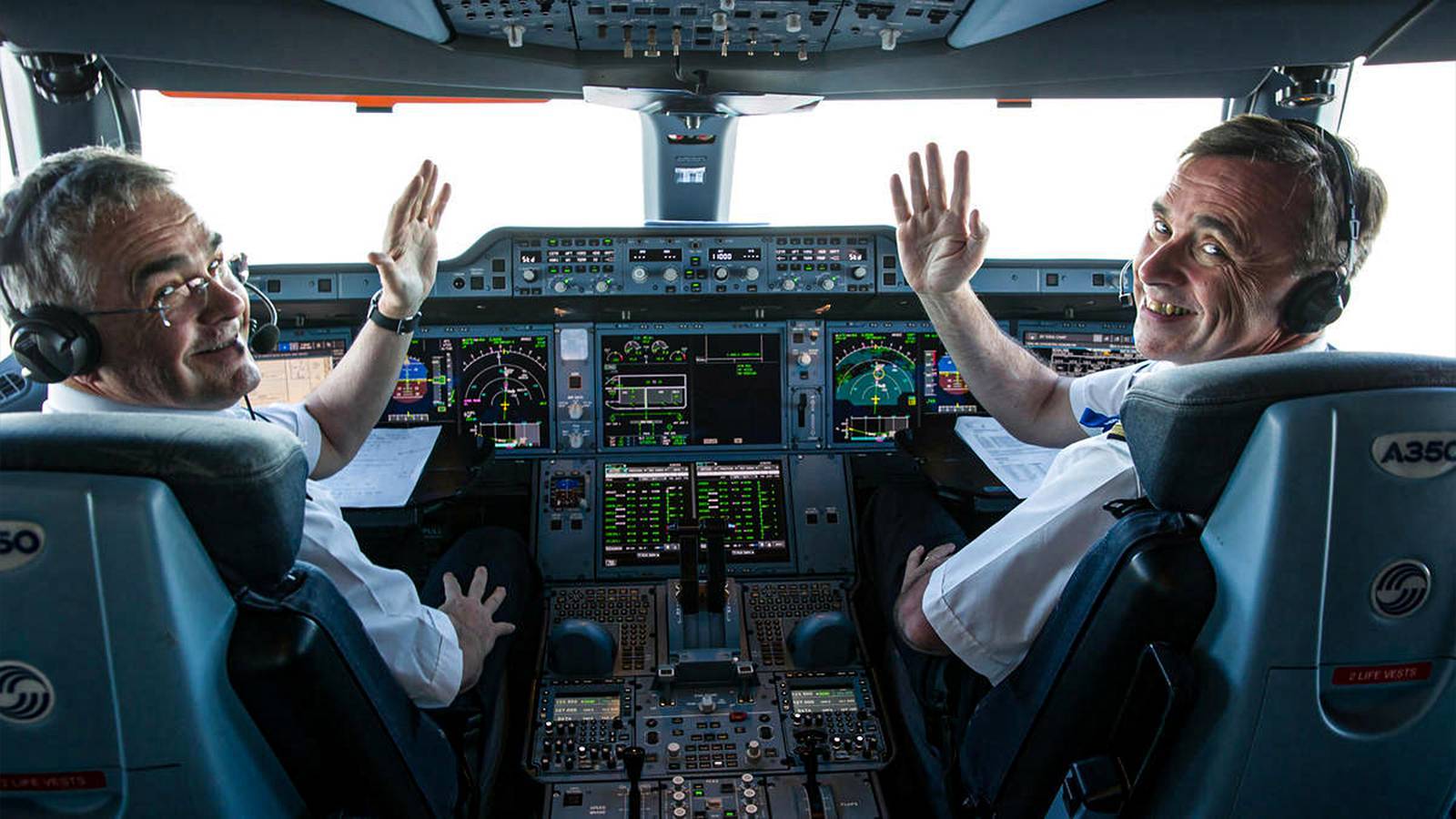
Published Nov 20, 2026, 3:00 PM EST Daniel comes to Simple Flying with a business focused approach to the aviation world. Daniel enjoys analyzing strategy and how companies move against each other to gain a step ahead in the skies. Besides strategy, Daniel also has a passion for aircraft design and the history of aviation. Based in New York Essentially, all commercial airliners in service today need two pilots: one captain and a first officer. These two have always been present on large transport aircraft, but airliners of the past also included a flight engineer, with earlier models even having a dedicated navigator and radio operator. However, as technology advanced and more aircraft functions were automated, manufacturers trimmed down flight crews until today, when most flights require only two pilots. Still, many widebody flights operate with three or four pilots, as one or two pilots may serve as a relief pilot. This is done on long-haul and ultra-long-haul flights because crew rest regulations allow each pilot to work only a limited number of hours each day. The larger roster allows pilots to rotate throughout the flight, with one or two resting onboard. This arrangement ensures compliance with regulations and preserves safety, but it's also expensive. As such, some airlines and Airbus are looking to change it. How Ultra-Long-Haul Flights Are Staffed Credit: EQRoy | Shutterstock Exact practices vary by local regulations and sometimes by standard airline operating procedures. Generally, however, the rule of thumb is that any flight over eight hours requires a third pilot to be rostered, while flights scheduled to exceed 12 hours must be staffed with four pilots. All crew members will be present in the flight deck during critical phases of flight. Meanwhile, during cruise, they will rotate among each other so that two crew members are flying while the third (and fourth, if applicable) are resting. Some carriers will roster the relief pilot as either another first officer or captain, while others may specifically roster 'second officers' (also known as cruise pilots) who do not perform takeoffs or landings. Aircraft Typical Pilot Crew Rest Facilities Airbus A330/A340 Located on passenger deck behind flight deck, or underfloor modules located within the cargo hold, or blocked business class seats Airbus A350 Overhead modules located in the crown area Airbus A380 Located on passenger deck behind flight deck Boeing 747 Located on passenger deck behind flight deck Boeing 767 Underfloor modules located within the cargo hold, or blocked business class seats Boeing 777-200ER Overhead modules located in the crown area (newer) or underfloor modules located within the cargo hold, or blocked business class seats Boeing 777-200LR/300ER Overhead modules located in the crown area Boeing 787 Overhead modules located in the crown area On the world's longest flights, carriers will typically staff flights with two of their most senior captains and two of their most senior first officers, while carriers that roster second officers will not schedule them on their longest services. The actual onboard rest schedule is typically determined by the pilots themselves, developed in such a way to ensure compliance with the airline's home regulator. Onboard, most modern widebody aircraft are equipped with crew rest pods located either above or below the passenger cabin, featuring two beds as well as a seat. These are often, but not always, separate from the flight attendant crew rest area, while aircraft that do not include a dedicated rest area instead have blocked business class seats for pilots. The Expenses Of Rostering Relief Pilots Credit: PJSAero | Shutterstock Most airline pilots are paid by the hour, which means that crew costs increase the longer a flight is. In addition, longer services require an extra pilot or two, which can nearly double pilot salary costs on an ultra-long-haul service. When taking into account that most long-haul flights are performed by widebody aircraft, this further increases crew costs. After all, widebodies pay more than a narrowbody aircraft type, resulting in extremely high labor costs for a 12, 13, or 15-hour flight using large twin-aisle jets. Long-haul and ultra-long-haul flights are quite challenging economically due to added fuel costs, overflight fees, and staffing costs. Augmented crews typically no longer require blocked seats due to the widespread use of underfloor or crown-area rest pods. However, the costs of rostering a captain and three first officers or two captains and two first officers on their own are immense. This is especially true when considering that pilots who regularly operate ultra-long-haul services are typically an airline's most senior and best-paid crew members. The airline industry is infamously cost-sensitive, and ultra-long-haul flights are the most difficult for an airline to make money on. This is despite the revenue premium that they typically command. Airlines, already constantly hunting for ways to reduce operating costs, have also been turning to pilots for more savings, particularly on widebody ultra-long-haul flights. For its part, Airbus has been working on systems to eliminate the need for augmented crews on the A350, which includes the ability to cruise with just one crew member at the controls. Single Pilot Operations On The A350 Credit: Nattanon Tavonthammarit | Shutterstock Airbus has been working on developing systems to enable extended Minimum Crew Operations (eMCO) for the A350. With this system, the aircraft still requires two pilots for takeoffs and landings, but one crew member would rest during cruise while the other would be present at the controls. The two would then rotate throughout the flight, with only one pilot actively flying at a time. Airbus's role would be to redesign cockpit displays and modify systems to reduce workload on the pilot. It has been working with airlines such as Cathay Pacific and Lufthansa to evaluate the feasibility of eMCO, while also working with EASA to assess whether the concept compromises safety. The agency launched a proposal in 2022, which was sent to ICAO, and aimed to potentially transition to eMCO operations as early as 2027. This could allow airlines to significantly cut crew costs for long-haul flights while also reducing the impact of the widely reported pilot shortage. Airbus has been discussing with customers implementing this potential new feature throughout the A350 family. It has also been looking at potentially implementing the technology in the upcoming A350F, which is set to enter service in 2027. While Airbus has been pushing for the development of eMCO procedures, Boeing has stated that the technology isn't yet in place for single-pilot cruise operations to be executed safely. What's more, while there was momentum for Airbus's eMCO initiative, this has since faded. Single Pilot Operations Won't Come Anytime Soon Credit: KITTIKUN YOKSAP | Shutterstock In February 2026, the US Congress passed a new law requiring two pilots to be present at all times in the flight deck on all commercial airline flights. While this was previously enforced by FAA regulations, the new legislation codifies this into law, essentially closing any pathways for airlines and manufacturers to push for single-pilot operations. While it wouldn't be impossible for this law to be undone, it's much more difficult to change the law than to amend FAA regulations. EASA has paused and shelved its research on eMCO and single-pilot operations, concluding that implementing such practices would reduce safety. The regulator was particularly concerned about fatigue management, meeting a pilot's physiological needs, and cross-checking between crew members. As such, it ruled out any regulatory changes in the near future. Instead, the focus is on improving cockpit technologies rather than reducing the number of pilots in the flight deck. While it's often been discussed that airline flight crews have shrunk throughout history, what is often overlooked is that not everyone performs the same function. Flight engineers, navigators, and radio operators all served distinct roles, while there were always two pilots who primarily flew the aircraft. The functions formerly handled by flight engineers, navigators, and radio operators have either been automated or are now handled by the pilots. A Conflict Between Safety And Cost Cutting Credit: Ryken Papy | Shuttertock Regulators have rejected single-pilot operations on commercial transport aircraft. EASA has shelved any plans to operate airliners with one pilot at any time, while the US has prohibited this by law. What's more, existing single-pilot aircraft remain under scrutiny, as the FAA has recently rescinded single-pilot operation exemptions for several Cessna Citation models. This was due to increased accident rates, reportedly double compared with two-pilot flights, along with widespread compliance failures. At the same time, pilots are expensive, and the airline industry is particularly cost-sensitive, which makes developments that cut down on crew costs quite lucrative to airlines. In addition to initiatives like Airbus's work on eMCO for the A350, Merlin is working on developing new AI-assisted copilot systems that could be installed on essentially any large airliner. While these systems are meant to assist pilots at first, the long-term goal is to enable single-pilot or fully autonomous operations. The burden on Airbus or Merlin is to prove that their proposals materially enhance safety compared to today's system of mandating at least two pilots during a flight. Thus far, they have failed to prove this, which means that these systems cannot be implemented in their intended form in the near future. What will happen in the distant future is unclear, but regulators have a responsibility to maintain and enhance safety in aviation, first and foremost.
Why Long-Haul Flights Carry 3 Or 4 Pilots & How Airbus Wants To Cut Some To 2
Full Article
Original Source
Read the full article at Simpleflying →KhanList aggregates and links to publicly available news content. We do not host full articles from third-party sources. Always verify important information with original sources.