
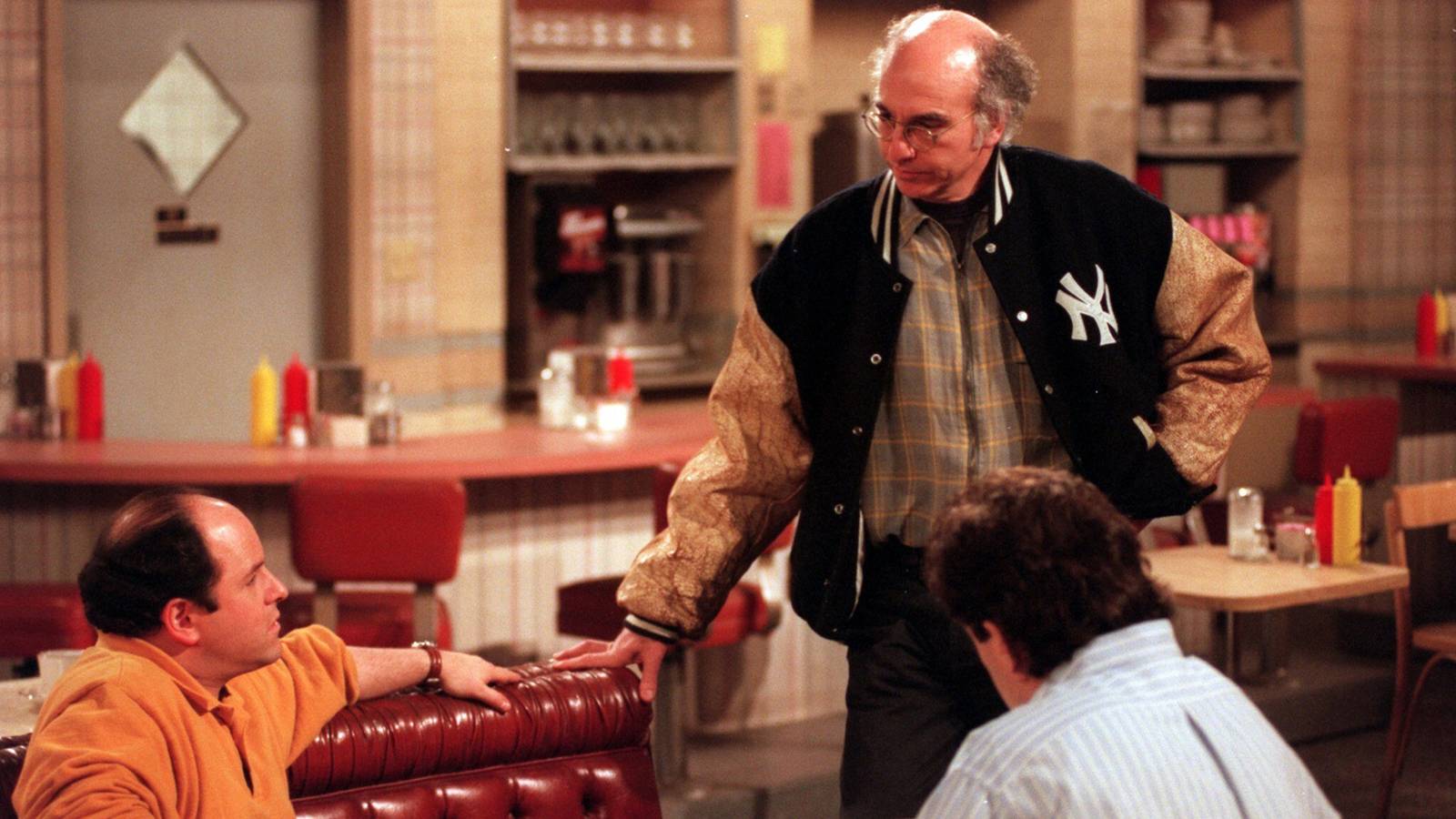
MovieStillsDB Updated Aug 23, 2026, 10:15 PM EDT Sign in to your ScreenRant account Despite helping to create one of the most acclaimed and influential sitcoms of the 1990s, Larry David left Seinfeld after season 7 due to concerns he had over the general direction of the show. Larry David and Jerry Seinfeld created Seinfeld in 1988, initially pitching it as a show about how a comedian gets their material. While Seinfeld himself obviously became the face of the show as its star, David's role was to run it from behind the scenes, serving as head writer and executive producer throughout the show's “golden era", which ended when he left Seinfeld in season 7. Though Larry David’s name wasn’t in the title, his persona persisted throughout, particularly in George Costanza, who was loosely based on him. David's particular sense of humor, which was very similar to Seinfeld's own humor, helped make the show stand out as a unique sitcom at the time. Though the early seasons of Seinfeld struggled to connect due to this distinct style, it eventually became a huge hit that spun into a cultural phenomenon, and the success of the series is part of the reason why David wound up leaving Seinfeld in season 7 despite the show being his own. Larry David Left Seinfeld Over Concerns Of A Dip In Quality Via MovieStillsDB Though Seinfeld was going strong in its seventh season, Larry David began to feel the pressure of keeping the show going. Although he had extremely high faith in the series, David worried that the quality of writing would begin to decline after so many years. By the end of Seinfeld season 7, David feared that the Seinfeld writers would run out of interesting things to write about, and became stressed by the pressure to produce better material for each subsequent episode after seven years. George Costanza actor Jason Alexander pointed out (via Uproxx) that Larry always considered Seinfeld a particularly stressful job, and that if the show failed, the responsibility would fall on him more than Jerry: “He always saw the doing of Seinfeld as a very stressful thing. If it broke, it was going to be he and Jerry that broke it, but I think he took on more of that responsibility,” Alexander told Maron. “We would finish every taping, and — he’s got a whole season arc laid out on some whiteboard somewhere — but we’d finish every taping and he’d go [in a Larry David voice], ‘It can’t be done again! That’s it! It can’t be done!” Like they had no idea for next week, but they had more than an idea. They had a draft. But he would feel pressure very acutely, and after seven years and the money he made, he thought he couldn’t do that anymore.” There were even rumors that Larry David threatened to quit Seinfeld nearly every season but would have to be talked into staying. David helped to create some of the best Seinfeld episodes that helped make the show so iconic, so while he only stayed for the first seven, his influence never faded. Seinfeld Suffered After Larry David's Exit Ironically, given the reason for Larry David's leaving after season 7, critics continually faulted Seinfeld for dipping in quality after his departure. The grounded and dark humor of the earlier seasons were replaced with more wacky antics and less cohesive storylines in the final seasons. However, nobody felt the impact of his absence more than Jason Alexander. David understood George Costanza's quirks better than anyone else and Alexander felt that the best of George exited with the Seinfeld writer. There was no bad blood between David and Seinfeld’s cast and crew, as the once-showrunner continued to voice George Steinbrenner and returned to write for Seinfeld’s controversial season 9 finale. Following Seinfeld’s hit run, David turned to HBO where he began Curb Your Enthusiasm in 2000, a series about a semi-fictionalized version of himself after his Seinfeld fame. David’s time on Seinfeld has frequently been referenced and made into plot points throughout the series, and the entire main cast of Seinfeld has appeared in several episodes. Playing on the criticisms of the Seinfeld finale, a season 7 episode of Curb Your Enthusiasm featured a Seinfeld reunion (fictional as it was), with David writing while Jerry, Julia Louis-Dreyfus, Jason Alexander, and Michael Richards reprised their roles. Interestingly, Larry David ended up having the same worries about Curb Your Enthusiasm as he did with Seinfeld and considered not making the ninth season because he feared the comedic storytelling would begin to decline after eight years (via THR). Larry David Found Curb Your Enthusiasm Less Stressful Than Seinfeld Although he wound up with similar concerns, it seems that Larry David's time writing for Curb Your Enthusiasm was, on the whole, less stressful than Seinfeld for several reasons. For one, Curb's average number of episodes per season was far lower than Seinfeld's, with David only having to worry about ten episodes per season over two decades rather than double that for Seinfeld over eight consecutive years. Related to this, NBC demanded seasons of Seinfeld back-to-back, whereas HBO has afforded David much more time in between seasons of Curb. HBO also gave the Seinfeld writer more creative freedom, which is also sure to make the gig a more satisfying one. Larry David's comedic writing is nearly unmatched, so it's good that he's been able to commit more wholeheartedly to a show that makes him more comfortable. Larry David Has Worked On Curb Your Enthusiasm For Longer Than Seinfeld MovieStillsDB Though it might have seemed like a risky decision for Larry David to leave Seinfeld in season 7, his success in television did not end there. In fact, with Curb Your Enthusiasm having come to a close in season 12, David's time on that show has far outpaced his time on Seinfeld. The difference in the two shows helps to explain the longevity David has had on the series, but the similarities between the shows may also explain why he is willing to continue. Curb Your Enthusiasm feels like a natural continuation of his work on Seinfeld with several Seinfeld-like episodes. David, along with Jerry Seinfeld, was able to take his particular sense of humor and use it to completely redefine what a sitcom could be. Having accomplished that, he was then free to take the same sense of humor to the less constrained cable networks to fully embrace that vision. As Curb Your Enthusiasm ends, its legacy as a sitcom is on par with Seinfeld, making it clear David's humor strikes a chord with others. Seinfeld 9/10 Release Date 1989 - 1998-00-00 Seinfeld is a television sitcom that follows stand-up comedian Jerry Seinfeld and his three eccentric friends, George, Elaine, and Kramer, as they navigate everyday life in New York City during the 1990s. Premiering in 1989, the series humorously explores the mundane and often trivial aspects of social interactions. Network NBC Cast Jerry Seinfeld, Jason Alexander, Michael Richards, Julia Louis-Dreyfus, Ruth Cohen, Wayne Knight, Larry David, Heidi Swedberg, Christopher Darga, Don Perry, Fern Fitzgerald, William Jackson, John Apicella, LaRita Shelby, Lou DiMaggio, Michele Maika, Mike "Boogie" Malin, Paul O'Neill, Amit Itelman, George Adams, Sergio Kato, Blaire Baron, Pete G. Papanickolas, Jack Esformes, Layne Beamer, Barbara Stock, Mariska Hargitay, Carol Kane, Judge Reinhold Writers Darin Henry, Bruce Eric Kaplan, Bill Masters, Bruce Kirschbaum, Steve O'Donnell, Tom Leopold, Don McEnery, Greg Daniels, Jon Hayman, Kit Boss, Lawrence H. Levy, Matt Goldman, Matt Selman, Billy Kimball, Fred Stoller, Charlie Rubin, Steve Lookner, Steve Skrovan Seasons 9 Streaming Service(s) Netflix
Why Larry David Left Seinfeld After Season 7
Full Article
Original Source
Read the full article at Screenrant →KhanList aggregates and links to publicly available news content. We do not host full articles from third-party sources. Always verify important information with original sources.