
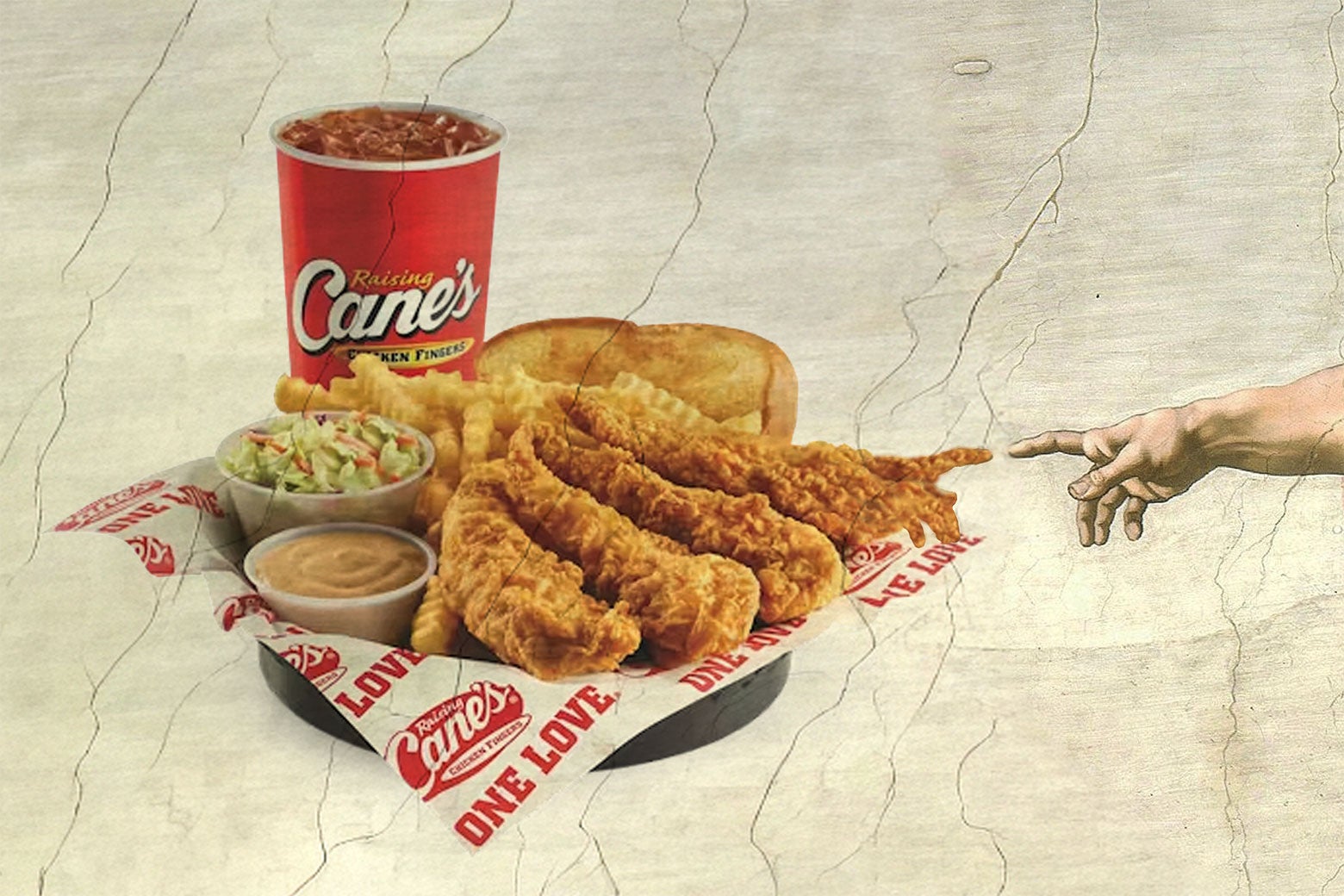
Photo illustration by Slate. Photos by Michelangelo, Public Domain, and Raising Cane’s. Moneybox The Church of Raising Cane’s The hottest restaurant chain in America is inspiring people to fly 16 hours to try it. I went to find out why—and I saw too much. Last November, Cierra Barrera arrived at the restaurant in Grand Rapids, Michigan, at 9 the night before it opened—and she wasn’t the first. More than a dozen people were already set up in front of her. For the next 13 hours, Barrera waited, vlogging her entire experience as temperatures dipped into the 40s and a brief morning rain washed over the crowd. Still, everyone remained. It was worth it. After all, this wasn’t just any restaurant. It was Raising Cane’s. “I’m kind of embarrassed, because I’ve never actually done this before, and there’s already people here,” she exclaimed in the video. “I’m thinking, This is a little too early, nobody’s going to be here. But people are here.” She told me later: “When I got ahead of when Cane’s was opening in my city, I made sure to put it in my calendar.” You should expect no less for Raising Cane’s, a chicken-finger spot that inspires something close to religious devotion among its growing flock. It recently surpassed KFC to become America’s third-biggest chicken chain, and it’s hot on the heels of Popeyes too. (Princely Chick-fil-A remains far and away No. 1, but never say never.) In the past five years alone, the chain has doubled its domestic sales to nearly $5 billion and opened more than 250 restaurants in the U.S. Cane’s secret sauce—besides the beloved Cane’s Sauce itself—is those fans. They are not like other fast-food fans. They are evangelists who worship at its Texas toast–padded altar. Caniacs, as they are called, camp out overnight and cause traffic pileups at new locations. About 250 people slept outside the Charlotte, North Carolina, store the night before it opened in February, when the temperature hit a low of 25 degrees. Hordes of international influencers have flown to the U.S. specifically to try the crispy chicken and that renowned dipping sauce. Their devotion knows few limits. At the Times Square location at noon on a steaming Wednesday in August, I got a taste of just how intense the fandom has become. Tourists hauled their suitcases over the doorstep into the fray, fresh off a flight or rushing to make one, if only they could get one last chicken finger first. “Get a video of the DJ—it’s only here,” one woman told her husband over pounding Bruno Mars, clutching her fanny pack. Another couple, wearing designer sunglasses, told me that they had traveled here all the way from Italy to try Cane’s. That’s about all they could say in English. Standing by the DJ booth with an armful of shopping bags, a tourist named Paul told me that he and his son have taken several trips from the Philippines to the States. “We try to come to Cane’s every time,” he said. “He loves it.” The mania is intense for a chain that entered the American market relatively recently. Todd Graves, who is still co-CEO, opened the first location 30 years ago this month—Aug. 28, 1996, to be exact—across the gates from Louisiana State University. That’s 60 years after KFC opened its doors in Kentucky. “At that time, I saw a gap that needed to be filled in the market,” Graves, who named the restaurant after his dog, told me. “Many concepts were offering chicken tenders, but none were craveable. It’s that craveability that sets us apart, and the way we’ve been able to maintain that is by focusing on doing one thing and doing it better than anyone else.” Indeed, Cane’s does only one thing, and that thing is chicken. Every single Cane’s meal has basically the same components: chicken, fries, toast, sauce, and sometimes coleslaw. That’s it. All of this rests on the hook of one single (chicken) finger. Compared to other quick-service competitors, who are increasingly offering labyrinthine menus with new products rolled out seasonally and limited runs of nostalgia items, Cane’s menu feels sparse, with a sort of Steve Jobs Apple-era minimalism. Except for chicken. Could all this hype really be for a chicken finger? What is happening here? The more I looked into the cult of Cane’s, the more I understood how the country’s most obsessed-over digit-shaped delicacy took America by storm, slowly and then all at once. Historically, chicken was a bit of an afterthought in fast food. America’s predominant drive-through fixation has been the beef: Burger King’s Whopper, McDonald’s Big Mac, White Castle’s sliders (widely acknowledged as the first fast food in America), Arby’s litany of meats. Chicken was something of a side act to the main stage, marketed primarily as a kid’s-meal option. But in the latter half of the 20th century, new research about the dangers of cholesterol and fat in beef began to shift consumer tides toward leaner proteins. To meet that demand, massive corporate farms also began churning out chicken, lowering the cost of the meat. Chicken not only became a more affordable option; it started being associated with less health risk. Chicken now holds its own as a fast-food category. Americans eat twice as much chicken today as they did in the 1970s, and fast-food places focusing specifically on chicken began swallowing truly staggering amounts of market share. Bojangles, the Southern fried chicken drive-through, began in 1977; Zaxby’s, Wingstop, and Raising Cane’s all opened in the 1990s. Dave’s Hot Chicken was founded just nine years ago, in 2017. Even international chains like Jollibee, the popular Filipino fried chicken spot, has spread throughout the U.S. in recent years. The competition in the chicken landscape is likewise intense, and corporations are battling to capture audience attention with different chicken offerings. Nothing illustrates this better than the great “Chicken Sandwich Wars” of 2019, when Popeyes decided to put its fried chicken on a bun and top it with mayo and two pickle slices— and it sold out within a month. The chain had officially entered chicken sandwich territory, and this quickly spurred a massive fight with the OG sandwich maker Chick-fil-A, with the two brands throwing jabs at each other online for weeks. By January 2021, more than 20 American fast-food brands had introduced or rereleased chicken sandwiches, including Panda Express, which launched an Orange Chicken Sandwich. For nonsandwiches, the chicken war is fought in sauces, suitable terrain for blank-canvas fried chicken and consumers who increasingly expect their food to be modifiable. (Think of it as the Starbucks menu effect.) Wingstop offers 13 different dipping sauces, and Buffalo Wild Wings boasts 23 different flavorings. Chili’s infamous Triple Dipper allows diners to dunk everything from its honey-chipotle chicken crispers (read: fingers) to its fried mozzarella sticks into any number of dipping sauces. Dave’s Hot Chicken quickly rolled out its own version, the Big Trio. But while all these chains rush to roll out more seasonal offerings and limited-edition menu items, Raising Cane’s is sticking to its guns. It offers one finger and one sauce—no more. “I’m always asked if I plan to add anything to the menu, and the answer is always no,” Graves told me. “You don’t need to be all things to all people, and too often brands are chasing trends or limited-time offerings that distract their crew from focusing on what made them successful to begin with.” In some ways, Cane’s is winning the chicken wars by not really fighting them at all. The menu, embracing its red-hued simplicity, almost reads as a rebuke to its competitors. It’s essentially just the chicken listed in different quantities: basket of fingers, box of fingers, finger sandwich (in some places), or a single-finger add-on. Dave’s Hot Chicken has adopted a similar premise for its spicier entry into the market, but for many Caniacs, nothing beats the stripped-down glory of the original. Raising Cane’s Is there a downside to this approach? Ari Felhandler, an analyst for the research firm Morningstar focusing on the food and drink industries, said that although keeping the menu tight allows costs to remain low and operations to remain relatively streamlined, it may also prevent the brand from remaining agile to meet constantly changing consumer tastes and avoid potential disruptions to its supply chain. “We think the firm’s concentration may also limit its ability to penetrate markets as deeply as more diversified peers like McDonald’s,” Felhandler said. Indeed, every fast-food brand is trying to find a new, louder way into the game. This year, Taco Bell released the limited-run Diablo Dusted Crispy Chicken Nuggets, and there are rumors that the chain is quietly testing out a Chicken Caesar Dorito Burrito, all in an attempt to get a little bit of real estate in the chicken sphere. Even though it has been known for burgers since it opened in the 1940s, McDonald’s has seen its chicken fare generate sales commensurate with beef, at about $25 billion in 2023, CEO Christopher Kempczinski said during a fourth-quarter earnings call. The chain rolled out three new chicken items at the end of last year, including permanently bringing back the Y2K-era McCrispy Strips. Graves, for his part, seemed unmoved by all this when we spoke. Perhaps because he has something better than Diablo Dust. At the Raising Cane’s in Times Square, it felt like being inside a very red megachurch. Pushing through the glass double doors, I found every inch of the restaurant pulsating with some kind of sensory experience. Oversized disco balls hung overhead, casting flecks of light onto the couches, which were shaped like the brand’s beloved Texas toast. The rest of the ceiling was lined in a digital screen displaying a close-up of fried chicken, and the walls were lit up with electric signs reading things like “Caniac Corner” and the brand’s motto, “One Love.” Every single Formica-topped table was packed to the brim. A thick queue of customers waited for the self-order kiosks. At least 20 more crowded by the pickup stand. Gaggles of British tourists with fur coats and spray tans jostled for seating, clutching their outerwear to their chests for space as they scouted for a table to open up. One man pushed past me with a backpack, shouting agitatedly about fried chicken. After several rounds of prowling, three friends and I managed to grab a table at the front, right by the DJ booth, which was blaring every single Top 40 song from 2016 in succession, including three Ed Sheeran club remixes. The DJ was silhouetted by a large window display of a gigantic, human-sized plastic re-creation of Raising Cane’s chicken tenders and crinkle-cut fries being dipped into a tub of Cane’s Sauce. I heard, in preparation for this story, that the DJ occasionally requests that visitors form a conga Iine. I eyed him suspiciously. It was 5 p.m. on a weekday. “Raising Cane’s is a step above other fast-food chicken forms,” one friend explained to me, a non-Caniac, over his three-finger combo. “The quality of the chicken is way better, so it’s worth it to spend a little more than you would at, like, a McDonald’s. It’s just not the same experience.” Being a Cane’s newbie, I felt dubious about this pitch. How different can a chicken finger actually be? But seeing the chicken in front of me, I had to admit that it really didn’t seem like the same experience at all. The chicken is visually distinct from what I’ve historically known a chicken tender to look like. Mostly: It’s really wet. My friend held up a chicken finger for me to inspect. It was almost limp with moisture, and there was an obvious contrast between where the breading ended and the chicken began. Unlike a McNugget or a chicken fry, both of which are primarily taut pieces of dry stuff that exist as vehicles for sauce, the Cane’s version is obviously and unmistakably chicken. The meat was so glistening that it caught the light of the disco ball. It tore easily into pieces. I took a bite of the buttery Texas toast and the crinkle-cut fries, then dipped them into the creamy, peppery Cane’s Sauce, which tasted something like pickled ranch. Fat and salt. But it really is that chicken. Especially in this setting, the fingers here just feel posher than other fast food (that is, if you consider eating fried chicken under a gigantic disco ball to be posh). Yes, Raising Cane’s is somewhat more expensive than other brands. Three combo meals and an additional drink ran my group about $50. A three-finger meal for $12.39 feels relatively steep in the reenergized era of the value menu. I asked my panel of chicken eaters if that was too expensive for fast food. “You need to think about this in relation to the other fast-food places,” one of my friends argued. “Think about what the chicken is usually like at other chains—the nuggets and tenders and stuff. Imagine that’s all that’s in your area. You don’t have a Cane’s near you. And then it finally opens, you go try it out, and you taste this.” Right now, there’s a halo of rarity around Raising Cane’s due to its newness, which likely adds to the psychosis. For reference, as of this March, there were 953 Cane’s locations nationwide, as opposed to 2,361 Wingstop locations and 3,413 Chick-fil-A locations. And those numbers pale in comparison to more-ubiquitous quick-service brands like McDonald’s, which operates 13,827 locations across the country, or Starbucks, with 16,875. In the same way that regional brands like Shake Shack and In-N-Out have maintained cult followings for their novelty, Cane’s has no doubt benefited from the same kind of rarefied air. Even my chicken-tasting panel had thoughts about what constitutes an actual Cane’s. “The real Raising Cane’s experience is in the suburbs,” a friend declared. Another nodded. “You have to imagine that you just finished volleyball practice and the JV squad is having a horrendous season to really get the full picture.” Everyone solemnly agreed. It won’t be long before that’s not true, though. Raising Cane’s is one of the fastest-growing quick-service restaurants in the country. Graves told me he plans to continue expanding nationwide, and even across the world. The chain opened seven new locations in May, 12 in June, five in July, and seven in August. Aggressive expansions typically come with plenty of risk: an immediate strain on resources, profit instability, and possibly outgrowing the existing business model. But the reason to keep on growing is clear. Cane’s is having a moment, and the chain doesn’t want to miss it. The chain also leans into the hype of new locations. It raffles off free Cane’s for a year to a “Lucky 20” customers who show up within the first few hours of an opening, offering Caniacs another reason to camp outside in the parking lot. Of course, there’s the DJs and giveaways, plus prizes for the first visitors in line. It’s the gift that keeps on giving: They stoke the flames, and the flames reward them back. Local news coverage and social media posts about the lines, traffic, and campers get the Cane’s name in front of plenty of people who would’ve never heard about the chain in the first place. (For her part, Barrera, in Grand Rapids, told me she ultimately found the chaos at the store opening a little disconcerting—but she kept vlogging all the same.) It’s an aggressive expansion tactic, but it works, and the chain is able to do it probably because it’s still privately owned. “Cane’s is one of few founder-led companies of its size,” Graves said. “It’s important to me and my family to be involved in every aspect of the business, and I want our customers to know that.” Noam Galai/Getty Images for Raising Cane’s Felhandler, the analyst, agreed that because Cane’s doesn’t have to answer to shareholders, that likely allows it to adapt more quickly to the market, a crucial ability in a competitive landscape desperate to meet fickle consumer tastes as quickly as possible. He added that franchise-heavy chains often struggle because the hundreds to thousands of independent owners don’t always agree with corporate leadership on things like menu prices, labor practices, and operations standards. It’s clear that Raising Cane’s leadership is aware of these advantages, as it has zero intentions of going public in the near future. “We use a traditional line of credit to be able to fund our growth and have the capital that is needed to grow our business,” co-CEO AJ Kumaran told CNBC. “We take a very long-term viewpoint in the business, and we have no interest in going public or taking private investments.” In other words, for now Caniacs are safe in their chicken-finger fiefdom, free from gimmicks in their food—save those for the DJ booth. What happens in the coming years remains to be seen. As Graves is well aware, the flock will be watching. Despite Raising Cane’s measured approach, the real engine of its recent success may be outside the restaurant entirely. Two British girls standing outside the restaurant in New York, surrounded by all their check-in suitcases on the hot concrete sidewalk, told me they had just landed in the U.S. for a summer camp in Pennsylvania, but that they first went to visit their brother, who had been in the city for three weeks. He had already gone to Cane’s three times. There’s a palpable sugar high that has spread throughout the Cane’s brand and its customers. And that has played out online. The clicky videos, the snaking lines of customers, the grandiose launch parties—it echoes similar consumer hype trends of the past, like McDonald’s hyperviral Travis Scott Meal or infamous Rick and Morty–fueled Szechuan Sauce incident. Like many other internet-fueled food crazes, Cane’s enthusiasm often spills offline in surprisingly tangible ways. Fans trade tips in online communities and treat new locations as pilgrimages. The craze is reflected on social media, where fried chicken has had a renaissance. Mukbangers, content creators who eat grotesque amounts of food on camera, frequently feature fried chicken. They crunch into every flavor of Wingstop and rack up millions of views; they clean Korean fried chicken drums in one fell bite, without leaving a trace of meat on the bone. And, notably, they eat Cane’s, whether it’s buying entire orders of just Texas toast or dunking their entire hand into a fountain cup of Cane’s Sauce and licking it off their fingers. Viral marketing has been a core part of Raising Cane’s success. Sure, celebrities often partner with fast-food restaurants to release collaboration meal deals, but Cane’s A-listers also seem to evangelize the brand itself. There’s Cardi B using Raising Cane’s moisturizing sauce in her skin care routine. There’s Ice-T giving out iced tea at the Times Square location. Love Island USA star Olandria Carthen walked the Raising Cane’s runway during New York Fashion Week in a Caniac-red gown designed by influencer Joe Ando-Hirsh. Graves is a regular face in all of this, going on beloved YouTube shows like Mythical Kitchen and hanging out with the likes of Glen Powell on camera, all in the name of Cane’s. He positions himself as a guy who wants to have a good time and who throws tentpole pop-culture events. It’s rare to see a fast-food CEO as public as Graves is—that can be risky, as the McDonald’s CEO can attest—but it’s another way the company is meeting its customers where they are. Although other CEOs have historically remained in the shadows, Graves is often splashed all over the brand pages. (To be fair, co-CEO Kumaran is rarely seen on the company TikTok page, and only Graves spoke with me for this piece.) “When I first started Raising Cane’s in 1996, we obviously didn’t have social media, but once I started to learn how to leverage it in a way that was authentic and genuine, that was a true unlock,” Graves said. “I have a lot of celebrity friends, and we’re always partnering with them around peak cultural moments, whether that be the Super Bowl, Winter Olympics, the drop of a new album, or anything in between.” Graves said that no one believed in this business model when he first set out to open his restaurant. “I had this idea for a restaurant that focused on just that, and when I put it into a business plan in college, it actually got the lowest grade in the class,” he said. “I was told it wouldn’t work, but that just made me more determined to prove that a focused concept would work.” Despite some critics, it’s clear that so far he’s been right. “It’s deeply personal to me,” Graves said. “I always say I believe that God made me good at chicken fingers to help people. I know it sounds crazy, but it’s true.” Melting on the sidewalk of Midtown Manhattan, sipping an iced sweet tea that tourists have taken 16-hour flights to try, I watched the hordes of tourists push their shopping and suitcases through the heavy glass doors, immediately enamored by the dulcet tones of EDM Ed Sheeran. Maybe this does help them somehow. I certainly felt different in there. Fast Food TikTok Restaurants
The Hottest Restaurant in America Does Only One Thing. Its Fans Are Obsessed. Its Secret Is There for All to See.
Full Article
Original Source
Read the full article at Slate →KhanList aggregates and links to publicly available news content. We do not host full articles from third-party sources. Always verify important information with original sources.