
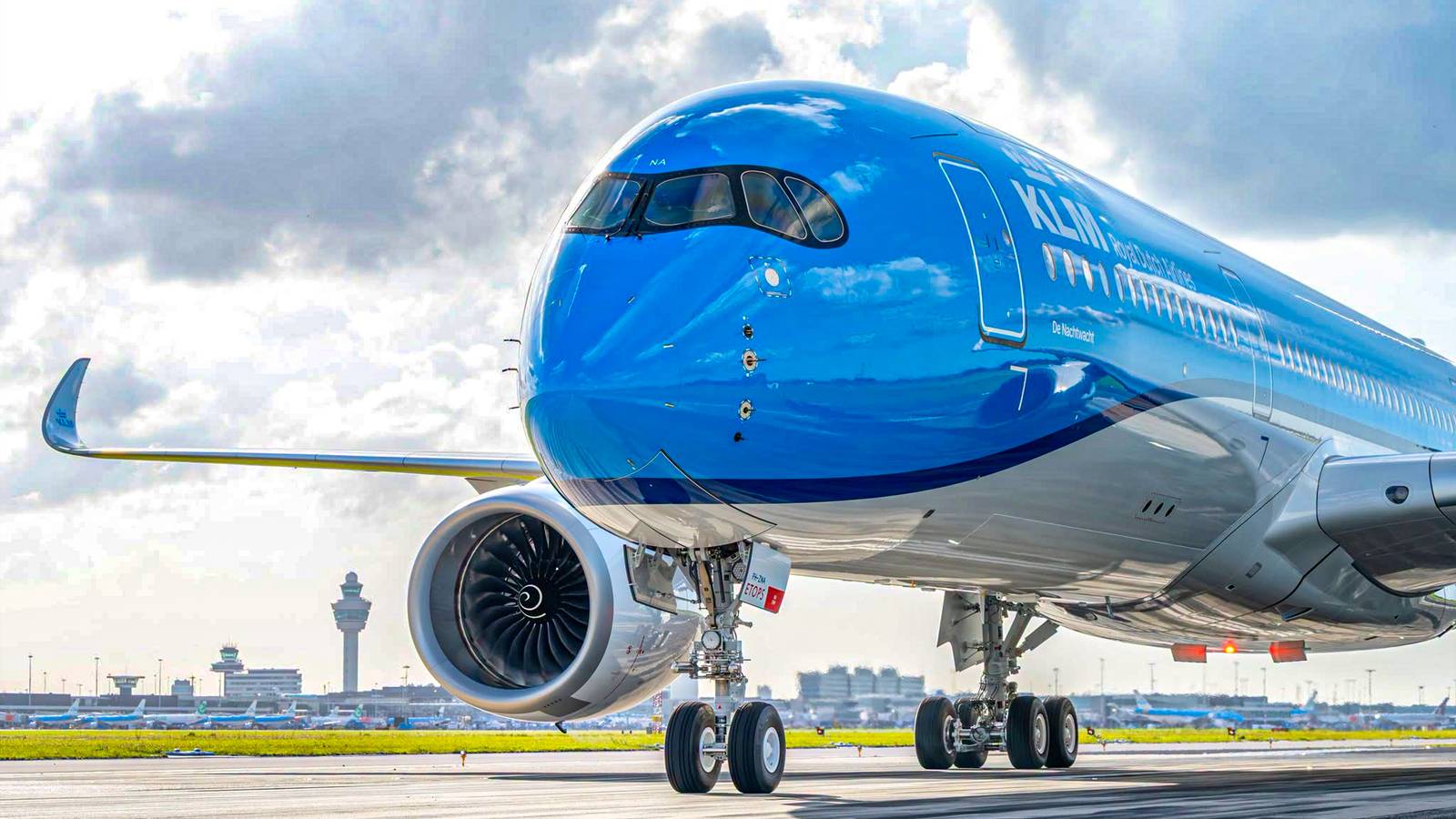
Published Nov 9, 2026, 4:01 AM EST Based in the UK, Josh is a keen writer with a degree in Military History. Having worked previously as a financial journalist, he has covered the aviation industry extensively, reporting on airlines' results and monthly passenger statistics in the aftermath of the pandemic, alongside the likes of regulation around sustainable fuels, and the prospects for hydrogen-powered commercial flight. He joins Simple Flying with a lifelong love of all things aviation. KLM Royal Dutch Airlines has just gotten its hands on Airbus’ latest next-generation widebody. The arrival of the Dutch airline’s first Airbus A350 marks the latest step in a larger effort to renew its long-haul fleet. Not only will this progressively leave KLM with jets that can fly farther and more efficiently than those they replace, but passengers should notice the benefits too. Airbus built the A350 from a clean slate and incorporated a range of features to enhance passenger comfort onboard. That means less fatigue and stress during what can be incredibly long flights for those onboard. Add in the operational cost reductions enabled by the A350, and the perks for KLM of phasing out older models in favor of the new widebodies really stack up. KLM Opens Up First Airbus A350 Route Credit: KLM Royal Dutch Airlines KLM has a way to go before it can start doing this in great numbers, mind. Having received its first Airbus A350-900 from the European manufacturer on October 2 this year, services are in their infancy and cover just one route as it stands. This connects Amsterdam Airport Schiphol (AMS) and Toronto Pearson International Airport (YYZ), with the inaugural A350-operated flight departing the Dutch capital on October 30. Initially, the route covering Canada’s largest city will be served by the A350 up to five times weekly. Come next March, this will switch to a daily service. In the meantime, Montréal-Trudeau International Airport (YUL) is set to become the next destination for KLM’s brand new A350s on November 30, initially flying three times a week. Soon after, on December 1, the first of two separate triangular routes serving Tanzania’s three main commercial airports — Kilimanjaro International Airport (KIA), Dar es Salaam’s Julius Nyerere International Airport (DAR), and Zanzibar’s Abeid Amani Karume International Airport (ZNZ) — will be added to the A350’s schedule. This does rely on KLM receiving its next A350s in a timely manner, though. KLM’s Multi-Billion-Dollar Fleet Renewal Credit: KLM Royal Dutch Airlines Following the arrival of its first A350 in early October, KLM expects to have received one more from Airbus come the turn of the year. Further models are then anticipated over the coming years. All told, these are being added as part of a wider €7 billion ($7.8 billion) investment to renew its fleet over the years ahead, according to KLM. Alongside A350s, KLM’s fleet renewal has seen Airbus A321neo and Boeing 787 jets added to its mainline fleet. Some 18 of the A321neos have been handed over to the carrier since August 2024, following a December 2021 order by parent company Air France-KLM Group for 100 A321neos to be shared among several subsidiaries. A total of 13 Boeing 787-9 and 15 Boeing 787-10 widebodies have also made their way to KLM since 2015, again thanks to an order placed by Air France-KLM Group, with the final delivery taking place early this year. Regional subsidiary, KLM Cityhopper, has also received 25 new Embraer E190-E2s under the modernization. Capacity 331 (three classes) Wingspan 212 feet, 5 inches (64.75 meters) Length 218 feet, 6 inches (66.61 meters) Height 55 feet, 11 inches (17.05 meters) Max range 7,633 nautical miles (14,136 kilometers) Max take-off weight 623,908 pounds (283,000 kilograms) With existing A321neo, 787, and E190-E2 orders fulfilled, the introduction of the A350S marks the next phase of modernization. Through this, plans are for the Airbus A350F to join its ranks in 2027 too, though these will be operated by Martinair on behalf of KLM Cargo. The four of these will replace Boeing 747 freighters currently operated by KLM Cargo and subsidiary Martinair. Similarly, the passenger A350 variants will replace aging mainline models directly at KLM. KLM’s Aging Airbus A330s And Boeing 777s Set To Go Including the one new A350, KLM operated seven widebody variants as of the time of writing in early November. These included Airbus A330-200, Airbus A330-300, Boeing 777-200, Boeing 777-300ER, 787-9, and 787-10s. Naturally, the new models are set to pave the way for retiring the oldest aircraft in these fleets. KLM has explicitly flagged that A350s will replace models of its A330-200, A330-300, and 777-200 aircraft. The carrier had four A330-200s and five A330-300s on its books as of November, averaging 20.5 and 14.0 years old, respectively, based on Planespotters.net data. Its 15 777-200 jets averaged 21.8 years old, meanwhile. Aircraft Number in fleet Average age Airbus A321neo 18 1.2 years Airbus A330-200 4 20.5 years Airbus A330-300 5 14.0 years Airbus A350-900 1 0.2 years Boeing 737-700 7 15.6 years Boeing 737-800 25 18.3 years Boeing 737-900 5 24.7 years Boeing 777-200 15 21.8 years Boeing 777-300ER 16 12.8 years Boeing 787-9 Dreamliner 13 9.9 years Boeing 787-10 Dreamliner 15 4.6 years Total 124 12.9 years The phase-out of its A330s is already well underway, with KLM having had a total of 12 in its portfolio historically. Expectations are that the remainder of these will go, including over the rest of this year, before KLM formally retires its A330-300 and 777-200 fleets in turn. A350s are not the only variants that will pick up the slack initially, though, with routes to the likes of Aruba, Bonaire, Riyadh, Dammam, and Miami mainly being operated by Boeing widebodies over the winter months. Longer-term, over several years, the arrival of new A350s will progressively open the door for further retirements, and should see KLM feeling the benefits more and more. Next-Generation Airbus A350 More Efficient Than Predecessors Credit: KLM Royal Dutch Airlines Airbus officially launched the A350 program back in 2005, a decade before the next-generation widebody entered commercial service with Qatar Airways. Initial plans called for the family to be based on the A330’s design, but Airbus soon dropped them and opted to build its latest widebody from scratch, partly after the early success of Boeing’s own clean-slate 787. Either way, the goal was always to bring a jet to the market that was significantly more efficient to run than its predecessors. Airbus did exactly this, heavily incorporating lightweight, composite materials rather than traditional aluminum, alongside high-bypass Rolls-Royce Trent XWB engines. Per the manufacturer, over 70% of the A350’s airframe is built with advanced materials, including carbon fiber-reinforced polymer in the fuselage, wings, and tail, which makes up 53% of its structural weight. High-aspect-ratio wings with morphing surfaces also contribute to aerodynamics, adapting during different stages of flight to minimize drag and maximize lift. All told, by incorporating the latest available technologies, Airbus rolled out an aircraft that burns about 25% less fuel than previous-generation aircraft. That means an equivalent drop in emissions as well as operating costs versus predecessors, which is no doubt a win for airlines. The program's success is clear: Airbus had penned 1,620 orders for A350 family jets from 69 customers as of the end of August. But it is not just airlines themselves that benefit from such next-generation aircraft. Airbus A350 Also Offers A More Comfortable Ride Credit: KLM Royal Dutch Airlines Beyond offering carriers an economical alternative for long-haul routes, the A350 was also developed with better passenger comfort in mind. As Airbus writes online, “This means a journey with wider seats, more natural light, and latest-generation air systems that enhance the sense of space and freshness." The A350, with a noise footprint that is approximately 40% smaller than the older models it will replace and sound-absorbing features, also offers one of the quietest widebody cabins in operation today. Specifically, passengers benefit from a lower cabin altitude of 6,000 feet (1,829 meters) aboard A350s, compared to up to 8,000 feet (2,438 meters) on the older 777-200s and A330s that KLM will phase out. Although subtle, this can help reduce fatigue, dehydration, and even mild hypoxia symptoms for some on lengthy journeys. Higher humidity levels inside, enabled by the use of rust- and corrosion-resistant composites, also contribute. Alongside these, Airbus notes that customizable ambient lighting helps reduce jet lag, while HEPA filters replace the air inside the cabin every two to three minutes. Of course, cabin class always plays a part. KLM’s A350s house 271 economy, 26 premium economy, and 34 business class seats. Economy seats are laid out in a 3-3-3 configuration on these, against 3-4-3 on its 777-200s, and 2-4-2 aboard KLM's A330s. Such standard seats boast a pitch of 29.9 to 33.1 inches (76 to 84 centimeters) on the A350s, compared to a blanket 31.1 inches (79 cm) on the older planes, meaning legroom can be better or worse for the bulk of passengers onboard. That said, higher humidity and a quieter cabin should still lead to a less taxing flight experience, meaning passengers arrive at their destinations feeling more refreshed than on aging equivalents. However, it could be some time before passengers have a greater chance of stepping onto a new KLM A350 rather than one of the outgoing jets. KLM Set To Get Plenty More A350s In Time Credit: KLM Royal Dutch Airlines KLM itself had been due to receive its first A350s some years ago, after parent Air France-KLM Group placed an initial order for 25 A350-900s in June 2013. However, 2019 saw the group opt to hand the new Airbus widebodies over to Air France and give KLM 787-9s originally intended for the French carrier in turn. That meant the two airlines went about renewing their long-haul fleets with the different variants until another order was placed by their parent for a further 50 A350 family planes in 2023. This included options for an additional 40 if needed. As it stands, KLM has confirmed to Simple Flying that it will receive 22 of these, with deliveries from the wider order carrying through to 2030.
Why KLM Is Replacing Older Widebodies With 22 Airbus A350s That Cut Fuel Burn & CO2 By 25%
Full Article
Original Source
Read the full article at Simpleflying →KhanList aggregates and links to publicly available news content. We do not host full articles from third-party sources. Always verify important information with original sources.