
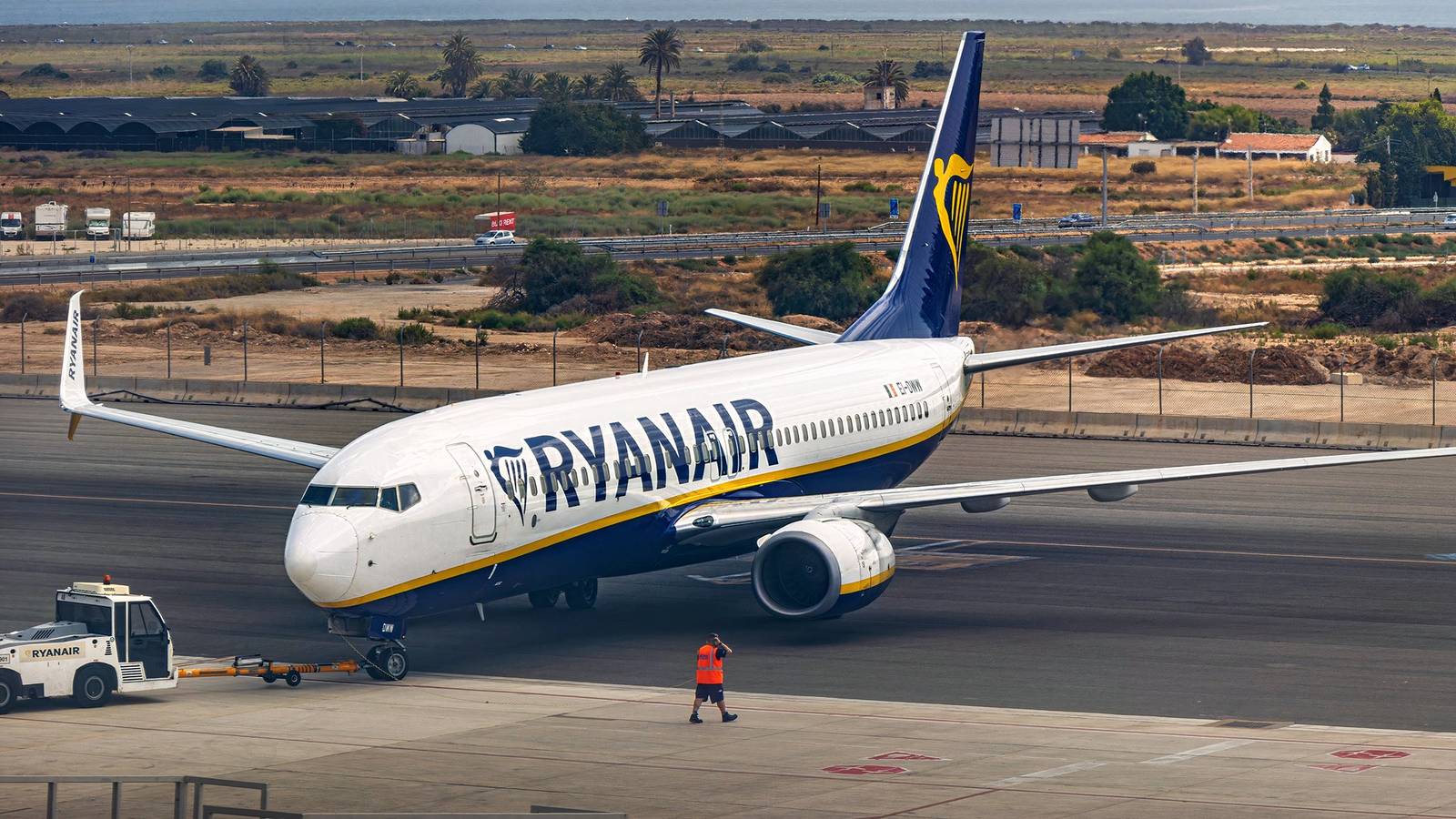
Published Nov 9, 2026, 1:00 AM EST Ethan is an aviation professional with a degree in Aviation Management with Flight from the Florida Institute of Technology. He previously wrote aviation and tourism features for Florida Tech’s student newspaper, The Crimson, where he developed a clear, reader‑focused reporting style. Aviation journalism has remained a consistent priority throughout his career. He currently holds a Restricted ATP and Commercial Multi‑Engine Pilot certificate and works in aviation supply chain and aircraft component repair. Alongside his industry role, he is pursuing his Certified Flight Instructor rating and actively building flight experience. A lifelong aviation enthusiast, Ethan spent countless hours at Raleigh–Durham International Airport’s observation deck studying air traffic and practicing amateur photography and videography. Alaska Airlines had finally let go of the "Proudly all Boeing" motto as displayed on many of their Boeing 737s. Primarily due to mergers with Virgin America and Hawaiian Airlines, both significant Airbus operators, retaining an all-737 fleet was no longer possible for the Seattle-based airline. Their introduction into long haul service under the Alaska brand further solidified the nail in the coffin for such fleet commonality. Even a company such as Breeze Airways (originally planned as Moxy Airways, retaining the MOXY call sign), did not have an easy path to fleet commonality, as a smaller scale origin and destination (O&D) structured airline. Breeze initially planned to operate an all‑ Airbus A220 fleet, back when the aircraft was still branded as the Bombardier CS100. However, prolonged program delays forced a strategic pivot. The airline adopted Embraer 190s as an interim solution, a move that proved crucial for capturing early demand during a broader supply‑chain bottleneck. This proves that maintaining true fleet commonality is trickier in practice than on paper. Ryanair Prevails With The 737 Credit: Markus Mainka | Shutterstock Since 1995, Ryanair has maintained an all-Boeing status. Better yet, the fleet consists entirely of 737 models, except for a wet-lease agreement with the now subsidiary Lauda Europe, featuring Vienna International Airport (VIE)-based Airbus A320aircraft. Prior to the delivery of the first 737, Ryanair also operated BAC One-Elevens and Aerospatiale ATR 42 600 aircraft, having been phased out in the pursuit of uniformity. Per Ryanair's website, the company currently has a fleet of 647 aircraft. A fleet of 411 737NGs and 210 MAX 8s represents thousands of daily cycles across Europe, each relying on the American manufacturer to deliver aircraft on time and support them consistently. The 300 MAX 10s on order are not just future growth; they are the backbone of Ryanair’s 2030s cost structure, intended to unlock lower fuel burn, higher seat density, and tighter turnaround efficiency. Any disruption in Boeing's delivery timeline directly constrains Ryanair’s ability to add millions of seats per year, depresses its yield strategy, and forces the airline to reshuffle capacity across its 90+ bases. The 26 A320s at Lauda are tolerated only because they serve a specific market niche; they remain an operational compromise rather than a philosophical shift. Lauda's aircraft are targeted solely at the Vienna market. The 737 MAX 10 Ambition Credit: VanderWolf Images | Shutterstock Ryanair placed a firm order for 300 MAX 10s earlier this decade. This massive order will enable the Dublin-based company to increase their fleet size by nearly 50 percent, while also retiring some aging 737 NG aircraft. Ryanair's 411 NG fleet is composed of 54 aircraft flown by its Polish subsidiary, Buzz, while Malta Air operates another 134. The MAX 10 has been a notoriously delayed variant of the 737 family, with its first delivery tentatively set for 2027. While still a 737 variant, with the same parts, engineering, and engine families as the MAX 8, Ryanair can save money on the introduction of the MAX 10 while staying put in one supply chain. However, the MAX 10 provides a slightly reduced range profile than even its related variants in the MAX 8 or 9. This expense comes with the benefit of increased passenger load. Ryanair’s devotion to the 737 is not aesthetic, but rather economic, operational, and deeply strategic. The 737 MAX 8 offers a range of about 3,550 nautical miles and typically seats 162–178 passengers, making it the most versatile member of the family. The larger 737 MAX 10 seats 188–204 passengers but has a shorter 3,100 nautical mile range due to its increased weight and higher fuel burn. Overall, the MAX 8 is optimized for longer thin routes, while the MAX 10 is built for high‑capacity short‑to‑medium‑haul missions. The MAX 10 provides Ryanair with a model that can more closely compete with easyJet and Wizz Air's respective Airbus A321 fleets. A Closer Look At Fleet Commonality Credit: Ceri Breeze | Shutterstock A strategy admired by Alaska and Breeze, and in practice by carriers such as Ryanair, easyJet, and Southwest Airlines, what exactly are the benefits of utilizing a single aircraft type in one's fleet? Economics is certainly at the center of all the benefits involved: Unified training and simulator use Lower maintenance complexity Simpler dispatch Consistent passenger experience Ryanair only needs to train their pilots on one aircraft type, and they do so with the use of one simulator configuration. Ryanair's career website outlines a selection of simulators that are each configured for the 737, mostly manufactured by Canadian Aviation Electronics Ltd (CAE): 3 x CAE SIM 21s 1 x CAE Classic 2 x CAE 5000 series 5 x CAE 7000XR series 2 x CAE 7000XR MAX series Fixed Based SIM: MPS FTD2 / FNPT2 Full service carriers with diverse fleets such as Lufthansa are required to operate and fund several aircraft types. Each software version that is loaded into the simulator device presents itself as an additional expense to the company; Ryanair only pays for the 737 family. While the different variants in practice present different operational quirks such as varied CG location, tail down force characteristics, and landing ground roll distance, pilots only need one type rating for all the 737 variants, according to the European Aviation Safety Agency (EASA). The Economics Of Simplified Maintenance Credit: Elijus3000 | Shutterstock Airframe families typically live inside of one unified supply chain, and the same goes for their respective engines. While a host of component repair shops and parts suppliers operate in the open market, operators like Ryanair typically choose a preferred handful of suppliers and stick with them under contractual agreements or fixed pricing. Material coordinators at Ryanair are relieved of a complex web of vendors and can nurture relationships with a select few. Ryanair describes a member of its purchasing team as someone who participates not only in material handling, but also in Aircraft on Ground (AOG) coordination and scheduled maintenance event planning. "The Materials team oversees all aspects of material and part usage within the Ryanair network and the extended network of approved repair shops. From the sourcing of new parts, the management of the repair and overhaul of a multi-million-euro pool of spares and the associated logistical demands of supporting over 600 aircraft across over 95 bases." Maintenance cost savings flow down to the hangar floor as well. When an Airframe and Powerplant Mechanic (A&P) becomes well-versed in a single aircraft type and corresponding engine model, maintenance as a whole becomes more efficient. Heavy maintenance checks become routine and somewhat predictable, material requests are fulfilled more rapidly, and a familiar network of vendors is already in place. Mechanics can also become more efficient with Illustrated Parts Catalogs (IPC), Component Maintenance Manuals (CMM), Aircraft Maintenance Manuals (AMM), and proprietary maintenance documentation. Less Chaos For Dispatchers Credit: Ryanair Careers Dispatchers have an undeniable luxury with a uniform aircraft fleet. When an aircraft swap is needed due to a delay, swapping in a different aircraft for a scheduled flight is simple and predictable. Variation may occur between, for example, a 737-800 and a 737 MAX 10 with respect to capacity and range. However, the scale of Ryanair's fleet variability is much lower in contrast to an airline like United Airlines, with many different aircraft types in use. Similar cabin layouts, loading procedures, and performance envelopes all come into play when a dispatcher adjusts a schedule. This standardization improves punctuality and utilization and streamlines the calculations and planning the dispatcher does. As an added bonus, less variation in aircraft performance profiles improves the margin of safety, highlighting greater familiarity and consistency with the 737 family. Circling back to a Ryanair pilot's single-type rating, this simplicity also helps crew scheduling in the event of a delay. All pilots and, to a lesser extent, cabin crew would be eligible for a call by crew scheduling, so long as they are legal and on reserve. This gives Ryanair an easy path to consistent delivery of its notorious passenger experience. A Uniform Passenger Experience Above All Credit: Mikel Dabbah | Shutterstock When traveling on a Ryanair flight, passengers usually know what to expect from the moment of booking, thanks to its strong branding and active social media presence. Of course, except for Ryanair's subsidiaries, the onboard experience remains largely consistent across its fleet, partly due to the operational consistency outlined above. Ryanair's marketing department is well aware of this. The cabin layout of its 737s is so predictable that a window seat on its 737-800 aircraft that does not actually have a window became known as seat 11a, sparking an internet phenomenon. CEO of Ryanair, Michael O'Leary, is known as being objectively blunt and, at times, very bold in making statements. This tone is also reflected in the official company social media pages and press releases on its website. According to The Guardian, O'Leary once described the customer experience in an extremely blunt fashion. "Are we going to say sorry for our lack of customer service? Absolutely not," he explained.
The Real Reason Why Ryanair Still Flies Only Boeing 737s
Full Article
Original Source
Read the full article at Simpleflying →KhanList aggregates and links to publicly available news content. We do not host full articles from third-party sources. Always verify important information with original sources.