
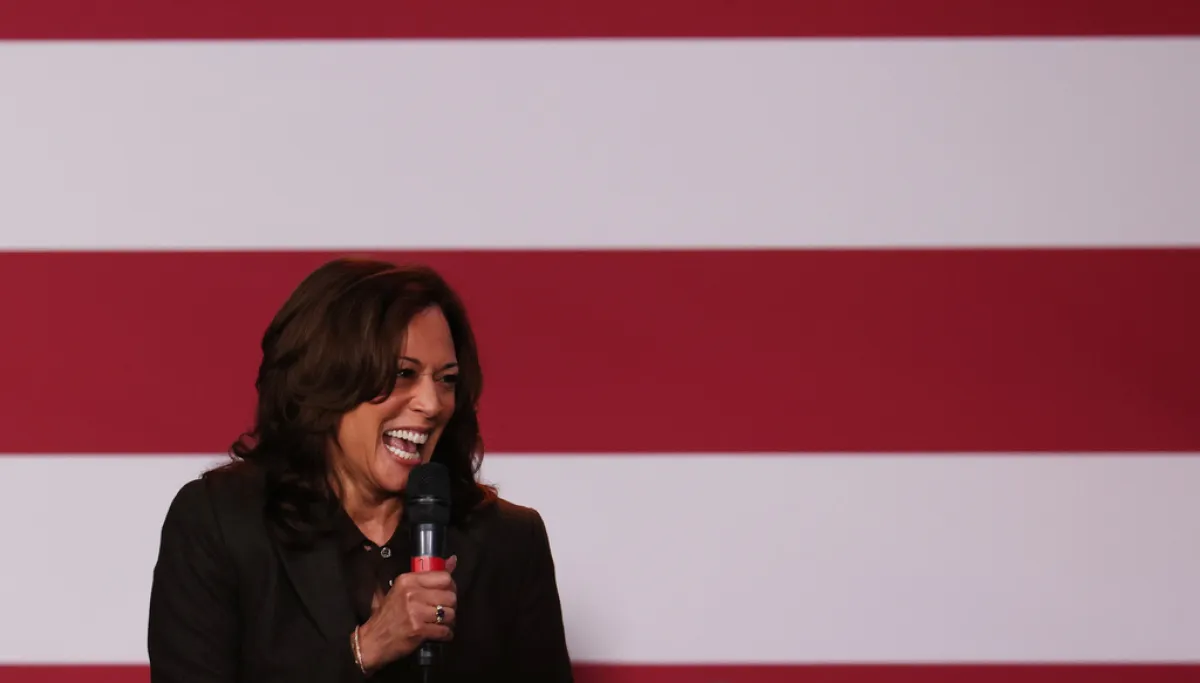
WHY KAMALA HARRIS WILL NEVER AGAIN BE THE DEMOCRATIC NOMINEE. The 2028 Democratic presidential race, still unformed, has changed a lot since the midterm elections. At the beginning of the month, former Vice President Kamala Harris led the polls over Gov. Gavin Newsom (D-CA), according to the RealClearPolitics average of polls. Now, newly reelected Sen. Jon Ossoff (D-GA) is in second place. Rep. Alexandria Ocasio-Cortez (D-NY) has moved up to third place, which she shares with former Transportation Secretary Pete Buttigieg. Newsom has fallen from second to fifth.But Harris, though faltering, is still hanging on to the lead. That leads to the question: Is she actually running for president again? There are conflicting reports. But here is one confident, historically based prediction: Kamala Harris will never again be her party’s presidential standard bearer.Democrats do not like to renominate their failed former nominees. The last time they tried was in 1956, and it didn’t work. They’ve never done it again. Adlai Stevenson was the Democratic nominee in 1952, running against Dwight D. Eisenhower. Eisenhower won in a landslide, capturing 55% of the popular vote, 39 states, and 442 electoral votes. Republicans also won the House and the Senate.After such a loss, one might think the last thing Democrats would do would be to renominate the candidate who lost so decisively to Eisenhower. Yet that is what Democrats did. After losing the White House, House, and Senate, the party had no national leader. Stevenson wanted another chance and actively pursued renomination. No other Democrats mustered much of a campaign against him, and he won the party’s nomination again in 1956.It was a rematch with Eisenhower, and Stevenson lost again, worse than the first time. This time, Eisenhower won 57% of the vote, 41 states, and 457 electoral votes.In 1956, some elderly Democrats remembered when the party last gave a losing nominee a second chance. In 1896, William Jennings Bryan was the Democratic nominee and lost to William McKinley. In 1900, Democrats again nominated Bryan to run against McKinley, and he lost again.So the Democratic Party has good reason to move on when its candidate loses a presidential election. But that hasn’t kept losing nominees from hoping for another shot.In 2004, nominee John Kerry lost to incumbent President George W. Bush. As 2008 approached, Kerry made clear that he wanted to run again. The party’s response: thank you for your service — now, let’s move on. Instead of a Kerry rerun, Barack Obama won the 2008 Democratic nomination and was twice elected president.In 2016, nominee Hillary Clinton lost to Donald Trump. When talk about the 2020 election began, Clinton sent subtle signals that she might like another run at the nomination. The party’s response: thank you for your service — now, let’s move on.Now, with the 2028 nomination contest underway after the midterm elections, the best-known potential candidate in the field is the most recent losing nominee. In the RealClearPolitics average, Harris leads the pack with 16.5% over Ossoff at 15%, Buttigieg and Ocasio-Cortez (D-NY) at 14% each, and Newsom at 11.3%.In public, at least, Harris has been doing the things that someone planning a run should do. She did some — but not a lot — campaigning for Democrats in the midterm elections. (If you want to see a Democratic hopeful who went all out for the team in 2026, try Buttigieg.) Harris has also done a lot of public appearances at which she draws admiring crowds.She has also written a book, which is usually part of the drill, but Harris’s book is not a forward-looking, this-is-what-I-would-do-if-I-were-president kind of book. Instead, the memoir of her campaign, 107 Days, is an extended exercise in excuses and blame shifting for her 2024 loss to Trump.There are signs Harris is getting a cool reception from party donors who want a new Democratic nominee in 2028. Even at home, the atmosphere is not encouraging. Last month, the Wall Street Journal reported that even as Harris “lays the groundwork” for a 2028 campaign, her husband Doug Emhoff “has privately told some people he would prefer she didn’t run.”Then there is Harris’s Gavin Newsom problem. The outgoing California governor is clearly building the foundation for a 2028 run and has been doing so for some time. But after all that work, on Sept. 14, Newsom told CNN that he would not run if Harris chose to run. “I don’t know if she runs, but we’ll see,” Newsom said. “But I wouldn’t run if she ran.”Newsom expressed great concern for Harris’s feelings. “I wouldn’t do that to her,” he said. “I wouldn’t do that to you. I wouldn’t waste everyone’s time. Who needs that?”BYRON YORK: HOUSE DEMOCRATS SIGNAL INVESTIGATION TARGETSA lot of political observers did not take Newsom’s words at face value. Gavin Newsom selflessly offering to set aside his driving ambition if his fellow Californian chose to run? That just seems unlikely. Instead, observers took it as proof that Newsom is fully convinced, or perhaps even knows for a fact, that Harris will not run.It seems likely that Newsom’s bet will turn out to be a good one, and that, in the end, Harris will decide not to run. But even if she chooses to go ahead, it is even more likely that the party’s response to its former nominee would be what it was to Kerry and Clinton: thank you for your service — now, let’s move on.
Why Kamala Harris will never again be the Democratic nominee
Full Article
Original Source
Read the full article at Washingtonexaminer →KhanList aggregates and links to publicly available news content. We do not host full articles from third-party sources. Always verify important information with original sources.