
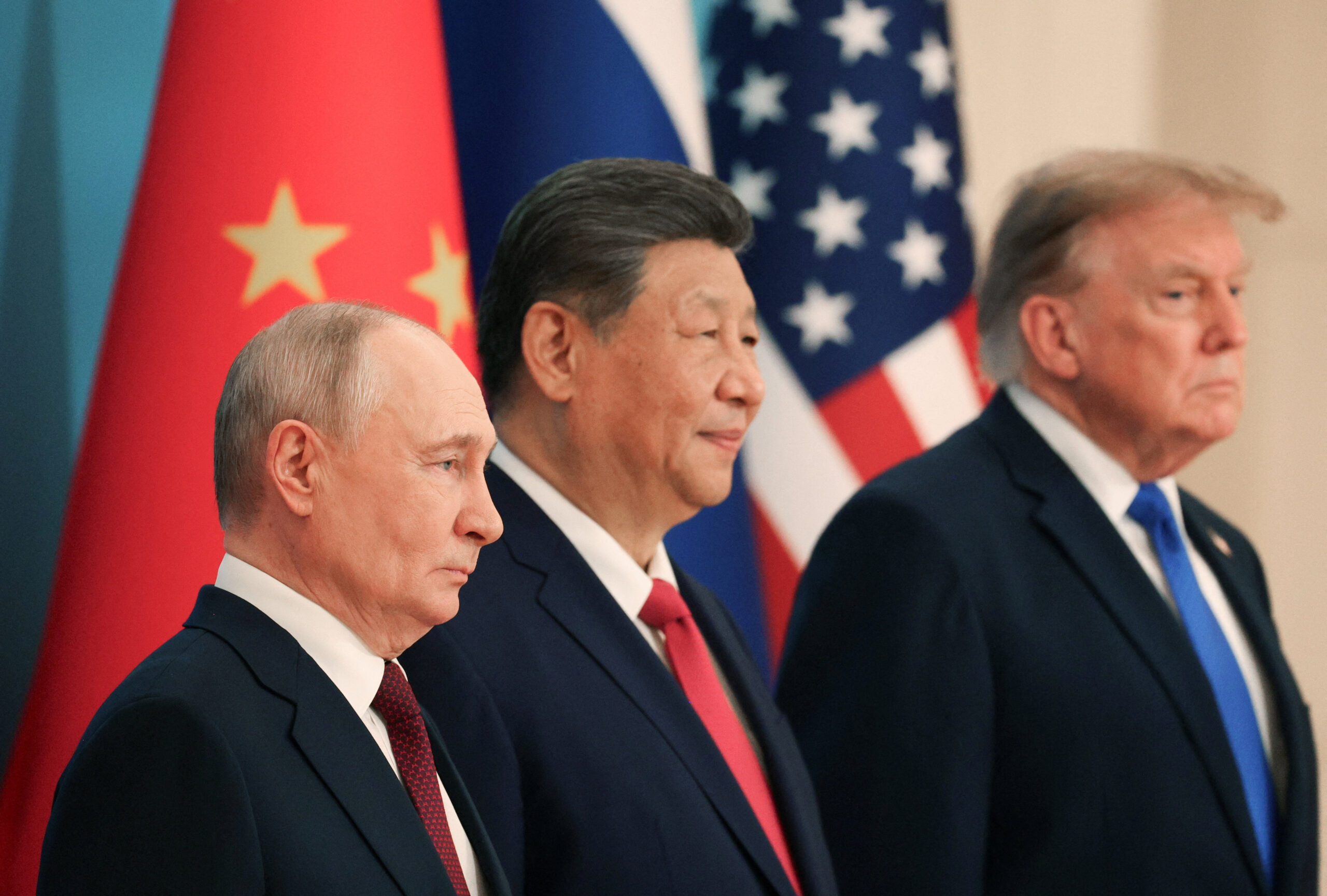
WASHINGTON—For any leading US official, there is merit to talking directly to the leaders they disagree with, even their staunchest adversaries. Sometimes that is the best way to break new ground. At minimum, it may provide new intelligence about what makes a particular leader tick and how best to influence them. That can be particularly useful with authoritarian regimes, where the top leader is the key—sometimes the only—decision maker. But the United States should never walk into those meetings without a clear plan. Otherwise, the US risks giving the other side an opportunity to use the exchange for its own ends in ways that may directly undermine US national interests. That is what happened this week in Shenzhen. The United States walked in without a strong plan and wound up bolstering Russia and China at US expense. The trilateral summit on Thursday was all image, no substance, and the image was Chinese President Xi Jinping presiding over US President Donald Trump and Russian President Vladimir Putin as equals—with Beijing shaping the narrative. The real big three In his statements to Fox News right before the trilateral summit, Trump revealed three big misconceptions that are driving his approach. The first: that Xi and Putin like him. He repeatedly referred to his relationship with Xi as one of “friendship,” when the reality is that Beijing views Washington as, at best, a fierce competitor. Xi simply does not do friendships, even at home, and definitely not with Americans. The second: that China’s pomp and splendor for the US president benefits the US. The top bullet on the White House list of “key moments” from the interview focuses on the razzle-dazzle: the seating chart, the fact that Xi greeted him at the airport. Or to quote Trump: “the fanfare, the beauty, the pageantry, the thousands of people… the soldiers, the whole thing.” Trump described the show as “a big win for us.” It was not. A big win would be getting a commitment from China to provide rare earths to US companies without forcing them to travel to Beijing to beg for every single shipment. But so far, the meetings have produced no true wins beyond pomp and circumstance. The third misconception: that US actions under former administrations drove China and Russia together, and that because “they both like Trump,” that relationship will change. The pattern of Chinese and Russian actions demonstrates how false that hope is. Washington would do better to focus on its own allies—the countries who really do want to work with the US—rather than spinning its wheels trying to drive China and Russia apart. Four points, but for whom? When all three leaders met, Xi got the image he wanted: China presiding over the United States and Russia, not only as a peer competitor, but in the central, commanding seat—in the driver’s seat, with the US and Russia along for the ride. The meeting did produce a four-point “US-Russia-China Heads of State Declaration toward Peace” that gives China and Russia what they want. For China, it calls for United Nations reform (a major Chinese initiative aimed at weakening Western values). For both China and Russia, it calls for more fossil fuel production. Both China and Russia likely pushed the call for heads of state to enjoy immunity from the International Criminal Court—something particularly galling given Russia’s abuses in Ukraine and Putin’s own charges before the ICC. Washington likely added the fourth point: “The three countries will conduct a dialogue on reducing nuclear risks and preventing the proliferation of nuclear weapons.” China is building its nuclear arsenal at a pace the world has never seen, and the US is keen to engage on nonproliferation talks. But Beijing has no intention to slow down its own armament. Agreeing to empty dialogue is just another way to buy time. The US side is coming home from Shenzhen empty-handed, but Chinese and Russian officials are likely patting themselves on the back. Both left Shenzhen with plenty to crow about. The images from this summit will have a long half-life, particularly among US allies and partners, all of whom will be wondering what this means for their own relationships with the US. While another trilateral is unlikely, Trump is expected to meet with Xi next month at the Group of Twenty (G20) meeting in Miami. Let’s hope the US side goes into that meeting with a stronger plan.
The US didn’t have a strong plan for the Shenzhen summit. It showed.
Full Article
Original Source
Read the full article at Atlanticcouncil →KhanList aggregates and links to publicly available news content. We do not host full articles from third-party sources. Always verify important information with original sources.