
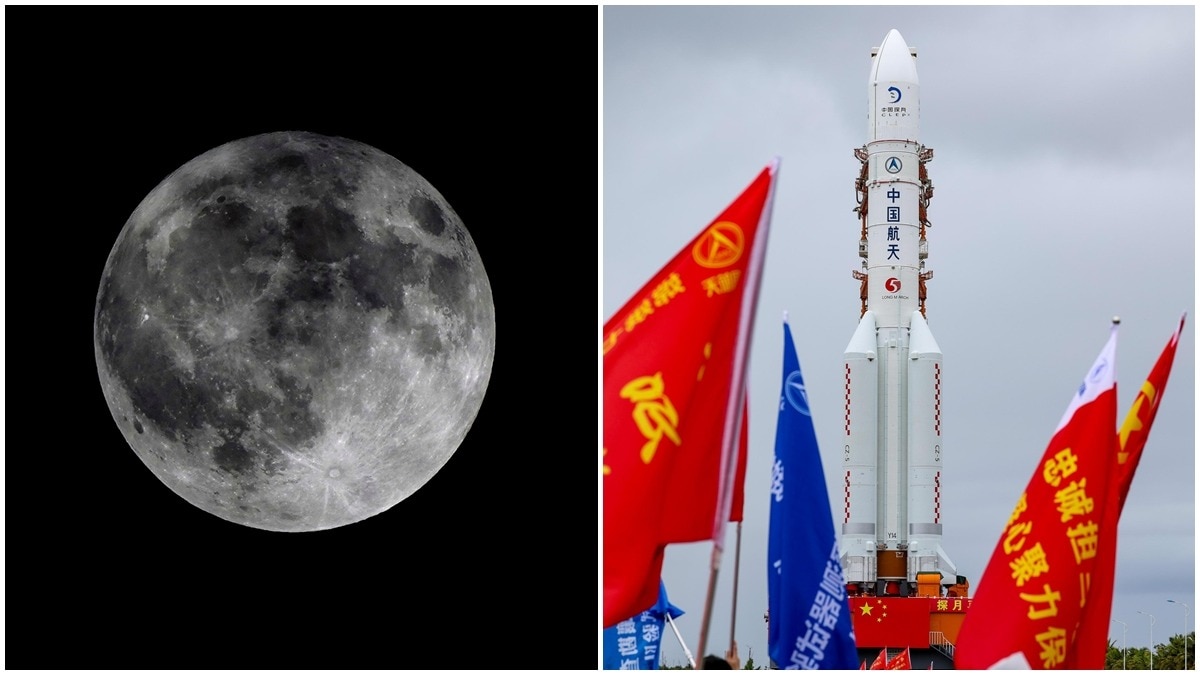
China's Chang'e-7 mission is preparing to venture into some of the Moon's most extreme terrain to study a region and a resource that could shape future lunar exploration.China is joining the global push to study the Moon's south pole. (Photo: X)China is preparing to send Chang'e-7 to the Moon’s South Pole, one of the most extreme and coldest environments in the Solar System.The robotic mission is designed to explore permanently shadowed craters, where sunlight has not reached the surface for billions of years and temperatures can fall to around -203°C.Nasa has described such permanently shadowed regions as among the coldest places in the Solar System.Now, China is joining a growing global push to explore the Moon's South Pole. Chang'e-7 mission's Long March 5 rocket is pictured. (Photo: X) The mission’s attraction, however, is not the cold itself. It is what that extreme cold may have preserved; water ice and other volatile materials.WHY IS CHINA'S GOING TO A COLD AREA ON THE MOON?At the lunar poles, the Sun stays very low on the horizon. Meaning, deep craters can remain permanently shielded from sunlight, and with no substantial atmosphere to spread heat, their interiors become extremely cold.That makes these craters natural cold traps. A mosaic of a lunar crater created by the Lunar Reconnaissance Orbiter Camera and ShadowCam teams. (Photo: Nasa) Water and other substances that would otherwise evaporate under the harsh lunar environment can remain frozen there for extremely long periods.India's Chandrayaan-1 mission had already provided definitive evidence of water ice on the Moon, with much of the ice concentrated in polar craters.For China, Chang’e-7 is about mapping the distribution of water ice, studying the lunar South Pole's environment, and investigating whether these frozen resources could support future human missions.WHAT WILL CHANG'E-7 DO?Chang’e-7 is part of China's fourth phase of lunar exploration and is scheduled for launch on Monday, August 24, from the Wenchang Space Launch Site in Hainan. China, however, is yet to confirm the exact time of the launch. Chang'e-7 mission's Long March 5 rocket is seen on the launch pad. (Photo: X) The launch will occur aboard a Long March-5 rocket.The mission will use several spacecraft and vehicles to explore the region from different angles, including orbiter, lander, rover and a small hopping probe.The probe is particularly important because it is designed to reach difficult terrain, including permanently shadowed areas.Chang’e-7 will survey the lunar surface environment and resources, study the Moon's terrain, composition and structure, and investigate water ice and other volatile materials.Furthermore, its hopping probe will be used to investigate areas that conventional rovers may struggle to reach.A MISSION FOR THE LUNAR FUTUREThe Chinese mission is bigger than just a search for frozen water.How do we know there is water ice on the Moon?NASA's Clementine in 1994 and Lunar Prospector, which began its mission mapping the Moon this week in 1998, were two of the first missions to find evidence for the existence of water ice on the Moon.In this visualization of Lunar pic.twitter.com/RfEJljLqjA— NASA History Office (@NASAhistory) January 13, 2026China has been developing plans for an International Lunar Research Station, with Chang’e-7 and the subsequent Chang’e-8 forming important steps towards that longer-term ambition.It's therefore no surprise that China hopes to find lunar polar resources that could eventually support human activity on the Moon.If Chang'e-7 can map and characterise lunar ice, it could provide crucial information for future missions.Water could potentially be used for drinking, while its components can also be used to produce oxygen and, potentially, rocket propellant.That is why China is heading to one of the coldest places in the Solar System, in the hope that one of the harshest environments in the Solar System may also contain one of the most valuable resources for humanity's future beyond Earth.- EndsPublished On: Aug 22, 2026 10:24 IST
Why is China launching Chang'e-7 to a freezing neighbourhood on Moon?
Full Article
Original Source
Read the full article at Indiatoday →KhanList aggregates and links to publicly available news content. We do not host full articles from third-party sources. Always verify important information with original sources.