
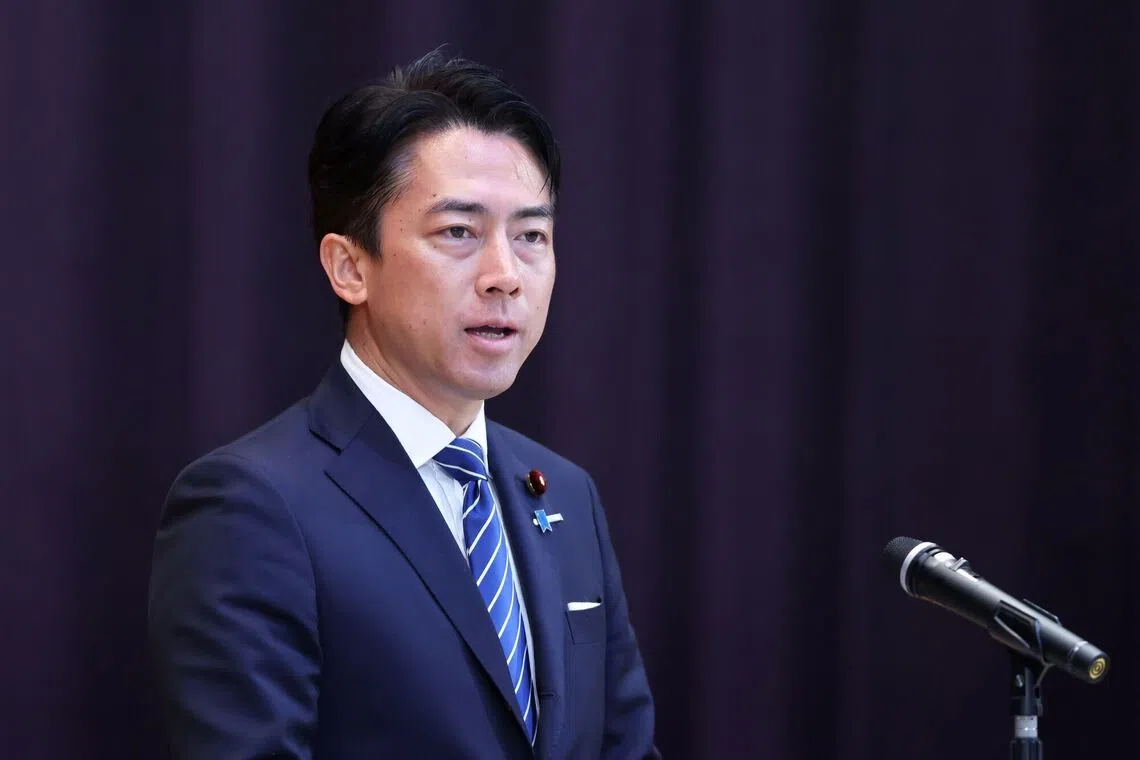
– On the surface, it seems like a standard humanitarian mission. On Aug 30, the Japanese Maritime Self-Defense Force (MSDF) transport ship Kunisaki departed Hiroshima, bound for the smoky peatlands of Kalimantan, Indonesia.It was ferrying 350 military personnel and three CH-47 heavy-lift helicopters, dispatched to help Jakarta douse the raging fires choking parts of South-east Asia, including Malaysia and Singapore.While the water-bombing operation was the first-ever overseas firefighting deployment in the history of Japan’s Self-Defense Forces, it also symbolised a far more ambitious, steel-edged agenda emerging from Japan’s Defence Ministry.Nearly a year into his tenure as Japan’s Defence Minister, the charismatic, English-speaking Shinjiro Koizumi, 45, is fundamentally rewriting his country’s post-war security playbook in a manner rarely seen among his predecessors.Gone is the largely passive partner heavily reliant on the protective shadow of its sole security ally, the United States. In its place is an active player in security diplomacy as Japan weaves a resilient web of “middle-power” partnerships across the Indo-Pacific without Washington’s direct involvement.At the centre of this strategy is Koizumi, who has maintained a relentless pace of high-profile overseas visits since his appointment by Prime Minister Sanae Takaichi on Oct 21, 2025. In 10 months, his travels have spanned North America, Europe, the Middle East, and Japan’s Asian neighbours.While his attendance at security forums such as the Munich Security Conference in February or the Shangri-La Dialogue in Singapore in May was to be expected, Koizumi also held court for Japan – with Takaichi absent – at the World Economic Forum in Davos in January and the North Atlantic Treaty Organization (NATO) Leaders’ Summit in Turkey in July.“Koizumi has not only grown in the job, but also in stature,” Heng Yee Kuang, who heads the security studies unit at the University of Tokyo, told The Straits Times.“I have been in the same room watching him deliver speeches confidently in English to foreign defence attaches and ministers, he is very much at ease and builds strong rapport with his counterparts”.Japan’s Defence Minister Shinjiro Koizumi speaking at the plenary session on Managing Regional Tensions Amid Global Competition at the Shangri-La Dialogue in Singapore on May 31. ST PHOTO: JASON QUAHThis personal brand of active diplomacy is yielding strategic dividends.While it remains unclear whether Koizumi will retain his post as Takaichi prepares for a Cabinet reshuffle later in September, analysts note that he has been instrumental in assembling this “middle-power” network in a strategy born of stark geopolitical necessity.Facing a US military stretched thin across multiple global conflicts and the political volatility of US President Donald Trump, who has pressed allies on defence spending and trade tariffs, Tokyo is deepening its partnerships.Although Japan has largely escaped Trump’s wrath thus far, his recent scaling back of joint military drills with South Korea and repeated questioning of alliance commitments mean Tokyo cannot afford to be caught off-guard.Furthermore, the redeployment of the Yokosuka-based aircraft carrier USS George Washington to the Middle East has left East Asian waters without a US carrier strike group presence for the first time in years.Ryo Sahashi, an international relations scholar at the University of Tokyo, told ST that Japan is positioning itself as “the centre of security networks in the region” to fill a vacuum left by shifting US priorities.Kazuto Suzuki, director of the Institute of Geoeconomics, added that this regional self-reliance is designed to preserve, rather than replace, Tokyo’s primary security anchor.“Japan believes that by strengthening its own capabilities through enhanced cooperation with like-minded nations, it ultimately reinforces the US-Japan alliance,” Suzuki said.“Amid growing uncertainty surrounding the Trump administration and as Asian nations begin to distance themselves from Washington, Japan is expected to serve as a linchpin connecting the US and Asia.”Tosh Minohara, chairman of the Research Institute for Indo-Pacific Affairs, agreed that while the American shield remains indispensable, Tokyo’s hedging is born of raw pragmatism.“Japan sees it as far safer to stand on two legs than one,” Minohara said. “The second leg will not be as strong as the dominant one, but working with like-minded partners forms a functional network.”Hardware transfersThe firefighting mission in Indonesia is a manifestation of this strategy, arising from a landmark defence agreement signed by Koizumi and his Indonesian counterpart Sjafrie Sjamsoeddin in May.“In defence cooperation, when a friend is in need, the other steps in to help,” Sjafrie told Indonesia’s House of Representatives Commission I on Aug 31.Yet the soft-power disaster relief is but one side of the coin. On the other are hard-power defence transfers, with Koizumi reportedly planning to make his third trip to Indonesia in just five months on Sept 10 to sustain the diplomatic momentum.Koizumi and Sjafrie have agreed to launch formal working-level consultations to export retired Japanese Asagiri-class destroyers to the Indonesian Navy, while on Aug 26, they joined Australian Defence Minister Richard Marles for their first-ever trilateral meeting, pledging to expand three-way security ties.Jakarta has expressed strategic interest in acquiring eight units of Japan’s cutting-edge upgraded Mogami-class frigates – the very same stealth warships selected by Australia for its fleet modernisation programme.This flurry of activity has intensified since April, when Tokyo relaxed its self-imposed defence export guidelines on lethal weapons. Experts note this policy change allows Japan to expand its domestic defence industrial base while building operational interoperability across militaries.Indonesia is merely one anchor in this broader architecture as Japan assembles a security mosaic.With Singapore, the MSDF and the Republic of Singapore Navy (RSN) held the inaugural joint Exercise Singapan off the waters of Japan from Aug 26 to 28. The drills featured live gunnery exercises, cross-deck helicopter landings and tactical manoeuvring involving the RSN Formidable-class frigate RSS Steadfast alongside MSDF destroyers.Also in August, Koizumi’s diplomatic push resulted in back-to-back trips to India and Australia, which are fellow members of the Quadrilateral Security Dialogue, or Quad. The US is the fourth member.In New Delhi, he met Indian Defence Minister Rajnath Singh to finalise Japan’s first-ever bilateral Memorandum on Maritime Security Cooperation, establishing mutual port access, joint naval shipbuilding initiatives, and shared ship-repair facilities.Japan’s Defence Minister Shinjiro Koizumi inspecting the guard of honour at the Manekshaw Centre in New Delhi on Aug 20. PHOTO: AFPTokyo also committed to transferring its advanced UNICORN (NORA-50) integrated communications mast to Indian Navy destroyers, in what will be one of Tokyo’s first major exports of sensitive defence technology under revised rules.The visit yielded another military milestone: Japan’s Air Self-Defense Force will deploy three F-2 fighter jets and 110 personnel for the Veer Guardian 26 joint air exercises, marking the first time that Japanese combat aircraft will operate from Indian soil. In Canberra, Koizumi discussed a deal to allow Japan’s land-constrained military to test its long-range stand-off and hypersonic missiles at Australia’s firing ranges.Japanese Defence Minister Shinjiro Koizumi (right) and South Korean Defence Minister Ahn Gyu-back inspecting honor guards during a welcoming ceremony in Seoul on June 28. PHOTO: REUTERSHe also achieved a breakthrough in June as the first Japanese defence chief to visit Seoul since 2015. Meeting with South Korean counterpart Ahn Gyu-back, the duo agreed to resume joint maritime search-and-rescue drills after a nine-year hiatus and expand coordination in defence technology, including military artificial intelligence.Not standing aloneBeijing, wary of strategic encirclement, has accused Tokyo of “ganging up” against it.Suzuki acknowledged that China’s characterisation is “not incorrect”, but argued that Beijing’s opaque military buildup and regional assertiveness left Tokyo with little choice.“Given China’s military strength, middle powers coordinating alone cannot fully deter Beijing,” Suzuki said. “The approach is to use the US to anchor deterrence in the region, and on that foundation, build middle-power networks to deter aggression through collective coordination among allies and like-minded nations.”At home, this active diplomacy is supported by robust security measures and increasing military spending. Koizumi has, among other things, presided over Japan’s first deployments of domestic long-range stand-off missiles in Kumamoto and Shizuoka, and submitted a record 8.9 trillion yen (S$72.3 billion) budget request for fiscal 2027.His ministry is on track to revise Japan’s three core security documents – National Security Strategy, National Defense Strategy, and Defense Buildup Program – by year-end.By evolving Japan into an active architect of regional defence, Koizumi is redefining post-war Japanese statecraft. In an unpredictable multipolar world, Tokyo is building a network of partners to ensure that in its time of need, it will not be standing alone.
How Shinjiro Koizumi is redefining Japan’s security strategy as defence minister
Full Article
Original Source
Read the full article at Straitstimes →KhanList aggregates and links to publicly available news content. We do not host full articles from third-party sources. Always verify important information with original sources.