
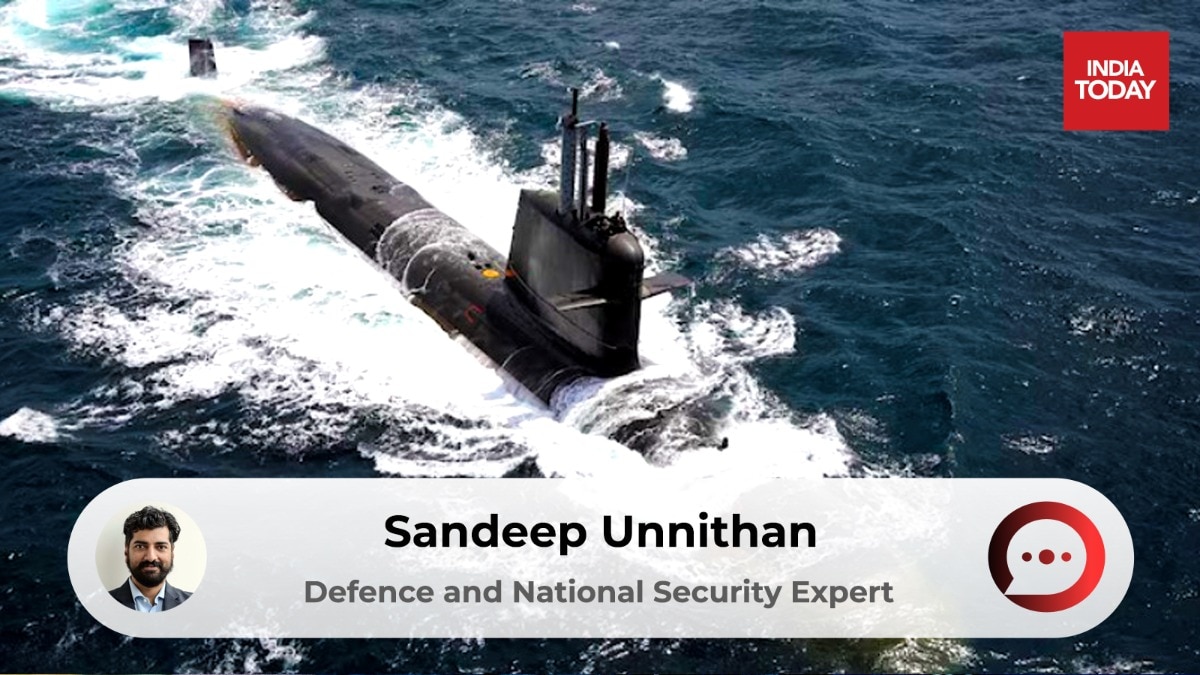
Germany's TKMS has emerged as the preferred bidder, with the submarines to be built at Mazagon Dock in Mumbai with technology transfer. The deal comes amid an urgent need to replenish India's ageing conventional submarine fleet, with most of its SSKs having crossed 25 years of service.Stake buys, a strategic partnership: why India needs to think out of the box on a mammoth submarine orderOver the next few weeks, India and Germany will sign a USD 9 billion deal for six diesel-electric submarines. India’s largest-ever arms deal and will be dwarfed only by another upcoming mega order, USD 34 billion for 114 Rafale fighter jets from France. Both government-to-government level arms contracts could indicate India’s diversification away from the US and Russia towards European partners.The Project 75I submarine deal has been in the pipeline for over 20 years. Germany’s Thyssen Krupp Marine Systems (TKMS) beat out rivals from Russia, South Korea, France and Spain to offer the best deal on price and technology transfer. The boats offer the Indian Navy an urgently needed capability – two-thirds of India’s SSK submarine fleet have crossed the 25-year platform life. India’s 30-year submarine building plan, launched in 1999, has delivered only six of a projected fleet of 24 conventional submarines.India has built its own nuclear-propelled ballistic missile submarines, the four-unit Arihant class. But since it is one of the few major countries not to have designed conventional submarines, it is at the mercy of a few nations with conventional submarine building expertise. This has led to conundrums like a single 3,000- ton P-75I conventional submarine costing as much as an indigenous, nuclear-powered 7000-ton Arihant class SSBN, or the USD 9 billion deal worth more than German sub maker TKMS’ USD 7.50 billion market capitalisation. Critics of the deal question why a 2016 DRDO proposal to design and build an indigeneous P-76 class of SSKs, using expertise from the four Arihant class SSBNs, has not received adequate budgetary support.The Indian Navy is now betting on a larger variant of TKMS’ Type-214 design to tide over its current conventional submarine crisis. The submarines will bolster India’s conventional underwater deterrence, attack enemy warships and merchant vessels using torpedoes and anti-ship missiles, carry out area-denial missions in the Indian Ocean and carry land-attack cruise missiles for long-range precision strikes on shore targets. The navy’s experience has been shaped by its positive experience of the four smaller HDW (now TKMS) Type 209 submarines bought in the 1980s, and still in service. TKMS will design an enlarged version of the Type 214 SSKs and transfer design know-how to build them at the Mazagon Docks Ltd, Mumbai. The submarines have an Air Independent Propulsion (AIP) package powered by hydrogen fuel cells to double underwater endurance. The contract has an option clause for buying three more submarines. The first submarine will be delivered seven years from the contract signing, that is, by the early 2030s.For Berlin, the deal is part of a strategy to reduce India’s dependance on Russian arms. A ‘Focus on India’ paper adopted by the German cabinet in October 2024 says arms cooperation with India is being expanded, because it ‘wants India to rely more strongly on German arms companies as partners in future, not least so that it can free itself further from its arms-related orientation towards Russia.’ Arms sales are political decisions. But it also means domestic political compulsions dictate to whom arms can be sold to. For nearly two decades, Berlin declined to supply Indian forces with a puny but popular submachine gun (SMG), the Heckler & Koch MP5. The reason? Opposition from coalition partners in German governments who feared the guns could be used to commit human rights violations. Spares for guns already sold to counter-terrorist units like the NSG were hard to get. Germany lifted the ban only in 2024, when multiple Indian companies began entering the small arms business.It must also be remembered, however, that during the Cold War, West Germany transferred entire production lines of G3 assault rifles, MG 3 machine guns, and the MP5 SMG – to the Pakistan Army. This means that in any India-Pakistan infantry battle, there is an extremely high probability of Indian soldiers being killed or wounded by German-designed small arms. The arms trade is fickle, even more so when priorities are dictated by geopolitics.But submachine guns are not submarines. The six-sub deal means India will be locked in a relationship with Germany for at least four decades. Given the tectonic global geopolitical shifts underway, a future German government could decide that India is uncomfortably close to its continental rival, Russia, and act to deny spares or support for the P75I submarines. Nothing stops Germany from selling submarines to India’s adversaries, Turkiye or its alliance partner, Pakistan. A government-to-government deal insulates the deal from some, if not all, such geopolitical headwinds. This is where India needs to think differently to future-proof the deal from the vagaries of export licensing disputes, German coalition politics or a change in Berlin’s threat assessments.A STAKE IN TIMEA decade ago, TKMS was struggling with orders and corruption scandals. French rival Naval Group had beaten their German rivals to orders. The German firm’s net worth had dipped to around USD 1 billion and Indian construction giant L&T briefly considered a buy TKMS turnaround began recently. In 2025, parent company Thyssenkrup, spun the firm out as a separate defence company. Today, TKMS is flush with orders and a backlog of 21 billion Euros, including an upcoming sale of 12 Type 212 submarines to Canada.It is not known if India’s submarine deal with Germany has clauses insulating it from political turbulence in Berlin. Stripped of its G2G jargon, this contract would be what India’s Defence Acquisition Procedure (DAP) 2020 calls Buy (Global -- Manufacture in India). The aim is to get foreign companies to create a manufacturing ecosystem within India. If the P-75 contract is disrupted, India has no institutional voice inside TKMS to push back.This changes if the government of India buys stakes in TKMS through one of the Defence Public Sector Undertakings (DPSUs) like MDL. Indian equity in TKMS makes New Delhi a TKMS stakeholder. German engineering giant Thyssenkrupp controls the company with a 51 per cent shareholding. Since the German government decides who can buy more than a 5 per cent stake in TMKS, it would be a chance for Berlin to walk the talk on its vision of a partnership with India.AN I2U PROJECTIf the German submarine deal goes through, India and its strategic partner Israel will operate common German-designed platforms. Israel’s six Dolphin class boats, built by TKMS between 1999 and 2026, are of the same design lineage and roughly the size of India’s planned P-75I boats. This offers the possibility of an India-Israel-Germany maintenance or spares-pooling arrangement for these boats. The three countries could collaborate on logistics, spares parts and possibly joint AIP and fuel-cell development.The India-Israel relationship is a strategic partnership of the kind New Delhi shares with very few countries. During the Kargil War, Israeli engineers flew in to help the IAF improve the accuracy of its Litening pods to strike at posts occupied by the Pakistani military, and Tel Aviv flew in stocks of 155 ammunition from its war reserves for the Indian army. New Delhi has long memories of countries standing by it in times of crisis. India returned the favour during Israel’s ongoing war in West Asia, where Indian companies reportedly supplied the Israeli military with drones and ammunition.Israel, a country the size of Manipur, lacks the geographical or industrial depth to enable it to fight long wars of attrition. India has both geographical depth and industrial depth and this is the reason why both countries now plan to integrate their military supply chains. This cooperation could extend to submarines. Especially since Israel’s SSKs are vital to its survival as a state – they are, in reality, SGNs – conventional submarines carrying nuclear weapons, assuring a second strike in case of a nuclear attack on Israel.The Israeli navy has far more experience operating the larger Type 214s. It recently reposed its faith in the design by ordering three larger Dakar class SSKs to replace its first three Dolphin class submarines in the 2030s. Israeli submarines can be refitted in Indian yards and future submarines could perhaps even be built in India.The UAE, which has close relations with both Israel and India, could be a possible fourth partner in this deal. The UAE Navy has ambitions for an undersea arm and plans to set up a submarine support facility in Fujairah port – outside the Strait of Hormuz.India’s long-delayed submarine deal thus has the possibility of being far more than just an arms deal between two countries, and a collaborative venture between partner countries invested in a common strategic vision.- EndsPublished By: Priyanka KumariPublished On: Aug 18, 2026 08:00 IST
Why India needs to firewall its $9 billion German submarine deal
Full Article
Original Source
Read the full article at Indiatoday →KhanList aggregates and links to publicly available news content. We do not host full articles from third-party sources. Always verify important information with original sources.