
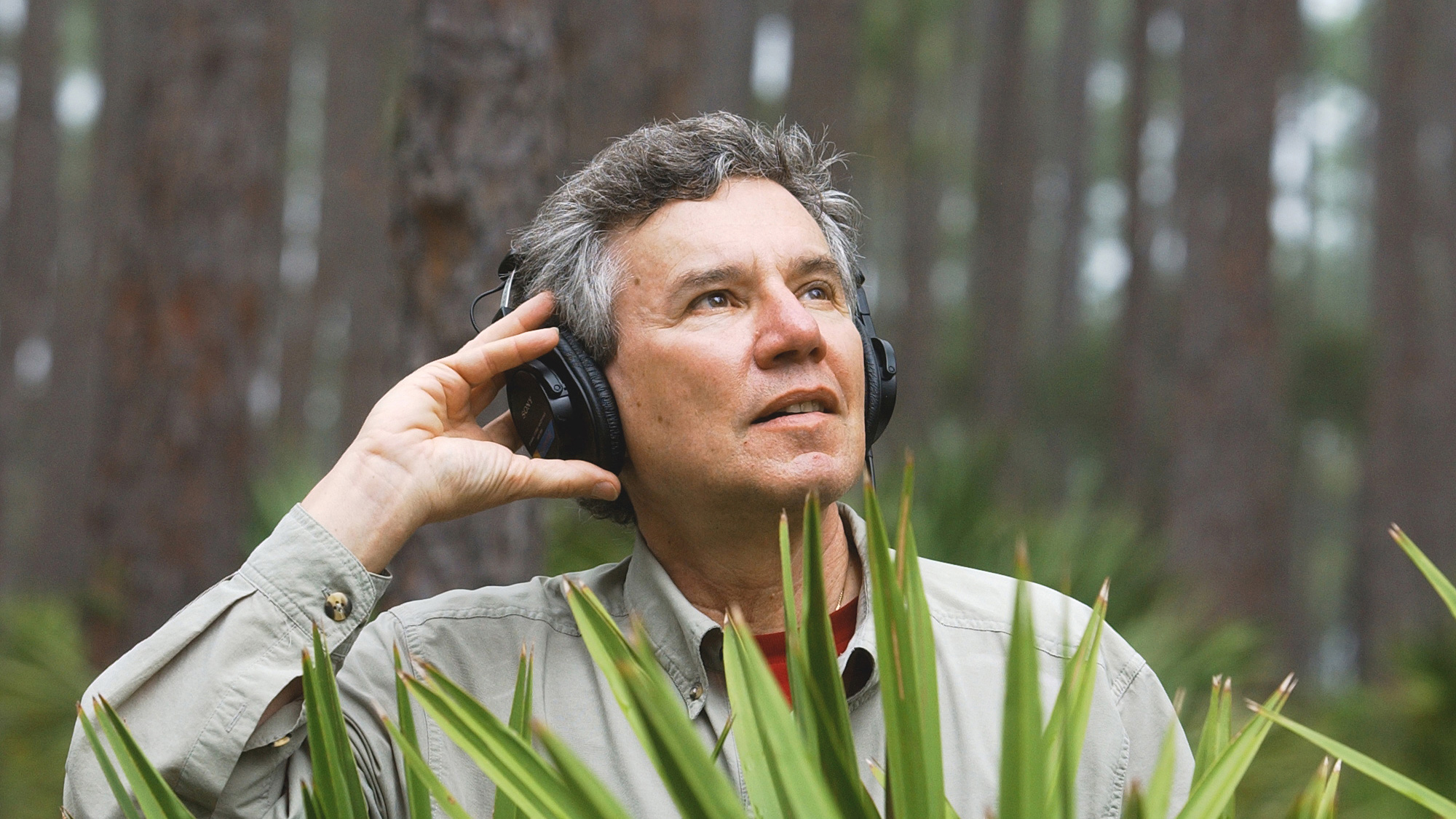
Drawing on more than half a century of recording natural soundscapes, soundscape ecologist Bernie Krause reflects on how disappearing wildlife voices reveal ecological decline.Concerned about political threats to science, Krause transferred a copy of his extensive recording archive to a foundation in Paris to safeguard it for future generations.In this commentary, he argues that nature’s interdependence offers lessons for human societies about diversity, equity and inclusion, and calls for protecting both living ecosystems and the scientific records documenting their loss.This article is a commentary. The views expressed are those of the author, not necessarily of Mongabay. It is a peculiar irony: as technology reaches ever deeper into Earth’s living systems, the primal sonic expressions of the natural world—wind, water, leaf, and creature—have never been more imperiled. Soundscape ecology rests on a simple conviction: the collective voices of the nonhuman world are not only eloquent, but essential. Recorded and preserved over time, these biophonies become enduring ledgers of planetary health, as valuable as genetic databases or satellite images. Over more than half a century, I have gathered more than 5,000 hours of marine and terrestrial recordings. Across those decades, I have heard both the vivid symphony of life and its alarming decline. When science came under siege In recent years, the value of these scientific records—and the ethics of preserving them—has been thrown into sharp relief by forces not of nature, but of governance. In 2017, only weeks after a new U.S. administration took office, a chill settled over the scientific community. Colleagues described research suddenly treated as suspect, funding cut, and datasets removed from public view. It became alarmingly clear that science itself was under siege. Archiving natural soundscapes was no longer solely an act of devotion and curiosity. It had become an urgent responsibility. The danger was not only the destruction of habitat or the extinction of a particular songbird; it was also the erasure of a coherent body of knowledge. Beyond political reach I felt compelled to act. With a sense of defiance and duty, I copied my entire field collection—thousands of hours documenting changes in ecological health across continents and decades—and transferred it to the Fondation Cartier pour l’art contemporain in Paris. There, it would stand beyond the daily reach of political expediency. The decision arose from necessity, but also from faith: faith that these recordings—hours of wind, birdsong, and marine voices—might serve a future wiser than the period in which we now live. That choice has only grown more prescient. Congressional and executive efforts to defund environmental and climate research do more than restrict inquiry; they help unmake public knowledge. Whether explicit or implicit, their effect is to distance people from the living world and to weaken the next generation’s ability to ask and answer questions about our only home. In this context, the archive transcends its role as a scientific resource. It becomes an enduring legacy: a historical record whose integrity does not depend on the fortunes of any administration or the lives of any individual researchers. What the recordings reveal The recordings themselves—collected year by year, place by place—bear witness without malice or agenda. A rainforest dawn chorus from the 1970s, dense with the voices of countless species, can be compared with the thin echoes of that same forest today. The clicks, snaps, and groans of a healthy coral reef can be set against a soundscape altered by warming seas, pollution, and acidification. By measuring the quality and quantity of creature voices over time, we can hear the effects of climate change on living communities. Ecological disruption becomes audible, immediate, and heartbreakingly clear. Soundscape ecology therefore offers a distinctive lens on environmental change—one that is both quantifiable and deeply human. Each call, chirp, trill, and moan is more than a data point; it is an expression within the living tapestry of the world. Every missing voice is a warning. Every silence is a loss. As those absences accumulate, the effect resembles the disappearance of a language or the burning of a great library. Conditions of survival Amid political noise and media echo chambers, it is easy to forget that the natural world is our primary mentor. In every thriving ecosystem, diversity, equity, and inclusion are not abstract aspirations; they are conditions of survival. Diversity gives an ecosystem resilience through differences in species, age, form, function, and voice. Equity allows each organism its place and role within a web of reciprocal dependence. Inclusion sustains the integrity of the whole by ensuring that no necessary voice is excluded. A forest is healthy not because every tree is the same, but because it is a riot of difference, intricately interwoven. An ocean is resilient not through the dominance of a single species, but through the complexity of its food web. These lessons do not depend on opinion polls or political consent; they are encoded in the structure of life, itself. In a healthy soundscape, diversity is essential, equity is practiced, and inclusion is a necessary state of being. To deny this interdependence is to sever ourselves from the foundational principles of our own survival. To imagine that the tuning of the natural world can be disrupted without consequence is, as I have sometimes remarked to colleagues, like expunging the “Sermon on the Mount” from the “Gospel of Matthew”: a willful erasure of wisdom that has shaped not only belief but being. Resistance and hope Recording, archiving, and analyzing natural soundscapes is therefore a labor of resistance and hope. Each recording is a memento of the past, a document of the present, and a signal to the future—a way of saying: “We listened. We cared. We prevailed.” These archives will outlast propaganda and the brief cycles of political fortune. Long after the performative noise fades, they will remain as testimony to what we have lost, what might be restored, and what must never be forgotten. To those who would diminish science or bury its most illuminating findings beneath denial and distraction, the answer is simple: the voices of the natural world speak more powerfully than any decree. Painstakingly gathered and rigorously preserved, the evidence will outlast this moment. It is a chorus that cannot be silenced. The Future For those willing to listen—truly and mindfully—to wild voices, the lesson endures: life flourishes where difference is honored, where every voice can be heard, and where the integrity of the whole is fiercely protected. If we wish to understand what lies ahead, we would do well to remember a paraphrase of David Bowie’s aphorism: “The future belongs to those who can hear it coming.” Header image: Bernie Krause on St. Vincent Island, Florida in 2003. Photo by Tim Chapman Credits Topics
Why I sent my archive of nature’s sounds to France (commentary)
Full Article
Original Source
Read the full article at News →KhanList aggregates and links to publicly available news content. We do not host full articles from third-party sources. Always verify important information with original sources.