
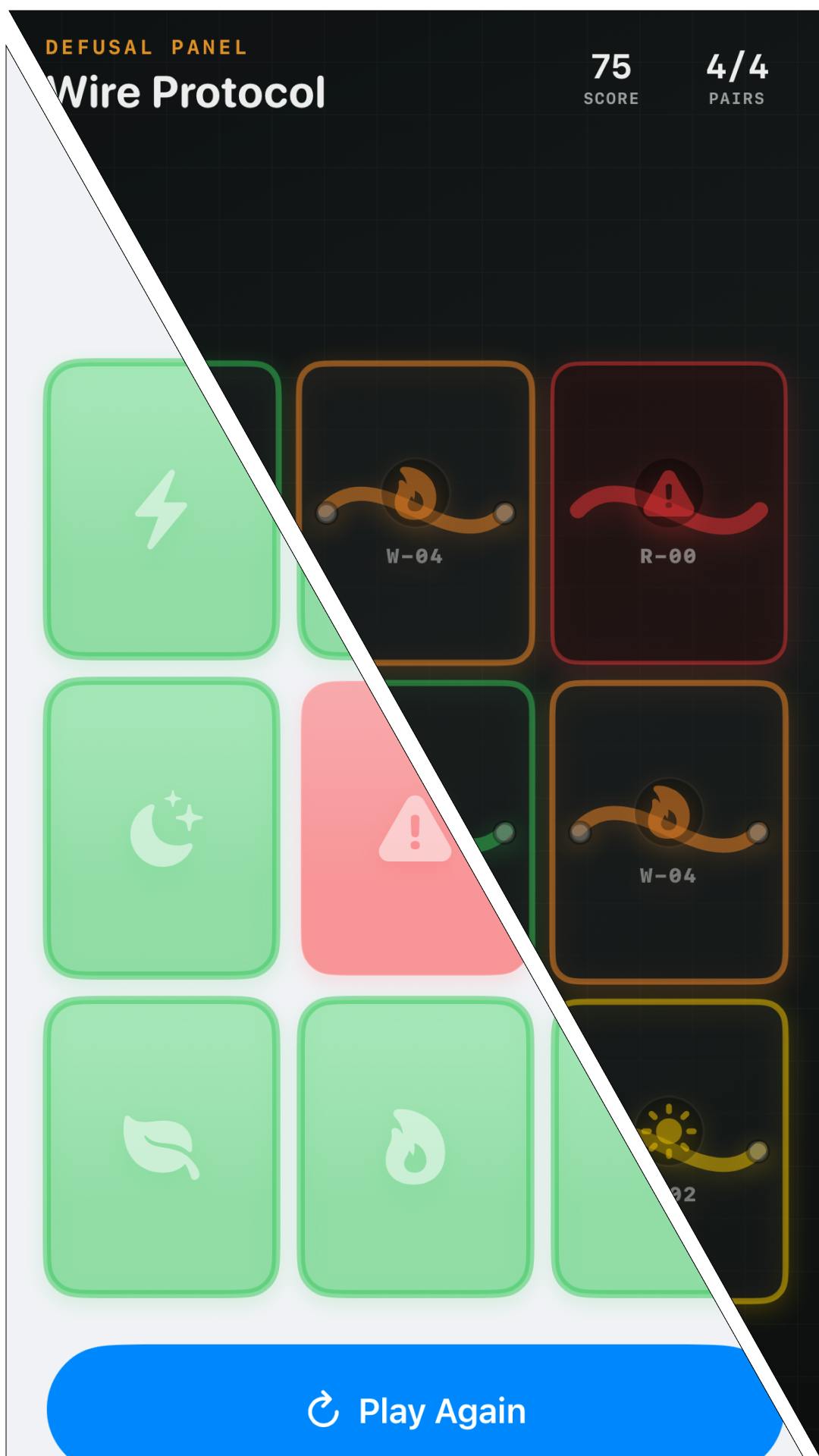
I recently asked for feedback on a fairly important question about Adversary, my Shipaton build: What should the identity of the game be? Should it stay simple and immediately recognizable as a memory game, with the Danger card providing the twist? Or should the entire game lean into a stronger theme that gives the cards and the Danger mechanic a world of their own? This wasn’t just a question about which screenshot looked nicer. It was about what Adversary should fundamentally feel like when someone starts playing. And, as it turns out, the most useful answer didn’t come from the vote count. Option A: Simple The Simple direction keeps Adversary close to what people already know as a memory game. You see cards. You flip them. You find matching pairs. Except somewhere on the board is a Danger card waiting to ruin what was otherwise a perfectly respectable attempt at remembering things. The advantage of this direction is clarity. Players don’t need to first understand a theme before they understand the game. The familiar structure does most of the explaining, which leaves the Danger card to be the unusual part. It also gives me quite a bit of flexibility visually. The core idea can stay familiar without every card, screen, or visual detail needing to be generic. Option B: Themed The alternative was to give the entire game a stronger concept. The example I created was a bomb defusal theme. Instead of matching traditional cards, you could be matching colored wires. The unmatched red wire becomes the Danger element. Suddenly the memory mechanic is part of a larger scenario rather than simply being a memory game with a dangerous card hiding inside it. And I still like that idea. A theme can give the game more personality. It can make individual mechanics feel like they belong together and potentially make the whole experience more memorable. The bomb defusal version was only an example, though. I wasn’t really asking, “Should Adversary be about defusing bombs?” The bigger question was whether Adversary should have that kind of themed identity at all. The tradeoff This is where I got stuck. Themed gives Adversary a stronger personality. Simple makes Adversary immediately recognisable When you’re building something yourself, there’s also a small problem: you know what everything means. I can look at an interface I designed and think, “Yep, perfectly obvious.” Of course it is. While the Themed options received a few more votes, the written feedback I received was much more helpful. One person felt the Simple version popped out more. Another pointed out that it was easier on the eyes and that the shapes and colors were easier to distinguish. That became much more important to me than which option had a few more votes. Those comments were identifying something I couldn’t properly judge myself anymore: how quickly someone unfamiliar with the game could understand what they were seeing. I already know how Adversary works. The person downloading it for the first time does not. And if the simpler version makes the board easier to read and the game easier to interpret, that is a pretty strong argument in its favor. So, Simple it is I’ve decided that Adversary will have a Simple core identity. It will be recognizable as a memory game first, with the Danger card acting as the thing that changes the experience. The community feedback didn’t simply confirm an option I already wanted. It gave me a better understanding. Once I looked at it that way, the decision became much simpler (see what I did there 😅). And that is probably the most useful thing I got out of this poll. Simple doesn’t mean boring Choosing Simple also doesn’t mean the game needs to look exactly the same forever. There is still plenty of room to give Adversary some flair. I’d like the game to be able to support different visual treatments in the future: card skins or seasonal styles. The important distinction is that those would change how the game is presented, not what the game is supposed to be. The foundation stays simple. Then I can have some fun on top of it. Why I’m asking these questions publicly This was a small decision in the grand scheme of building the game, but it turned into a good example of why I’m enjoying the Build in Public process. If I had only looked at the votes, I might have walked away with a different conclusion. Instead, a couple of people took an extra minute to explain what they were seeing and why one option worked better for them. That changed how I evaluated the whole decision. I’d like to thank everyone who added some reasoning along with their preference. The button you clicked was useful. The explanation next to it was much more useful. There will be plenty more decisions before Adversary ships, and I’ll keep sharing them as I go.
Why I Ignored the Winning Option
Full Article
Original Source
Read the full article at Hackernoon →KhanList aggregates and links to publicly available news content. We do not host full articles from third-party sources. Always verify important information with original sources.