
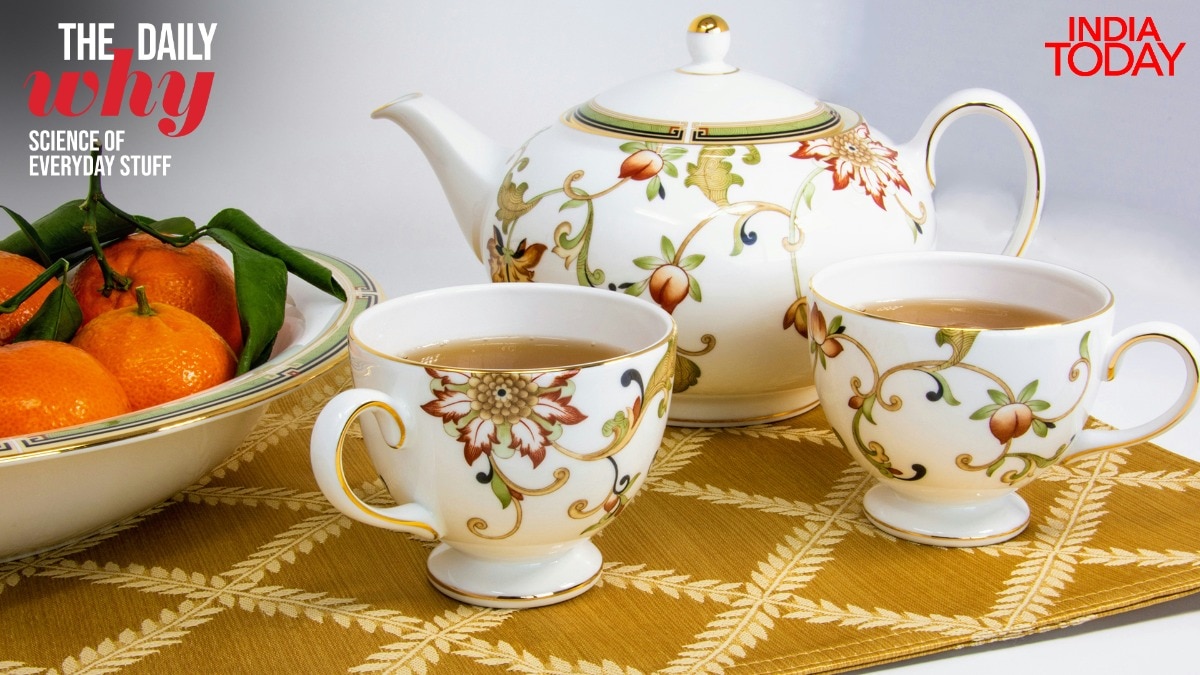
That trickle of tea running down the outside of your cup has a name, the teapot effect, and it puzzled physicists for over 65 years. We explain why liquids cling to a rim, and the everyday chai trick that makes them pour cleanly.Pour a cup of chai slowly and a thin trickle doubles back under the lip and runs down the outside, the everyday nuisance physicists call the teapot effect. (Photo: Unsplash)Watch anyone pour a cup of chai and you will see it happen. The tea leaves the rim in a neat little arc, and then, just as the cup tips back, a thin trickle doubles back beneath the lip and runs down the outside, onto the saucer, onto the tablecloth, and onto your fingers. You wipe it, you mutter, you pour on.You have just been beaten by one of the most stubborn little problems in physics.WHAT IS THE TEAPOT EFFECT?That dribble has a name. Physicists call it the teapot effect, because a teapot with a nicely rounded spout is the worst offender of all. The term was coined in 1956 by Markus Reiner, a rheologist, a scientist who studies how materials flow. The same mischief happens whether you pour from a fancy teapot, a steel tumbler, a kitchen jug or a chipped mug. Named by the rheologist Markus Reiner in 1956, the teapot effect makes liquid cling to a lip and dribble down the outer wall of any vessel. (Photo: Unsplash) You would think something this ordinary would have been settled a century ago. It was not. The teapot effect resisted a full explanation for decades, and only in 2021 did a team at TU Wien finally publish a complete theory of why it happens. WHY DOES THE LIQUID CLING INSTEAD OF FALLING CLEANLY?Every pour is a quiet tug of war between two forces.The first is cohesion, the tendency of water molecules to cling to one another. It is cohesion that gives water its surface tension, the taut, skin-like pull that lets a drop hold its round shape. The second is adhesion, the attraction between the water and the cup itself. How eagerly a liquid spreads across a surface is called wetting, and a surface that a liquid spreads over readily is described as wettable. Adhesion and surface tension overpower a slow stream, so the tea hugs the curved lip instead of falling away in a clean arc. (Photo: Unsplash) When you pour slowly, the forward momentum of the stream, its inertia, is weak. Adhesion and surface tension win the contest. Instead of flying off in a clean arc, the tea hugs the curve of the lip and wraps around it. The TU Wien researchers showed that a minuscule drop stays permanently wetted just beneath the edge, and below a certain pouring speed, that clinging drop steers the entire flow around the corner and down the side.Surface science makes the point even more sharply. In a celebrated 2010 study, Cyril Duez and colleagues at the University of Lyon showed that wettability is the master switch. On a water-repellent, or hydrophobic, surface, where water beads up rather than spreading, the dribble disappears altogether.WHY DOES TOUCHING TWO CUPS TOGETHER STOP TEA FROM DRIPPING?This is where the old chai habit turns out to be clever physics.When you rest the base or lip of the full cup against the rim of the empty one and then tip it, you create a continuous wetted path between the two surfaces, a tiny liquid bridge that scientists would call a capillary bridge. The tea, which prefers to travel along a solid surface it can wet rather than leap through open air, simply follows that bridge into the second cup. Resting a full cup against an empty one lays down a wetted bridge, and the tea follows that path across instead of dribbling down the side. (Photo: Unsplash) You are not really pouring at all. You are laying down a rail and letting the liquid run along it. The same touch also wipes away the last clinging drop, so nothing is left to trickle down the outside.It is, in essence, the same surface tension and wetting behaviour that causes the dribble in the first place, just redirected on purpose to work in your favour instead of against you.HOW DO YOU POUR TEA WITHOUT DRIPPING?Once you understand the physics, the cures are obvious, and they are all the same trick in different clothes.Pour faster. A quicker stream carries more inertia, so it has the momentum to fly off the edge instead of bending back around it. Pour from a sharp edge. An abrupt corner forces the liquid to let go, which is why a thin, crisp rim behaves and a thick, rounded one dribbles. And if a spout were ever coated in a water-repellent surface, the liquid could never wet it enough to cling in the first place. Pour faster, tip from a sharp edge, or use a water-repellent surface, each helps the stream detach cleanly rather than cling. (Photo: Unsplash) You will often hear the dribble blamed on the Coanda effect, the tendency of a fast jet to bend towards a nearby surface. It sounds convincing, but modern research pins the teapot effect mostly on surface tension and wetting, not on Coanda-style attachment.So the next time you steady an empty cup against a full one and let the chai run across, do it with a little pride. You are quietly solving a puzzle that outwitted physicists for 65 years, engineering the delicate boundary between tea, air and ceramic with nothing more elaborate than a practised hand and a steady wrist.- EndsPublished By: Radifah KabirPublished On: Sep 14, 2026 13:12 IST
Why does tea dribble down the cup's side while pouring? Blame the teapot effect
Full Article
Original Source
Read the full article at Indiatoday →KhanList aggregates and links to publicly available news content. We do not host full articles from third-party sources. Always verify important information with original sources.