
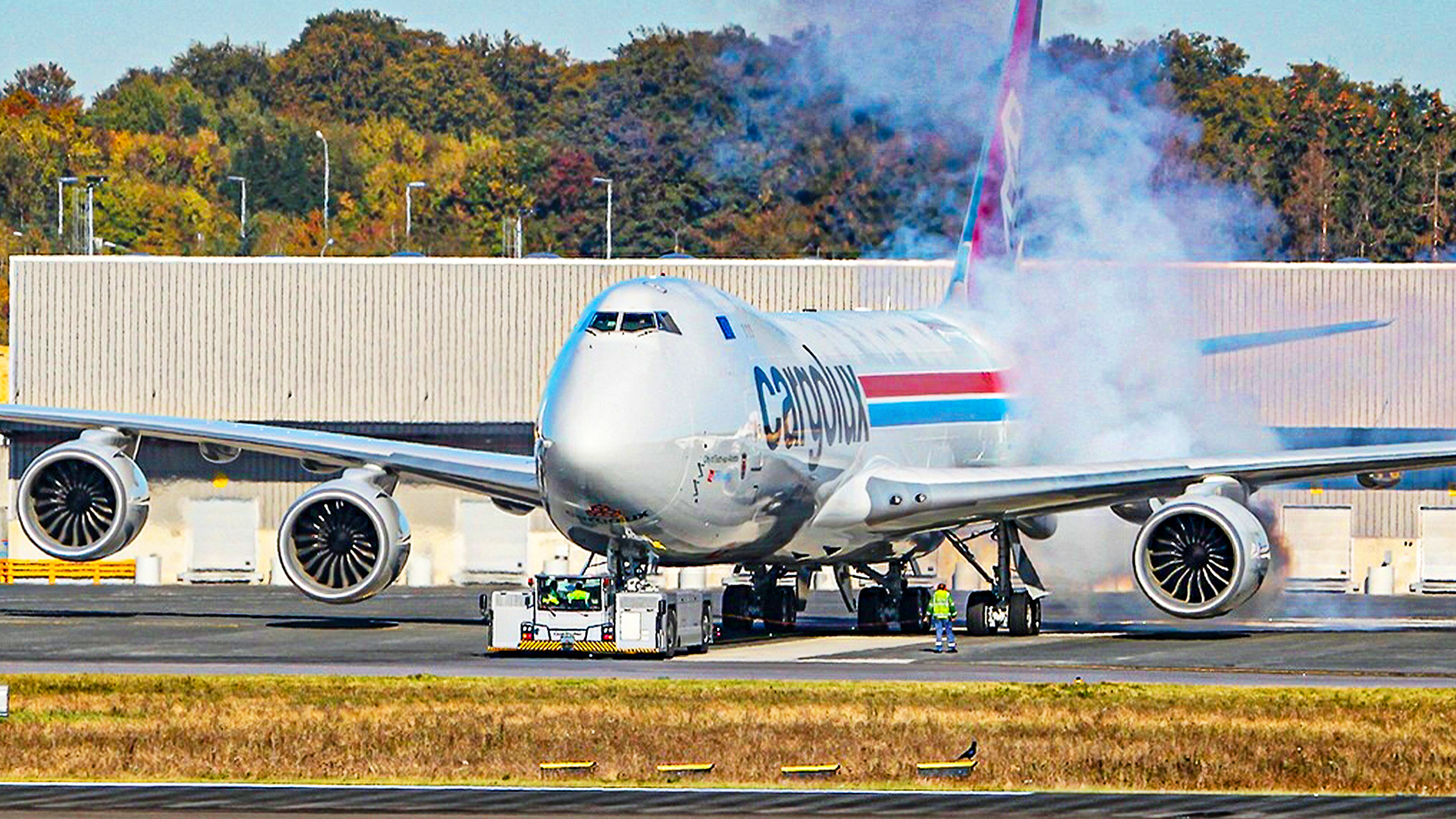
On November 17, 2026, Uzbekistan's civil aviation authority granted Luxembourg-based Cargolux Airlines a permit to operate scheduled cargo flights to Navoi International Airport (NVI) with Boeing 747F freighters. The surprise is that a major widebody cargo carrier, operating a 30-aircraft fleet of Boeing 747-400Fs and 747-8Fs, is betting on Navoi as a pure-play cargo hub with a free customs zone as opposed to focusing on Tashkent, the Uzbek capital. For most travelers, Navoi barely registers on the aviation map, but freight planners are looking closely at what the airport offers. Why would one of the world's largest cargo airlines pursue regulatory approval for a small Central Asian airport before announcing a launch date, frequency, routing, payload, or European network link? For Cargolux, opting for an airport out of the spotlight may just be one of the best moves available. A Real Cargo-First Airport? Uzbekistan's civil aviation regulator, the Uzaviation Agency, granted Cargolux Airlines a permit to operate scheduled Boeing 747F cargo services to Navoi International Airport, setting the scene for one of the more intriguing route expansions. The authorization builds on earlier bilateral aviation ties, including a 2019 air traffic protocol designed to support Cargolux transit cargo flows to Asian markets starting in 2020. An important shift in how Navoi is governed helps explain why the hub is drawing direct freighter interest now. Navoi International Airport was decoupled from centralized operational control under Uzbekistan Airports LLC in 2026, gaining commercial autonomy to negotiate agreements directly with international airlines and logistics partners, as reported by the Tashkent Times. Operating independently lets Navoi tailor slot coordination, ground arrangements, and commercial terms to cargo operators rather than competing for attention inside a passenger-led airport group. Navoi reinforced that cargo-first positioning in October 2026 with the opening of its Porto-Franco free customs zone, established under Presidential Resolution No. PP-50 of February 9, 2026. Described as Central Asia's first free customs zone of its kind, Porto-Franco supports duty-free storage and processing of international goods alongside upgraded ground handling equipment. Together, commercial autonomy and customs-free handling give Navoi a distinct institutional foundation as a dedicated freight hub. All About Location Uzbekistan's air cargo market has expanded rapidly, creating a strong commercial backdrop for Navoi's push. Air cargo volume in Uzbekistan climbed 182% between 2019 and 2024 before rising another 33% in the first half of 2026, per Trend News Agency. That sustained growth reflects rising trade flows across Central Asia and growing demand for reliable transit links between Asia and Europe. Geopolitical disruptions in the Middle East have added urgency to that shift by straining traditional southern routing options. As conflict-related closures and airspace restrictions affect Gulf hubs and Middle Eastern corridors, freight forwarders and airlines have increasingly looked toward Central Asian transit routes as an alternative connection point between Asian manufacturing centers and European markets. Uzbekistan sits directly along that overland and aerial corridor, making it an ideal location under these circumstances. Within Uzbekistan, Navoi is being positioned as a dedicated cargo and multimodal logistics hub and is not necessarily competing head-to-head with Tashkent's passenger-heavy gateway. Connecting air freighters with regional rail and road networks allows shipments to move smoothly across Eurasia and keeps heavy freighter traffic away from crowded capital-city passenger operations. For cargo operators, that separation makes Navoi a cleaner fit for high-volume transit. Exceptional Infrastructure Progress Backing up Navoi's hub ambitions can only be achieved with improved capacity on the ground as freighter traffic scales up, as detailed in reporting from Air Cargo Week. That capacity is well on its way, with a new 172,223-square-foot (16,000-square-meter) cargo terminal under construction at the airport, paired with fuel storage expanded to 16,535 short tons (15,000 metric tons) to support long-range widebody turnarounds. Those upgrades give cargo operators dedicated warehouse space and reliable uplift in a way that does not strain existing apron operations. Technical and maintenance support is also part of the buildout roadmap as Navoi prepares for heavier widebody use. According to Trend News Agency, plans include a dedicated aircraft maintenance and painting center for widebody aircraft targeted for completion by 2028. This will expand local technical capabilities alongside cargo handling. Ultimately, having heavy maintenance and paint capacity closer to the corridor reduces repositioning overhead for operators. Those investments tie directly to ambitious operational targets set for the end of the decade, highlighted in coverage by UzDaily and Trend News Agency. Navoi is aiming for 7,000 annual flights and 49,604 short tons (45,000 metric tons) of cargo by 2030 as commercial agreements and logistics partnerships scale up. Hitting those milestones, though, will all depend on the planned terminals, fuel capacity, and 2028 maintenance facilities and whether these can provide steady daily throughput. How Will Cargolux Affect The Airport? Cargolux brings a specialized all-cargo fleet built around the 747 family, with a 30-aircraft lineup of Boeing 747-400F and 747-8F freighters detailed in Trans.ru's report on the permit and Cargolux's fleet overview. What makes the 747 particularly unique and well-suited to cargo operations is its nose-loading capability. Nose-loading widebody freighters are well suited to bulky, outsized, and high-value shipments moving along Eurasian corridors where straight-in main-deck loading saves handling time and supports long-range trunk lift. Even with the November 17, 2026 approval in hand, key operational details remain unannounced within UzDaily's coverage of the permit and Kapital.uz's report. Neither a launch date nor flight frequency has been disclosed, and public reporting has not yet confirmed exact routings, payload allocations, or how Navoi flights will link into Cargolux's broader European network out of Luxembourg. From the viewpoint of cargo planners and shippers, that gap means the permit marks a regulatory green light rather than an immediate timetable. Until schedules and routing structures are published, market watchers will look to subsequent announcements, whether that be from media outlets or the airline itself, to see whether Navoi will be a dedicated regional stop, a multi-sector transit point, or an overflow hub for high-density freight. Different To Other Cargo Hubs? Navoi's pure-play cargo and multimodal positioning sets it apart from Tashkent as well as other Central Asian and nearby Caucasus logistics hubs competing for Asia–Europe freight, as examined by Air Cargo Week and Seetao. Other airports in the region generally rely on belly hold capacity tied to passenger schedules. Meanwhile, Navoi focuses on dedicated freighter turnarounds backed by road and rail links across Central Asia and China–Europe trade lanes. Across the wider region, airports and logistics corridors in Central Asia and the Caucasus are expanding capacity simultaneously to capture shifting transit flows, as covered in Air Cargo Week's regional cargo capacity analysis. Competition centers on customs efficiency, ground handling speed, and seamless links between air corridors and overland rail or trucking routes. Airports such as Baku Heydar Aliyev Airport (GYD) already have established cargo demand, supported by Baku-based Silk Way West as well as the presence of operators such as Cargolux. Overall, Navoi is looking to be in a really good position to establish itself strongly in the global cargo network. As such, it may not be long before more operators, in addition to Cargolux, look to cement their operations in this Central Asian hub. Regional hub rivalry comes down to execution and reliability, and Navoi's infrastructure growth epitomizes this. Hubs that pair multimodal connectivity with predictable clearance and turnaround times stand the best chance of holding onto Asia–Europe cargo once routing choices stabilize. The Potential To Make A Massive Change In The Region Cargolux's November 17, 2026 permit to operate Boeing 747F flights to Navoi International Airport is a major milestone for Central Asian aviation, a decision that highlights how shifting trade corridors, Middle East airspace disruptions, and hub design are reshaping Asia–Europe air cargo. With commercial autonomy and the Porto-Franco free customs zone, alongside a 30-aircraft 747-400F and 747-8F operator, Navoi has an incredible opening to compete as a dedicated freighter hub rather than an afterthought behind Tashkent. Going from regulatory approval to sustained commercial volume will depend on decision-making across both airlines and airport planners over the coming years. While launch dates, frequencies, routings, payloads, and European network ties remain unannounced, Navoi's 172,223-square-foot (16,000-square-meter) cargo terminal buildout, 16,535-short-ton (15,000-metric-ton) fuel storage expansion, 2028 widebody maintenance and painting center, and 2030 goals of 7,000 annual flights and 49,604 short tons (45,000 metric tons) of cargo set clear benchmarks. Ultimately, whether Navoi becomes a permanent fixture on Cargolux's 747 map will come down to real-world performance when up against rival hubs across Central Asia and the Caucasus. If multimodal rail and road links, customs clearance, and widebody ground support deliver consistent turnarounds as traffic grows, an airport most flyers have never heard of could support a major link in Eurasian cargo logistics.
Why Cargolux Won Approval To Fly Boeing 747 Freighters To An Airport Most Flyers Have Never Heard Of
Full Article
Original Source
Read the full article at Simpleflying →KhanList aggregates and links to publicly available news content. We do not host full articles from third-party sources. Always verify important information with original sources.