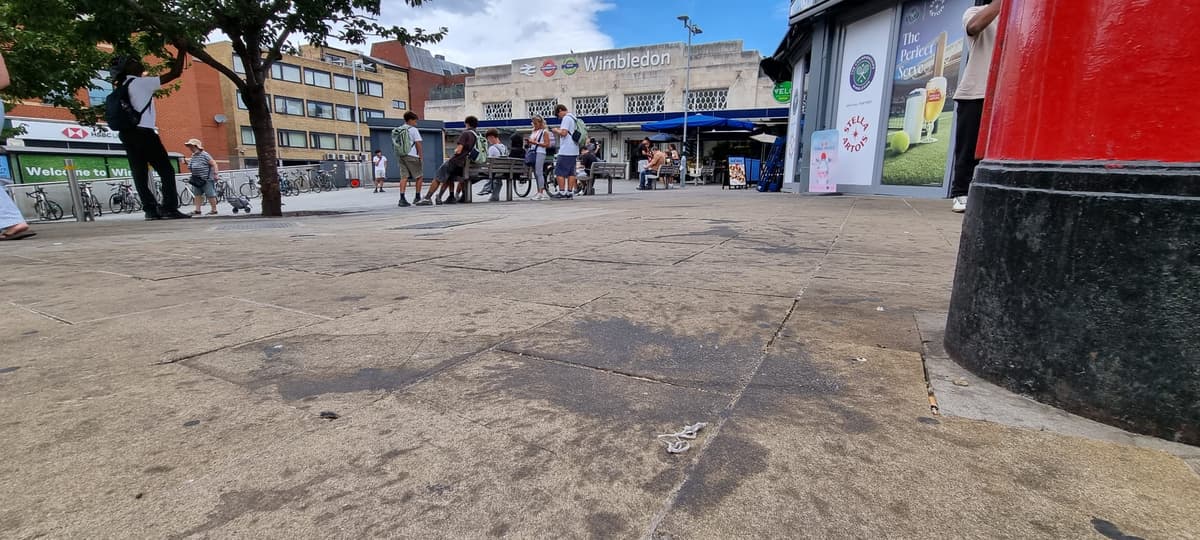
The prolonged spell of hot weather has been a boon for London’s hospitality sector, with more people staying to enjoy food and drink during the long, balmy summer evenings. Wimbledon has been no exception, as commuters spill out of the station and into the town’s many bars and restaurants after work.Yet the long, dry summer has also shone a spotlight on a growing problem. With little rain to wash away fresh spillages, Wimbledon town centre’s pavements have become stained and grimy, prompting residents to label them “filthy” and “messy”.“They are a disgrace and not what is expected in Wimbledon or any self-respecting village, town, or city in the UK,” said local resident Tom Kelleher. “Any visitors to the area must think the council and residents of Wimbledon are happy to live in these conditions, which will leave a lasting negative impression.”The Local Democracy Reporting Service (LDRS) visited Wimbledon town centre earlier this week to assess the condition of the pavements first-hand and ask residents whether they saw them as “a disgrace” that Merton Council should address urgently, or simply an unfortunate but inevitable consequence of hot weather and heavy footfall.Dirty streets in WimbledonLDRSHawes & Co estate agency overlooks the busy area outside the New Wimbledon Theatre, where visitors regularly gather before shows. One of its agents told the LDRS about his concerns over the current state of the town’s footways.“I came back from Spain last week and it made me realise how dirty the place is. It does look messy and scruffy,” he said.The agent also said the uncleanliness had the potential to impact house prices in Wimbledon. “It is supposed to be an affluent area,” he added.This was a view shared by Mitcham resident Alan Hutchings, who was visiting Wimbledon for a shopping trip with his partner. He told the LDRS that “the council should be doing more.”“This is supposed to be the richer end of the borough, where they spend all of the money,” he added.The contrast in pavement cleanliness was most visible outside Wimbledon Quarter, the town’s main shopping centre. A clear divide could be seen between the areas maintained by shopping centre staff, which appeared recently jet washed, and the adjoining council-owned pavement which was blackened with stains.Cleaner pavements outside Wimbledon Quarter contrast with others blackened with stains LDRSWhile many residents felt the council should be hosing down streets to remove these stains, Merton Council confirmed it does not have a statutory duty to pressure wash pavements throughout the year. However, it said it operates a jet washing programme across the borough’s town centres, particularly in high-footfall areas.Read MorePart of residents’ frustration was the perception that Merton Council focused cleaning efforts on the more affluent Wimbledon Village ahead of the Tennis Championships fortnight, while they felt the town centre had been left to deteriorate.However, the council said cleansing work had also been scheduled to begin after the tournament. They said that other major sporting events, including the World Cup, had also placed additional strain on the public realm due to increased footfall.Other residents felt the continuing absence of rain had contributed to the build up of stains and dirt on the pavement. “I think a lack of rain is the issue, there is nothing to clean it down,” one Wimbledon resident told the LDRS.“I mean it doesn’t look great, especially if you have all this mess out in front of your shop. Yet if everything is dirty its fine and no one will notice,” the resident joked.Despite these concerns, the council said rain does not remove existing stains but can make recent spillages less visible. It also said the current Thames Water hosepipe ban has not affected its street cleaning programme.Morden residents Stephen and Judith Line were also visiting Wimbledon for a shopping trip. While they said they still enjoyed going for a “mooch” around the town centre, they also felt the streets appeared dirty and highlighted the build-up of chewing gum on the pavements.“Many things have been tried, but people still chuck things on the floor,” said Judith. Elsewhere, Stephen pointed to piles of bin bags accumulating on pavements outside eateries due to a lack of bins as another issue facing the town.However, both also acknowledged the council’s limitations and suggested other areas may need to be prioritised. “People want clean pavements and litter-free areas, but you can’t have everything,” Judith said.“If the council are doing that, we think what are they not going to do in its place,” she added.Dirty Wimbledon streetsLDRSResponding to resident complaints about what they described as “filthy” town centre streets, Merton’s Lib Dem opposition has written an open letter to the Labour-led council calling on it to “keep our streets clean”. The letter urges the council to publish a plan for ongoing pavement maintenance in high-footfall areas, provide details of enforcement action against commercial waste practices that stain pavements, work with partners, and give regular updates on cleaning schedules and methods.Speaking to the LDRS about their call for action, Lib Dem Leader of the Opposition Cllr Anthony Fairclough said: “Merton Labour talks a lot about ‘Civic pride,’ but Civic Pride means more than managing down to the minimum statutory grade for litter and detritus.“It means a visible, reliable standard for the public realm in our busy town centres. We recognise that not all town centre pavements are public highway, and the constraints of cost, water use, run-off, disruption and noise.“Those constraints do not, however, absolve the Council of responsibility for keeping our streets clean, nor do they justify the absence of a clear strategy.”In response, a Merton Council spokesperson said: “The Council has a borough-wide jet washing programme in place that operates across key, prominent areas within its five town centres: Mitcham, Morden, Wimbledon, Wimbledon Village and Colliers Wood.“This work is carried out by dedicated resources during periods of low pedestrian activity. During warmer months, when town centres experience higher footfall and increased outdoor food and drink consumption, spillages can lead to a more rapid recurrence of staining.”The council added that Wimbledon receives daily street cleaning, while pressure washing takes place once or twice a year as part of a rotating schedule. It said street cleaning has increased since the service was brought back in-house, with all streets receiving a weekly cleaning visit.A source within Merton Labour also criticised the Lib Dem opposition for not supporting Labour’s plan for targeted funding to deliver a deep-clean programme, including regular jet washing in town centres and other high-footfall areas.
Why are Wimbledon's streets so dirty?
Full Article
Original Source
Read the full article at Standard →KhanList aggregates and links to publicly available news content. We do not host full articles from third-party sources. Always verify important information with original sources.