
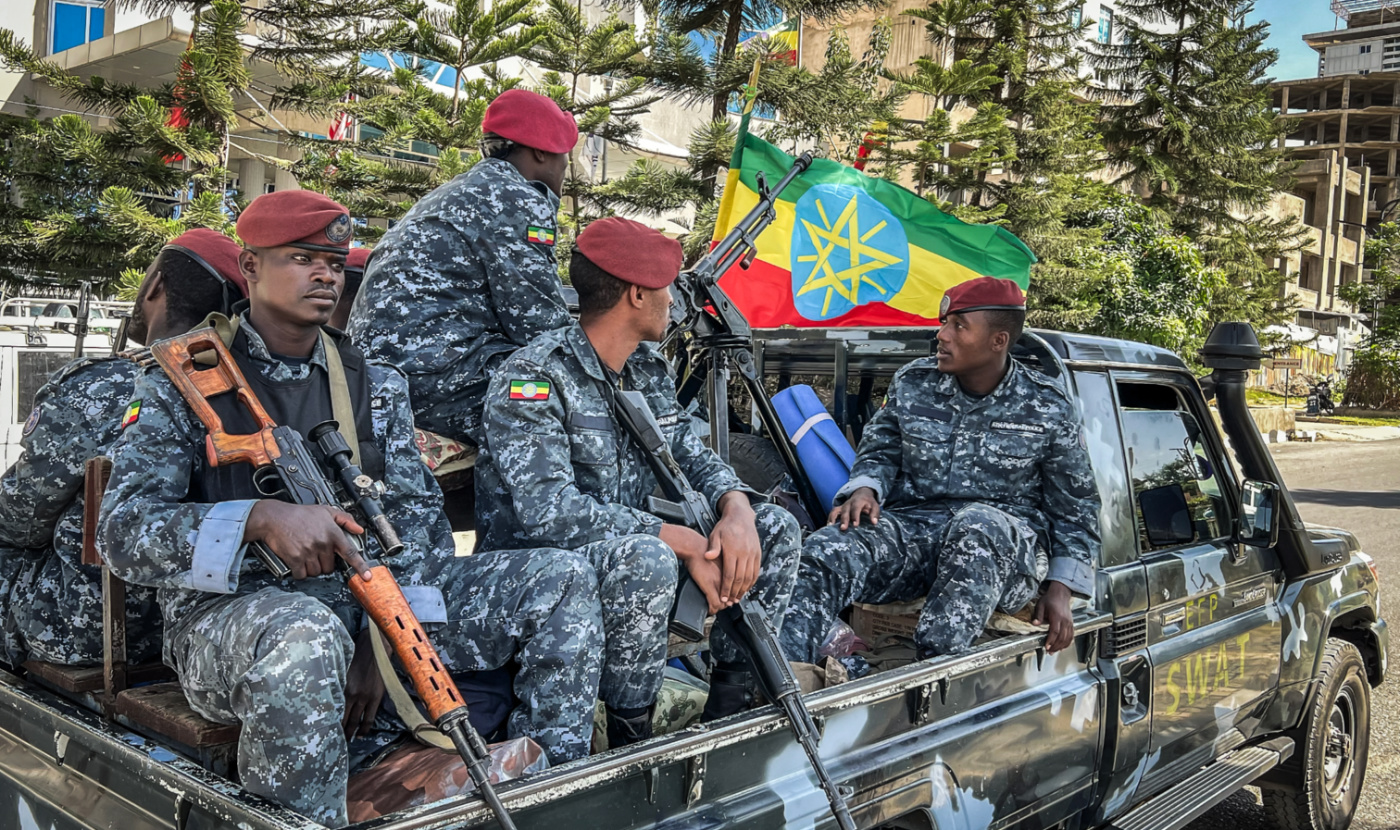
Fighting has continued across the Tigray region of northern Ethiopia, after a coalition of rebel groups seized territory in September. The government, which the insurgents have vowed to overthrow, has managed to contain much of the fighting, although explosions were heard in Addis Ababa in October. Tigray is no stranger to conflict. Amid accusations of war crimes and genocide, hundreds of thousands of people were killed and millions more displaced during the civil war from 2020-22. But now there are fears that the current conflict could escalate into a war between Ethiopia and neighbouring Eritrea, which it accuses of backing the rebels. The two countries severed relations in October. The Red Sea region is already beset with war across Sudan, Yemen and Somalia. New MEE newsletter: Jerusalem Dispatch Sign up to get the latest insights and analysis on Israel-Palestine, alongside Turkey Unpacked and other MEE newsletters Ethiopia has an ally in the UAE, while Eritrea can look to Saudi Arabia, Egypt and Sudan for support. Here’s everything you need to know about Tigray, past conflicts, and the role other countries are playing. Where is Tigray? Tigray is Ethiopia’s northernmost state, bordering Eritrea and a small part of Sudan. Roughly the size of Slovakia or the US state of West Virginia, it has a population of around 7.5 million people, according to the Ethiopian government. The majority of the inhabitants are Tigrayan, one of the 80-plus ethnic groups in Ethiopia and make up around six percent of the overall population. The landscape is dominated by rocky highlands, which contain some of Ethiopia’s largest deposits of gold and other minerals. The largest faith is Orthodox Ethiopian Christianity, as it is in the rest of Ethiopia, although a third of the country’s population is Muslim. Most Tigrayans speak Tigrinya, the most widely spoken language in Eritrea. Eritrea shares strong cultural roots with Tigray, but itself split from Ethiopia in 1993 after a bloody series of wars that lasted three decades and killed between 100,000 and 200,000 people. Who are the Tigray People’s Liberation Front (TPLF)? Politics in Tigray is dominated by the TPLF, a paramilitary group and political party founded in 1975. It fought a war against Ethiopia’s military governments from 1975 to 1991, during which it allied with Eritrean separatists themselves fighting for independence from Ethiopia (which they formally achieved in 1993). The conflict ended when the TPLF and other rebels overthrew the Ethiopian government. The TPLF-led coalition established the Ethiopian People's Revolutionary Democratic Front, a left-wing government, that ruled for the next 27 years, overseeing economic growth and expanding public services. A TPLF fighter pictured during the Ethiopian civil war, circa 1975 (Creative Commons) But it was accused of suppressing dissent, concentrating power in the hands of Tigrayan elites and voter intimidation in elections where it often won every parliamentary seat. The coalition also fell out with Eritrea, fighting a two-year border war over Tigray during 1998 that saw tens of thousands killed on each side. In 2018, Abiy Ahmed, from the Oromo, Ethiopia’s largest ethnic group, came to power after anti-government protests. The following year, as prime minister, he dissolved the government and formed the Prosperity Party, a new coalition which the TPLF refused to join. Ahmed also signed a peace deal with Eritrea in 2018 that officially ended the earlier conflict and for which he was awarded the Nobel Peace Prize. What happened during the 2020-22 civil war? In 2020, the TPLF held its own regional elections in Tigray in defiance of Addis Ababa. War broke out in November 2020 when Ethiopia’s army began an offensive in Tigray, amid accusations of TPLF attacks on military bases, which the rebels denied. Eritrean fighters and militias, particularly from the neighbouring Amhara region, fought alongside the government. The government blockaded imports of food, medicine and other goods into Tigray, triggering mass starvation estimated to have killed at least 200,000 people. Ethiopian refugees who fled the Tigray conflict at the Um Raquba refugee camp in Sudan in December 2020 (AFP) Rights monitors accused all sides of war crimes and crimes against humanity, including the large-scale rape and massacre of civilians. The government and its allies were also accused of genocide against Tigrayans. Death toll estimates range from 160,000 to over 600,000, with more than two million internally displaced, and tens of thousands more leaving the country, mostly to neighbouring Sudan. The war ended in November 2022 with the Pretoria Agreement, mediated by the African Union, which gave the TPLF some regional autonomy. Why is there war in Tigray now? Since 2022, peace in Tigray has been fragile. Many provisions of the Pretoria Agreement, including the return of displaced people and the disarmament of the TPLF, remain unimplemented. The TPLF has faced its own internal power struggle. In March 2025, a TPLF faction led by Debretsion Gebremichael, an opponent of aspects of the Pretoria Agreement, forced out Getachew Reda, leader of the regional administration, who fled to Addis Ababa and became an adviser to Abiy, his former enemy. In January clashes broke out between the TPLF and government forces in western Tigray. By July the TPLF declared the Pretoria Agreement “effectively dead”. In September, the TPLF said it had joined with other groups, including former civil war enemies, to form the Ethiopian Peoples' Forces Coalition for Survival (also known as Tsimdo). Russian President Vladimir Putin greets Ethiopia's Prime Minister Abiy Ahmed in Moscow on 28 October 2026 (AFP) In a joint statement, the groups said they would overthrow Abiy’s government, saying that “war, genocide, mass slaughter and absolute poverty have become its defining features”. Tsimdo launched a military offensive on 23 September, seizing Mekelle, Tigray’s regional capital, as well as territory in the states of Afar and Amhara. The government retook Mekelle without a fight within weeks, with the TPLF fleeing to outposts in Tigray’s highlands. But the rebels have vowed to continue fighting. Gebremichael said on 4 October: "We will attack the enemy where we choose, not where he chooses for us." How is Eritrea involved? Ethiopia has accused Eritrea of covertly aiding the TPLF and sending troops across the border in support in September. Eritrea has denied the allegations, but witnesses and conflict monitors have reported its soldiers' presence in Tigray. Following Ethiopian drone strikes, it has withdrawn some fighters from Ethiopia. The two states severed diplomatic ties on 1 October. Ethiopia, in a letter to the UN Security Council, accusing Eritrea of “a blatant act of aggression that engages Ethiopia’s inherent right to self-defence”. Eritrea’s backing for the TPLF is a striking reversal from its position during the 2020-22 war, when it allied with Abiy’s government against the rebels, as well as the 1998-2000 war, when it battled a TPLF-led Ethiopia. Instead, the alliance harkens back to Ethiopia’s 1975-1991 civil war, the last major conflict when Eritreans and Tigrayan rebels fought together. The move comes amid a major fallout between Ethiopia and Eritrea over Eritrea’s prized Red Sea coastline. Ethiopia, with a population of 140 million, is the world’s largest landlocked state, having lost access to the sea when Eritrea gained independence in 1993. In recent years, Abiy has repeatedly stated that the country needs maritime access. Many Eritreans have interpreted this as a declaration of Ethiopian intent to seize territory: Eritrea's port of Assab is just 70km from Ethiopia’s border. What is the UAE’s involvement in Tigray? Abu Dhabi has strong ties with Ethiopia, where it has invested billions since Abiy came to power in 2018. Ethiopia has said the priorities are “manufacturing, food processing, agriculture, packaging, construction materials, and logistics”. A former Ethiopian government adviser told Middle East Eye in April that “many in Ethiopia’s foreign ministry and elsewhere believe the UAE has been calling the shots in Ethiopia in regard to the Sudanese government, RSF and Eritrea over the port of Assab for at least two years”. On 25 September, the UAE backed Abiy’s government and condemned the TPLF attacks. In the past, it has given Ethiopia military support: Emirati drones and other armaments were identified in the Ethiopian military’s arsenal during the 2020-22 war. Berbera Port, Somaliland, in August 2021. The UAE has invested heavily in the facility, which Ethiopia is keen to access (AFP) Both Ethiopia and the UAE want to expand their influence in the Red Sea. They have collaborated in Somaliland, the breakaway region of Somalia on Ethiopia’s eastern border where Abu Dhabi has invested billions in the Berbera seaport and Emirati military bases. In January 2024, Ethiopia signed a memorandum of understanding with Somaliland to use the facilities and to build its own naval bases in exchange for recognising Somaliland sovereignty. But the deal angered Somalia. Ethiopia was forced to row back its ambitions for naval bases amid diplomatic mediation from Turkey, which has ties with both states. Today, most of Ethiopia’s trade still passes through neighbouring Djibouti. Emirati relations with Eritrea are icy. Eritrea’s foreign minister Osman Saleh accused Abu Dhabi of pursuing “port imperialism” across Africa in an exclusive interview with MEE in September. Is Sudan involved in Tigray? Ethiopia has tense relations with its northern neighbour Sudan. In 2021, there were violent clashes between Ethiopians and Sudanese over the contested border area of al-Fashaga. The two countries have since exchanged recriminations. Ethiopian military chief Birhanu Jula accused Sudan in September of supporting the TPLF, although he gave no evidence. Khartoum called the allegation “baseless”. Ethiopia expelled six Sudanese diplomats on 4 November. The Ethiopian army base at Asosa providing support for Sudan's Rapid Support Forces, shown on 29 March 2026 (Imagery © 2026 Planet Labs/Analysis Yale HRL) In turn, Sudan accused Ethiopia of assisting the Rapid Support Forces (RSF), the UAE-backed Sudanese paramilitary force which is fighting the Sudanese government and is widely accused of atrocities. Both Ethiopia and the UAE deny backing the RSF. But their support is widely documented: analysis of satellite imagery by Yale’s Humanitarian Research Lab, revealed by Middle East Eye in April, showed strong visual evidence that RSF fighters and supplies were travelling through an Ethiopian military base in its western Benishangul-Gumuz state. How is Egypt involved with Tigray? Ethiopia, Africa’s second most populous country, and Egypt, its third, have long been regional rivals. Central to the tension is Ethiopia’s Grand Renaissance Dam, a $5bn megaproject inaugurated in 2025 that will lower water levels on Egypt’s downstream stretch of the River Nile, and is viewed in Cairo as a threat to national security. The rift has only widened amid Ethiopia’s alleged support for the RSF in Sudan, where Egypt has ties to the government forces. The Grand Ethiopian Renaissance Dam (GERD) during its official inauguration ceremony in Guba on 9 September 2025 (AFP) In September, Jula accused Egypt of supporting the TPLF without evidence. Egypt has denied the accusation. The two countries expelled each other’s diplomats in October, but maintain formal relations. Egypt has also developed close relations with Eritrea’s leader Isaias Afwerki amid joint concerns about Ethiopia’s Red Sea ambitions. What about Saudi Arabia and Tigray? The media in Ethiopia has accused Saudi Arabia, the UAE’s main regional rival, of backing the rebels in Tigray. Riyadh has yet to comment on the war, but it has grown closer to Eritrea in recent years, where its diplomatic engagement and investment has been encouraged by Egypt. The kingdom also backs the SAF in Sudan in its fight against the RSF, which in turn is supported by the UAE.
Why are the UAE, Sudan and Egypt fighting for influence inside Ethiopia’s Tigray state?
Full Article
Original Source
Read the full article at Middleeasteye →KhanList aggregates and links to publicly available news content. We do not host full articles from third-party sources. Always verify important information with original sources.