
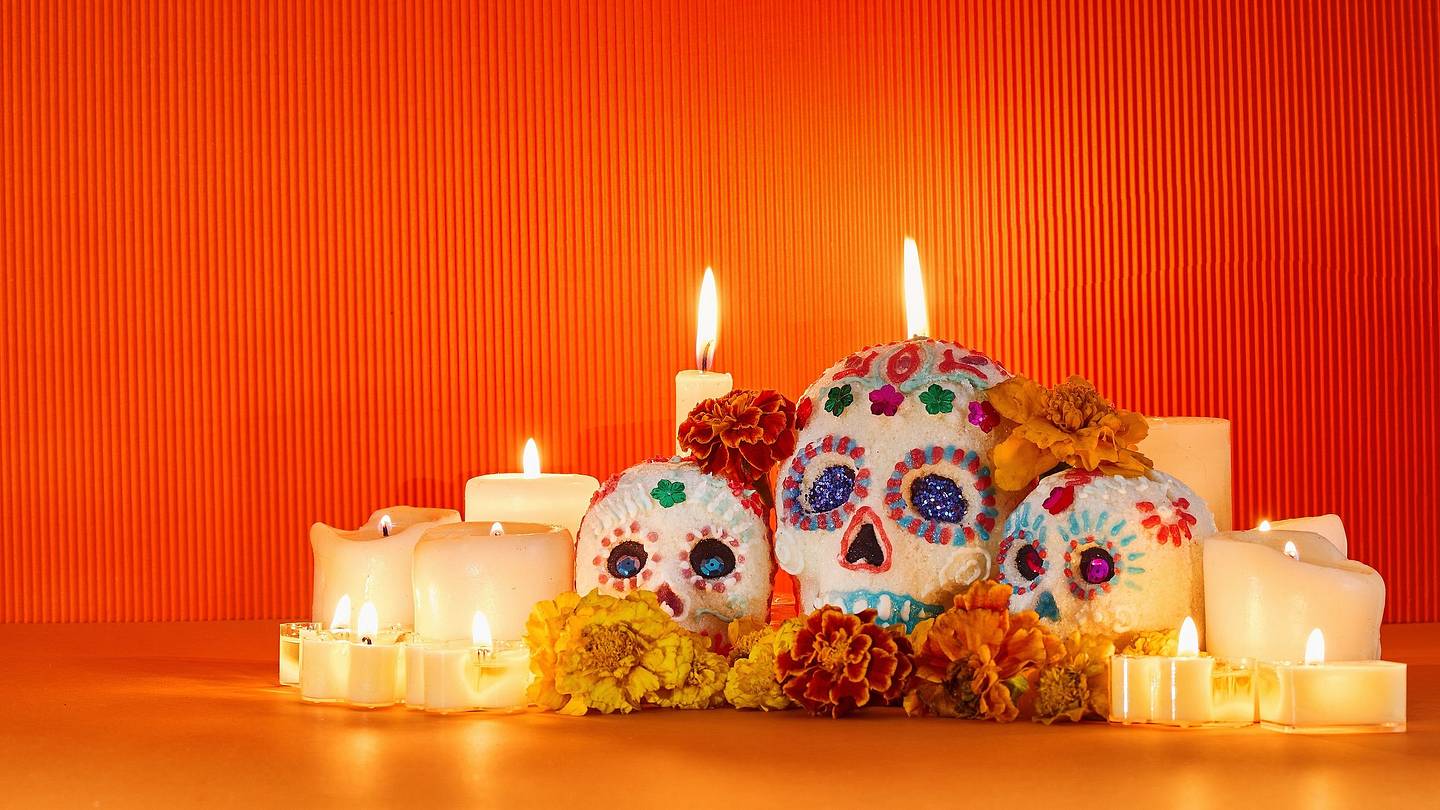
The room smelled like fragrant copal and fresh flowers. Candles covered the ofrenda, alongside photos of loved ones and plastic monarch butterflies. A child’s note to a grandmother sat in a frame on the right side, and I thought of my own departed grandmother, who had appeared in several dreams over the past few weeks.I was in a long room in the back of the store Luna and Luz, located in Albuquerque, New Mexico’s picturesque Old Town, where I was attending a garland-making workshop for Día de los Muertos. It was led by Aleja Grajeda, who runs a business called Las Ofrendas that offers postpartum care, folk medicine, and more.The store owner brought in a bag of freshly cut marigolds, the last piece we needed for the garland, and set them on the table. These flowers have long been connected to this holiday, which is widely celebrated from October 31 to November 2 and traditionally said to be a time when the dead can briefly return to the living. The marigolds’ sweet scent is widely believed to help deceased ancestors find their way back to their family homes during this famously liminal time. Their bright petals also add to the festive nature of this celebration of the dead. The meaning of marigoldsMarigolds and candles on table for Día de los Muertos at Luna and Luz in Albuquerque, New Mexico | Eden Gordon / Mental FlossThere are a number of reasons that marigolds always appear in traditional Día de los Muertos celebrations—reasons rooted in tradition and folklore that twine around each other like the flowers’ intricately layered petals.In the indigenous language Nahuatl, the flowers are called cempasúchil, which means “the flower of 20 petals.” Their use can also be traced back to a time before before Spanish colonization, when the Aztecs worshiped a goddess of death with a skeleton’s face known as Mictēcacihuātl. She was traditionally celebrated in July and August, and her worship was so deeply rooted among the Indigenous that the Catholic church’s efforts to stamp it out failed. Over time, people began subtly incorporating some of their traditional ways of honoring the dead into the Catholic holidays of All Saints’ Day and All Souls’ Day, and that festival eventually morphed into Día de los Muertos.One of the traditions that survived was the use of marigolds and other flowers to honor and aid the dead on their journey home. These bright orange blooms have a number of legends connected to them. One Mexican folktale holds that the sun god Tonatiuh gifted the flowers to the people so they could honor the dead with them. Another describes a couple named Xóchitl and Huitzilin. The story goes that after Huitzilin was killed in battle, Xóchitl asked Tonatiuh to reunite them. Tonatiuh turned her into a cempasúchil flower, which remained closed in a bud until Huitzilin’s spirit returned to her in the form of a hummingbird. The flower then unfurled, showing its vibrant orange color to the world. According to the tale, as long as marigolds continue to bloom on Earth, the couple’s love will endure. Today, marigolds remain key parts of many Día de los Muertos celebrations. Since scents are believed to help the souls of the dead find their way to the land of the living, they are often prominently displayed on ofrendas, in cemeteries, and as garlands. In small towns, families will often lay trails of marigold petals directly from cemeteries to their doors. The fragrant flower grows in Mexico as well as in Grajeda’s home base in the Southwest around this time of year. “The many layers have a significance. One is that they symbolize family: the layers are the many generations backing each other up and holding each other up,” she says. “The new layers of petals are fresh and small, and have a long way to go. The ones on the bottom are the dying ones, the past ones, the ones holding everybody up.” The petals, she continues, can also “represent layers of love, and the joy and the sweetness you feel for loved ones.”A ritual of remembranceFinished Día de los Muertos ofrenda at Luna and Luz in Albuquerque, New Mexico | Eden Gordon / Mental FlossWe started the garland-making process by drinking a cup of Mexican chocolate, a traditional beverage that dates back to Mesoamerican civilizations. Spiced with the ever-present chile, a staple of all New Mexican cuisine, the drink warmed me down to my bones, which, I reflected, will one day be all that is left of my body.Then we began using a needle to thread the marigolds onto a string, adding little purple flowers and dripping slices of pale oranges. During Día de los Muertos, food is traditionally left out for the ancestors in order to welcome them after their long journey from the spirit realm. Finally, we added sprigs of baby’s breath, another flower associated with Día de los Muertos that is said to pay tribute to any children who have passed on. The white twined with the yellowish-orange slices, the purple flowers, and the vibrant gold to create a string of colors that communicated celebration and welcome. If I were a spirit coming from the afterlife, I thought, I’d feel welcomed by the sight.How to celebrate Día de los MuertosViews Of Oaxaca Ahead The Day Of The Dead Celebration | Ani Saakyan/GettyImagesAnyone can celebrate Día de los Muertos in their own way, Grajeda says—marigolds not required. “You can have a feast of all their favorite foods and have your friends over…and enjoy your grandma's soup and their cookies,” she continues. “You don't have to be Mexican to celebrate this.”After all, people around the world have always honored their dead and celebrated their occasional return to the land of the living. “In Celtic cosmology and traditions like the European Samhain, they also say the veil is thinner, and it’s easier to contact your loved ones,” Grajeda adds. “So if you want a chance to talk to them, this time of year is a good time to do that. It’s a universal thing. Everyone has their way. You can adopt this way, or you can find your own.” Samhain, I knew, was the ancient holiday that my Celtic ancestors would have once celebrated by lighting bonfires and carving faces into turnips. It was also a holiday based on honoring the dead, and efforts had also been made to extinguish it.Yet like the marigolds of Día de los Muertos, Samhain traditions persisted and likely morphed into today’s Halloween. But while the ancient holiday’s reverential roots have been largely obscured, they are better preserved in Día de los Muertos traditions. Across the centuries, the bright orange marigolds and many vibrant traditions of Día de los Muertos have continued to resurrect themselves across generations, preserved by the strength of love and memory—the very things said to keep the souls of the dead alive, too.Ultimately, Grajeda says, Día de los Muertos is about celebration, and the marigolds, dances, and parades are all part of that. “It's a really happy time, actually. It’s not that you're not allowed to grieve; it’s that the custom is to celebrate life, and that we get the chance to have life and celebrate the dead,” she continues. “That's a privilege, so why not take advantage of that? Life is colorful and beautiful and unmuted, so we accentuate that during the festivities.”
Why Are Marigolds Displayed During Día de los Muertos?
Full Article
Original Source
Read the full article at Mentalfloss →KhanList aggregates and links to publicly available news content. We do not host full articles from third-party sources. Always verify important information with original sources.