
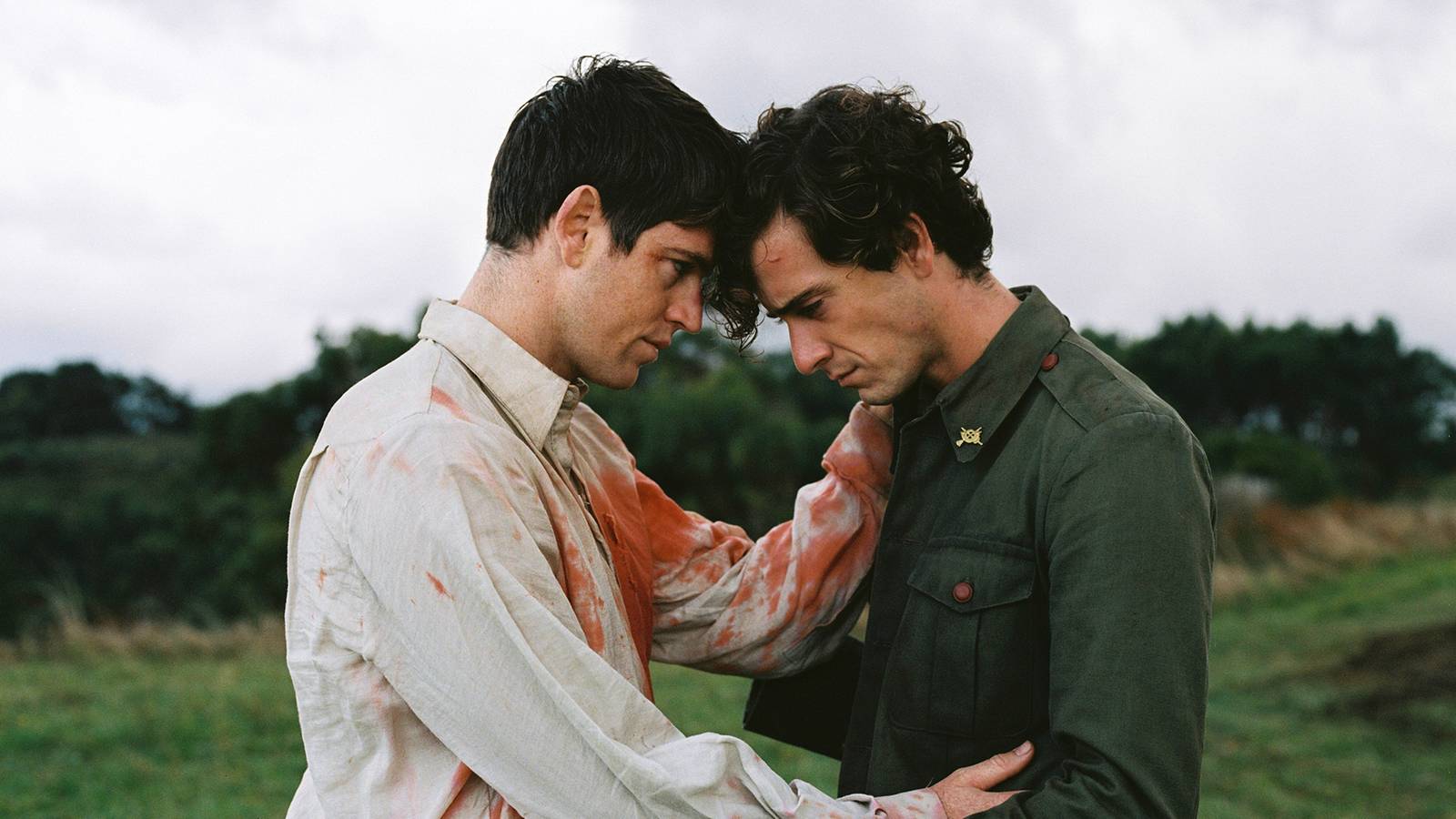
Published Oct 29, 2026, 5:59 PM EDT As a graduate of Columbia University in New York City, Tatiana studied theater and comparative literature. She has been passionate about all manner of storytelling from Jane Austen adaptations to anime. Aside from writing for Screen Rant, she co-hosts podcasts: The Flash Podcast and Ladies With Gumption. Sign in to your ScreenRant account Netflix's epic yet intimate historical drama, La bola negra, has been impressing audiences worldwide at film festivals before its limited theatrical run. Helmed by Javier Ambrossi and Javier Calvo, the movie spans nearly a century of Spanish history, but ultimately centers its narrative on three very different gay men who nonetheless are bound by fate. In 1932, young Carlos (Milo Queifes) is rejected from his local casino — symbolized by a black ball, the movie's namesake — due to rumors about his homosexuality. In 1937, Sebastián (Guitarricadelafuente) is forced to join the Nationalist army during the Spanish Civil War, where he meets a mysterious political prisoner named Rafael (Elite's Miguel Bernardeau). Finally, in 2017, Alberto (Carlos González) is putting the pieces together thanks to the pages of an unfinished Federico García Lorca play bequeathed to him by his late grandfather. Lorca ends up being the backbone that runs through La bola negra, though the filmmakers also adapted elements from a different play, La piedra oscura by Alberto Conejero. ScreenRant interviewed the directors and cast members about how they researched and understood Lorca's life and work, and what they took away from the emotional history lesson the film provides. (Please note: These interviews were initially conducted in Spanish before being translated into English.) La Bola Negra Gives New Life To Federico García Lorca's Unfinished Play Image via Netflix ScreenRant: One of the three timelines involves your interpretation of a potential ending to Lorca’s La bola negra. Did your approach to it ever change, or was the final cut your vision from the start? Javier Calvo: The script is quite similar to what ended up on screen. It's true that we strongly believe in the collective creative process, so we put a lot of stock in what the actors and the crew have to say. Therefore, obviously, there were changes. But it did truly end up as the film we first imagined, in many ways. Although, while filming Carlos's dance, it originally just said "Carlos dances at the bar” in the script. And then, suddenly, we had a whole flamenco scene with María Terremoto, with Raúl Refri, with El Niño. The script is what it is, but then there were a lot of new things that were added, because we like to play around and experiment with things when we're filming. Javier Ambrossi: When it came to La bola negra, outside of those four pages that exist, what we did was study a lot, research, and work with historians and Lorca experts, who guided us and helped us understand what Lorca might have intended through that list of characters. Because his house was near the casino, because he saw the fire, because in an interview he talked about what he wanted to do, because he told another friend how he wanted to continue the story… We investigated like detectives. ScreenRant: Milo, you’re part of history now, having helped create an ending to Federico García Lorca’s La bola negra. What did you discover about him or his life that you didn't know before, and how did it feel to bring that scene to life? Milo Quifes: Well, it's a real honor. I knew about Lorca before this, but I hadn't learned how to read Lorca. So, when I was given the role and had to learn to read Lorca, the imagery of the world he had created was incredible. Because Lorca didn't just create a community in space, but he did it in time. Queer people connected through the message that Lorca, or his perspective on love, gave us. It's incredible. And being one of the characters in what could have been La bola negra is amazing. ScreenRant: What was the most important thing each of you kept in mind when incorporating Alberto Conejero’s La piedra oscura into this film? Javier Ambrossi: To adapt the character of Sebastián, the most important thing was finding the right actor. In my mind, I needed to be clear about who Sebastián was going to be, because otherwise, I felt like I wouldn't be motivated. I needed a face that would make me want to create the character. And when Guitarricadelafuente popped into our heads, it was like, “Ah, okay, I know what movie it is. I'm going this way.” Javier Calvo: For me, it was about condensing and extracting the essence of that very long conversation that Rafael and Sebastián have on their last night together. Because in theater, the main instrument is the word. But in film, you have images, which are what have to tell the story. So, getting the right amount of dialogue, then making it smaller – and then making it bigger to fit the images – and going outside, and all that bombardment was very important. But first and foremost, it was about capturing the essence of the play. ScreenRant: Miguel, Rafael is motivated in large part by this mission passed onto him by Federico, but you as an actor spend very little time onscreen with him. How did you shape your character and their relationship, and did any historical records inspire you? Miguel Bernardeau: Yes, there isn't much that's known about the exact nature of their relationship. We know about the trips they took, so we know certain things, but not much. It was an exercise in imagination, through the interpretation of Lorca's Sonetos del amor oscuro, at least some of which seem to have been written for Rafael. There was also a letter, which was very significant to me and to the Javis as well, in which Rafael writes to Federico. Federico is going on a trip, and Rafael writes a letter. The way he writes it carries an intention; a decision to use a poetic language that he doesn't quite achieve. He doesn't quite express himself in the way Federico does, but he's trying to imitate the way Federico wrote his letters, and I find that very endearing. It speaks to someone who has that curiosity and desire to discover that world, but who at the same time perhaps doesn't yet have the linguistic tools that Federico had. But it represents the communication they had, and I really liked that. An Intense Acting Exercise For Newcomers & Veterans Alike Credit: Carla Oset / © Netflix / Courtesy Everett Collection ScreenRant: Guitarrica, this is your film debut, and I can only imagine the pressure there. How did you find your voice as an actor, and did your music background help? Guitarricadelafuente: I think that, as a musician, I saw a lot of similarities. The moment you step onto a stage, you can allow yourself to portray aspirational characters and qualities you can't be in your real life. Ultimately, there's control. There are limits, because you arrive, you leave, and you go back to your everyday life – and you're in control. I felt it was very liberating doing this for the first time; experiencing a set for the first time, where that control is no longer in your hands. For me, being able to submit to the Javis' will and be directed by them, seeing how that relationship between Rafael and Sebastián develops in that small room, feeling everything in my bones and letting myself be carried away by what I was experiencing in that moment – because it was the only way I knew how – was the only way I could interpret it. ScreenRant: This is Guitarricadelafuente’s film debut, but you knew once you saw him perform that he had to be Sebastián. What did he spark in your minds, and how did you know he was up to the task? Javier Calvo: You never know, but you trust the actor. It's an exercise in trust that you always have to build with an actor, especially when they're starting out. It's a process. You can't expect someone playing a role in a film for the first time to be perfect in an audition, because they have to learn. You have to teach them the tools to stand in front of the camera and act. It was an intuition based on his gaze, his magnetism, his mystery. But it was a leap into the unknown. So, it was about picking up the small details we could understand from the things that were said about them, or the interpretations we made of that letter. We then created a character and an imagined relationship – the one Rafael had with Federico – to create the scene they have together. ScreenRant: Milo, this is your feature film debut. How did the Javis and your fellow actors help you step into the role of Carlos? Milo Quifes: Yes, as a novice in screen acting, I didn’t know much about constructing a character. I’ve had to learn from zero! Thankfully, I was blessed with very good and patient directors, who were very dedicated to their work. So, I was given plenty of rehearsal time, which helped me understand what an internal monologue is, how to read subtext, and how to build characters. I also benefitted from the fact that my character’s lived experience was similar to my own. From there, we could rescue details that helped inform my performance. ScreenRant: Carlos, Alberto is a playwright, and you yourself have written and directed a short film in the past. Did you connect with him on this level? How does his history as a playwright influence your perspective on him? Carlos González: For me, it was very important to understand the failure this character had with playwriting and with the theater, because it was his first desire and his first attempt. And that frustration led him to perhaps to look at stories further afield; to look for something external to himself, and to completely disconnect from playwriting in order to be able to look for other things. It did make a lot of sense that this character would do that. ScreenRant: Having seen the movie in theaters, is there a moment that resonated with you most as an observer, rather than as an actor inside the work? Carlos González: We saw it at Cannes with an audience, yes. There's quite a powerful energy created by this film in the cinema, truth be told. Milo Quifes: It is a silence that is shared. It’s communal. When the movie ends, for example, you notice the heavy atmosphere. Carlos González: The idea of a movie theater being a community space is amazing. Even without knowing anyone there, you know? ScreenRant: Penelope Cruz’s scenes feel like such a light, or a joyous celebration, in the midst of a very sad story. What was the significance of her connection with Sebastián? Javier Ambrossi: It's precisely the window to something that all LGBTQ+ people share—a moment that everyone has either experienced or needs to experience. It’s someone telling you, "Hey, wait a minute, there's another world out there." And that's often a movie, a song, or a celebrity. It could be a friend, a mother, a female friend—it's usually many things—who tells you, "No, listen, there are other people like you." That moment seems to me one of the most important moments a gay man can have, at least in my case. ScreenRant: Was there one thing you learned about Spanish history through this experience that really sat with you? Carlos González: I didn't know Rafael Rodríguez Rapún. I knew a little bit about Lorca, because I learned about him in school when I studied Dramatic Arts. I worked with his texts, but I wasn't aware of Rafael's story. I knew there was a footballer from Santander. And about the Civil War, I learned from listening to my father, but I regret not having listened more to my grandfather. We need to listen more to our elders. Guitarricadelafuente: I think that, ultimately, it was a moment in our country's history that affected everyone. Nobody was unaffected; everyone was involved. All our ancestors had to live through that context. I was more familiar with the musical aspects of that time, because when I was commissioned to write the original song, I had already been listening to many songs from Canciones de la Guerra Civil Española, a Rolando Alarcón album of popular songs that were sung back then. Lorca's song, "Anda jaleo," was also part of that repertoire of songs sung during the Civil War. Miguel Bernardeau: I also discovered a lot about the Civil War. I mean, we researched and studied the Spanish Civil War extensively, and it really interested me. I even became a bit obsessed with the fact that I suddenly discovered that the story I had in my head wasn't the real story. The history I'd been taught perhaps glossed over all the events of the Civil War, and I became quite obsessed with studying and understanding it. Guitarricadelafuente: It's all very broad and very biased, isn't it? It’s a topic that, in the end, always resurfaces. Because it's a ghost that's always there, and it has affected all of us in a very personal way, through our families. It constantly resurfaces. La Bola Negra is now playing in select theaters and will begin streaming December 2 on Netflix. Release Date October 16, 2026 Runtime 155 minutes Director Javier Calvo, Javier Ambrossi Writers Javier Calvo, Javier Ambrossi, Alberto Conejero Producers Javier Ambrossi, Javier Calvo, Jorge Pezzi Cast Guitarricadelafuente Sebastian
How La Bola Negra Stars & Directors Gave Lorca’s Unfinished Play The Spotlight It Deserves
Full Article
Original Source
Read the full article at Screenrant →KhanList aggregates and links to publicly available news content. We do not host full articles from third-party sources. Always verify important information with original sources.