
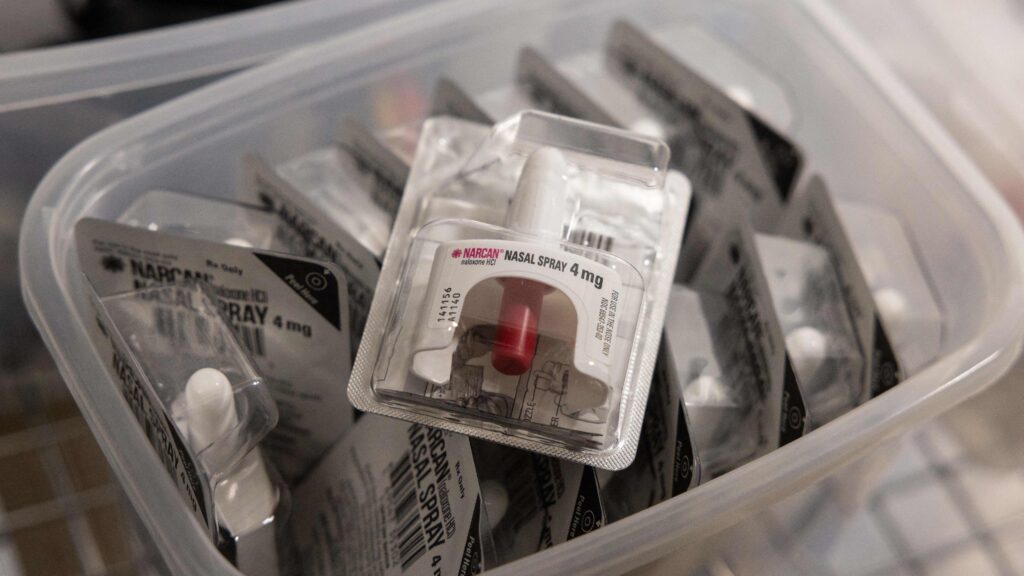
From 2021 to 2023, more than 105,000 people in the U.S. died from a drug overdose each year — tens of thousands more than the already high rates seen in the lead-up to the Covid pandemic. Then, suddenly, the death rates dropped. In 2024, U.S. overdose deaths decreased 27%. Preliminary data from 2025 show another meaningful drop, though overdose mortality is still quite high. Other countries with major overdose problems also saw fewer deaths: In Scotland, there was a 13% decrease in 2024, and in Canada, 9%. “It is unprecedented to see overdose deaths come down so dramatically, so quickly,” said Brandon Marshall, an epidemiologist at Brown University who studies overdose trends. Still, “we’re nowhere near out of this crisis.” It’s unclear what caused the decline. State health authorities who have been fighting the opioid crisis for decades are still surprised by the drop, said Evan Gumas, a senior research associate at the Commonwealth Fund. He wrote a report, published Thursday, on the potential factors contributing to the change. Gumas spoke with public health and addiction authorities from at least two dozen U.S. states and other countries about what they were doing to combat the overdose crisis. “The thing that every single one said … was there is no one thing that led to the decrease,” Gumas said. People he spoke to repeatedly mentioned a handful of initiatives: naloxone distribution and harm reduction responses, expanded access to medications for opioid use disorder, better treatment in and around prisons, and enhanced data infrastructure. The progress is encouraging, but experts worry about the future: Medicaid cuts loom, and the Trump administration, while generally supportive of medications to treat opioid use disorder, has positioned itself against some proven harm reduction measures. Behind the numbers One factor behind the decline in overdose deaths may be wider availability of the opioid overdose reversal drug naloxone. In 2022 the federal Substance Abuse and Mental Health Services Administration required states receiving opioid response funding to develop a “naloxone saturation” plan to ensure wide availability of the drug. From 2023 to 2024, Virginia saw a 40% decrease in overdose deaths after implementing such a plan. Maryland more than doubled its naloxone distribution between 2021 and 2025, including via vending machines, emergency medical services, and programs in which public safety personnel provide the drug to people at the scene of an overdose. The state saw a 25% decrease in overdose deaths from 2019 to 2024, per the report. “Every single overdose death is really a failure, because no one should die from an opioid-related overdose when we have an antidote,” said Sarah Wakeman, an addiction medicine physician who directs the Mass General Hospital Substance Use Disorder Initiative in Boston and did not contribute to the report. For people in recovery, medications for opioid use disorder like methadone and buprenorphine are still drastically underutilized in the U.S., but access is improving. That may have contributed to the decline in deaths as well. Medicaid expansion “is the single most influential lever for coverage and access to medication for opioid use disorders,” Gumas wrote in the report. In Colorado, the number of methadone clinics more than doubled, from 25 to 54 in five years. New York saw similar growth. Meanwhile, health authorities in Sweden told Gumas that a decade of concentrated expansion of access to these medications contributed to about a 25% reduction in deaths since 2017. Jurisdictions that Gumas communicated with also frequently mentioned increased access to medication for incarcerated people as an important way to reduce overdose deaths. Substance use disorders are 12 times more common in the prison system than in the general population, and the weeks immediately after a person’s release are especially risky. In New York prisons and jails, the use of medications for opioid use disorder increased seven times over between 2022 and 2025. There are some more sobering contributing factors as well, per Wakeman. “So many people died during the years of really accelerating death rates that actually, there’s not as large of a population at risk of dying,” she said. Additionally, the drug supply is always changing, with the potency of fentanyl declining in recent years. These shifts are difficult to track, but state surveillance systems can provide insight, Gumas wrote. Overdose deaths decreased in every U.S. state in 2024, except for South Dakota, which had three more deaths than the year before. Still, there was a wide and largely unexplainable range of geographical variety. “We need a lot more research rapidly to tease apart what is going on in terms of driving the variation,” said Marshall, who reviewed the Commonwealth Fund report and provided feedback before publication. “Right now the dominant hypothesis is that it’s mostly a function of the drug supply.” Emerging contaminants in the drug supply, including “tranqs” like xylazine and medetomidine, are still dangerous, but may not have the immediate risk of fatality that fentanyl does. Looking ahead While there’s hope that the number of overdose deaths will continue to decrease, it’s not necessarily expected. Provisional data for 2025 show that in Scotland, which has the second-highest overdose death rate in the world after the U.S., rates may have crept back up. In the U.S., many experts are worried that the progress states have made is at risk under the Trump administration. “They claim this as a priority for the administration, but then their actions — particularly funding decisions — risk and compromise much of the progress we have made so far,” Marshall said. SAMHSA, the federal mental health and addiction agency, was decimated in the first year of this Trump administration. More than half of the agency’s staff was cut, and roughly $1.7 billion in block grant funding was canceled, while another $350 million in addiction and overdose prevention funding was also cut. Earlier this year, an open letter from agency leadership warned against using federal funds to buy harm reduction supplies like sterile syringes and pipes, or to distribute test strips for common drug supply contaminants. Many states are still trying to figure out how to handle that directive, Gumas said. Experts agreed that the biggest threat to progress on overdose deaths is the looming Medicaid cuts. Researchers at Penn’s Leonard Davis Institute of Health Economics and Boston University estimated last year that the cuts would cause 156,000 people to lose access to opioid treatment, then lead the overdose rate to double among that group. “These cuts are going to be pretty catastrophic in a lot of cases,” Gumas said. STAT’s coverage of chronic health issues is supported by a grant from Bloomberg Philanthropies. Our financial supporters are not involved in any decisions about our journalism.
Why are drug overdose deaths declining?
Full Article
Original Source
Read the full article at Statnews →KhanList aggregates and links to publicly available news content. We do not host full articles from third-party sources. Always verify important information with original sources.